
Common Data Science Interview Questions and Answers - IABAC
Data Science Interview Questions

After going through a lot of Data Science Interview Questions, I can say it’s a mix of challenges and rewards. In the beginning, when I was a data analyst, I wasn’t sure what technical skills were necessary for a data science job. But with a lot of learning and practice, I became more confident in things like machine learning, statistics, and data manipulation. I learned that understanding programming languages like Python and R, as well as knowing important algorithms, was important for the interviews. Additionally, being able to think critically and communicate my ideas effectively helped me to be noticed among other candidates. IABAC offers valuable certifications that helped solidify my skills, and ATP’s specialized training programs provided in-depth knowledge to excel in the field.
Data Science is now one of the coolest and highest-paying jobs out there! With companies creating tons of data every day, they need experts who can find important information, tackle challenges, and make decisions based on data. If you want to become a data scientist, be ready for some tough interviews that will check your knowledge, problem-solving skills, and tech abilities. In this blog, we’ll look at some common Data Science Interview Questions and give you helpful answers to get you ready for your next interview.
What is Data Science?
Data science is a multidisciplinary field that uses scientific methods, algorithms, and systems to extract insights and knowledge from structured and unstructured data. It combines skills from statistics, computer science, and domain expertise to analyze data and solve complex problems. Data scientists leverage various tools and techniques such as machine learning, data mining, and predictive modeling to make data-driven decisions, uncover trends, and provide actionable insights across industries like business, healthcare, and finance.
Top Data Science Interview Questions and Detailed Answers
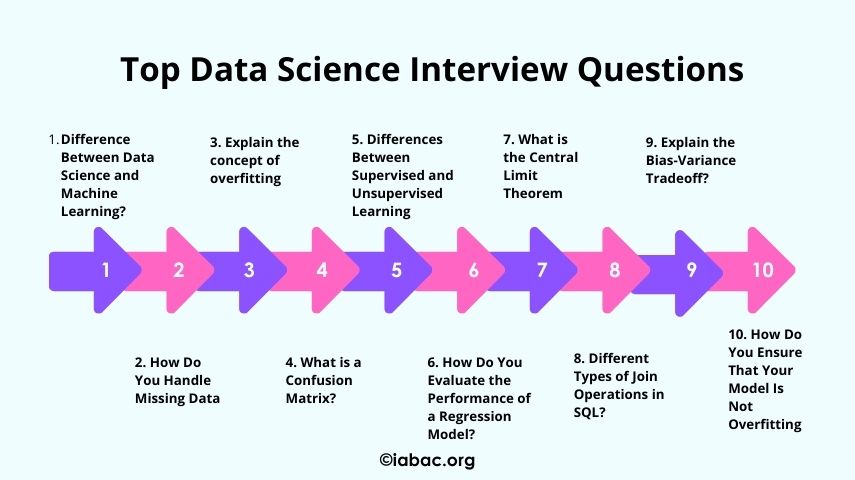
Top Data Science Interview Questions and Detailed Answers highlight essential questions often asked during data science interviews, providing comprehensive explanations to help candidates prepare effectively. It covers key concepts, techniques, and tools used in the field of data science.
1. What is the Difference Between Data Science and Machine Learning?
This question tests a candidate's understanding of the broader field of data science and its subdomains. Data science is a multidisciplinary field that involves extracting insights from structured and unstructured data. It combines statistics, programming, and domain expertise to interpret and analyze data effectively.
Machine learning, on the other hand, is a subset of data science that focuses specifically on building models that can learn from and make predictions or decisions based on data. While data science encompasses a broader range of techniques and tools, machine learning is more focused on algorithmic processes to train models and enhance automation. When preparing for Data Science Interview Questions, it's important to understand the distinction between data science and machine learning, as both play pivotal roles in solving complex data problems.
2. How Do You Handle Missing Data in a Dataset?
Handling missing data is one of the core tasks a data scientist faces when preparing data for analysis. There are several techniques to handle missing data, and your approach will depend on the nature of the data and the problem at hand. Common methods include:
Removing Missing Values: This method is effective when the missing data is minimal and does not significantly affect the overall dataset.
Imputation: Imputation involves filling in the missing values with statistical values such as the mean, median, or mode.
Prediction: Another technique involves predicting the missing values using machine learning models based on available data.
A good data scientist must also understand the impact of missing data on model performance and decide on the best course of action accordingly.
3. Explain the concept of overfitting and how to prevent it.
Overfitting is a common issue in data science where a model learns the details and noise in the training data to such an extent that it negatively impacts the model’s performance on new data. This happens when the model becomes too complex and is unable to generalize well. During Data Science Interview Questions, candidates may be asked to explain overfitting and its impact, as it is a crucial concept in building reliable and effective models.
To prevent overfitting, several strategies can be employed:
Cross-validation: Using techniques like k-fold cross-validation helps in assessing the model's ability to generalize.
Regularization: Techniques like L1 and L2 regularization can penalize overly complex models to reduce overfitting.
Pruning: For decision trees, pruning helps reduce the complexity by cutting off unnecessary branches.
A data scientist must have a keen understanding of model complexity and balance the need for accuracy with the model's ability to generalize.
4. What is a Confusion Matrix?
A confusion matrix is a tool used to evaluate the performance of a classification model. It provides a visual representation of the true positives, true negatives, false positives, and false negatives. From this matrix, various performance metrics can be calculated, such as accuracy, precision, recall, and F1-score. When preparing for Data Science Interview Questions, understanding how to interpret and use a confusion matrix is crucial, as it helps evaluate the effectiveness of a model, especially when dealing with imbalanced datasets.
Understanding how to interpret and use a confusion matrix is crucial for evaluating a model’s effectiveness, especially when working with imbalanced datasets where accuracy alone might not be a reliable metric.
5. What Are the Key Differences Between Supervised and Unsupervised Learning?
Supervised learning and unsupervised learning are the two main categories of machine learning.
Supervised Learning involves training a model on labeled data, where the input data is paired with the correct output. Common algorithms used in supervised learning include linear regression, logistic regression, and decision trees. Supervised learning is used for tasks like classification and regression.
Unsupervised Learning, on the other hand, involves training a model on data without labeled outputs. The goal is to find hidden patterns or groupings in the data. Clustering and dimensionality reduction techniques like k-means and PCA are examples of unsupervised learning methods.
A solid understanding of both types of learning is crucial for data scientists, as they form the foundation of most predictive analytics.
6. How Do You Evaluate the Performance of a Regression Model?
Evaluating the performance of regression models involves assessing how well the model can predict continuous values. Common metrics include:
Mean Absolute Error (MAE): Measures the average magnitude of errors in the model's predictions without considering their direction.
Mean Squared Error (MSE): Similar to MAE, it squares the errors, giving more weight to larger errors.
R-squared: Represents the proportion of the variance in the dependent variable that is predictable from the independent variables. A higher R-squared value indicates a better fit.
These metrics allow data scientists to quantify the effectiveness of their regression models and make necessary improvements.
7. What is the Central Limit Theorem and Why Is It Important?
The Central Limit Theorem (CLT) is a fundamental concept in statistics that states that the distribution of the sum (or average) of a large number of independent, identically distributed random variables approaches a normal distribution, no matter the shape of the original distribution.
This theorem is essential because it allows data scientists to make inferences about populations using sample data. By understanding the CLT, data scientists can apply statistical tests and construct confidence intervals with greater accuracy. In Data Science Interview Questions, candidates may be asked about the CLT to assess their understanding of fundamental statistical concepts and their ability to apply them in real-world data analysis scenarios.
8. What Are the Different Types of Join Operations in SQL?
SQL join operations are used to combine records from two or more tables based on a related column. The four most common types of joins are:
Inner Join: Returns only the rows where there is a match in both tables.
Left Join (or Left Outer Join): Returns all rows from the left table and the matching rows from the right table.
Right Join (or Right Outer Join): Similar to the left join but returns all rows from the right table.
Full Join (or Full Outer Join): Returns rows when there is a match in one of the tables.
Mastering SQL joins is crucial for data scientists, as they often need to query and merge data from multiple sources.
9. Can You Explain the Bias-Variance Tradeoff?
The bias-variance tradeoff is a critical concept in machine learning and model building. It refers to the balance between two types of errors that a model can make:
Bias refers to the error due to overly simplistic assumptions in the model, which can lead to underfitting.
Variance refers to the error due to excessive complexity in the model, which can lead to overfitting.
Achieving a good model involves finding the right balance between bias and variance, ensuring that the model is neither too simple nor too complex for the data at hand.
10. How Do You Ensure That Your Model Is Not Overfitting?
To prevent overfitting, several techniques can be implemented:
Cross-validation: This method splits the data into training and validation sets to test the model's generalizability.
Pruning (for decision trees): Removing unnecessary nodes from decision trees can help reduce overfitting.
Early Stopping (for neural networks): Monitoring the model's performance on a validation set and stopping training once performance plateaus.
By applying these techniques, data scientists can create models that are robust and able to perform well on unseen data.
Preparing for a data science interview can be overwhelming, but with the right mindset and preparation, candidates can confidently tackle Data Science Interview Questions. IABAC provides certifications that validate your skills and knowledge in data science, while ATP offers specialized training programs to enhance your expertise. Together, these resources can help you build a strong foundation and excel in your career.
Remember, the key to acing any Data Science Interview Questions is not just having technical knowledge but also the ability to communicate your thought process effectively. Keep practicing, stay updated with the latest trends, and most importantly, keep learning. The road to becoming a successful data scientist is challenging, but with the right preparation, it is also incredibly rewarding.
About the Creator
Enjoyed the story? Support the Creator.
Subscribe for free to receive all their stories in your feed.
Comments
There are no comments for this story
Be the first to respond and start the conversation.