
COLLAGEN
The Primary Structural Protein in Human Body
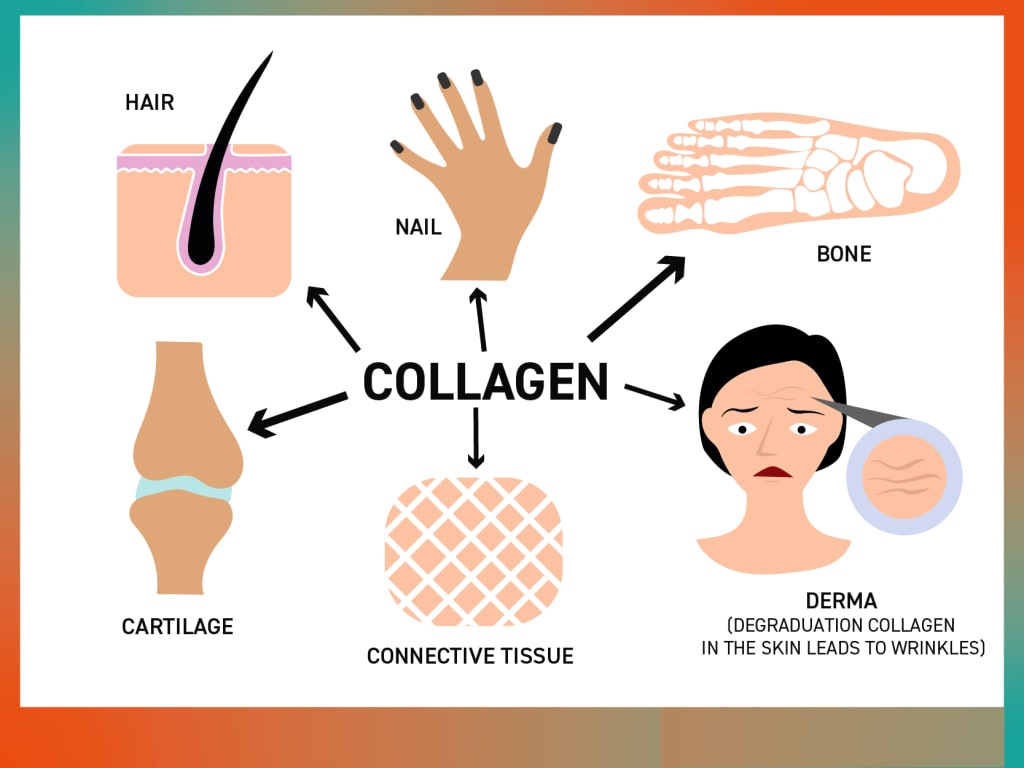
Collagen is the primary structural protein in the extracellular matrix that makes up the many connective tissues of the body.
Importance of Collagen. The major function of collagen is to give your body structure, strength, and support.
Collagen’s Specific Roles Include: *It helps slow down the aging of your skin by minimizing wrinkles and dryness. *It aids in the formation of fibroblasts in your dermis (middle skin layer), which aids in the growth of new cells. *Helping to replace damaged skin cells. *Providing organs with a protective coating. *Giving your skin structure, suppleness, and strength *Aiding in blood clotting
The Signs And Symptoms of Decreasing Collagen Include: *Wrinkled, saggy, or creepy skin. *Hallowing in and around your eyes, and on your face. *Muscle pain, weakness, and shrinkage. *Less flexible, stiffer tendons and ligaments. *Arthritis or joint pain brought on by worn cartilage. *Mobility loss brought on by joint stiffness or injury. *Gastrointestinal issues caused by the thinning of the lining of your digestive tract. *Blood flow issues
The Main Causes of Collagen Decline Involve:
1. Age Beginning in their late teens or early 20s, most people's bodies begin to produce less collagen, which declines by roughly 1% annually. According to Goldenberg, everyone's starting point for this process varies by age. After menopause, this collagen attenuation accelerates.
Whatever happens, the process is unavoidable and, regrettably, out of your hands. Goldenberg claims that "our bodies continually maintain a balance between collagen production and breakdown." "Our bodies make more collagen while we are young than we can possibly use. Since tissue regeneration declines with aging, this equilibrium shifts in the opposite direction."
How can you tell how much of your skin's aging is really a result of becoming older? Only 3% of skin aging, according to scientists, is caused by intrinsic aging. The remaining factors are extrinsic, which are more likely within your control. Or, to put it another way, you have the power to control up to 97% of the aging process for your skin.
Click here if you want to check for a Beauty Boosting Vegan Collagen Builder Supplement.
2. UV Damage ( Also called photoaging) Up to 80–90% of the look of skin aging is caused by collagen loss in the skin, which is mostly caused by UV damage. UV radiation results in both, *There will be less collagen generated, and * It also causes more collagen to be degraded in the skin's matrix metalloproteinases (MMPs) and other proteases. Enzymes called proteases break down proteins like collagen and elastin.
To prevent collagen deterioration from UV exposure, use daily wide spectrum sunscreen on exposed skin, wear a helmet, sun protective clothes, and avoid direct sunlight.
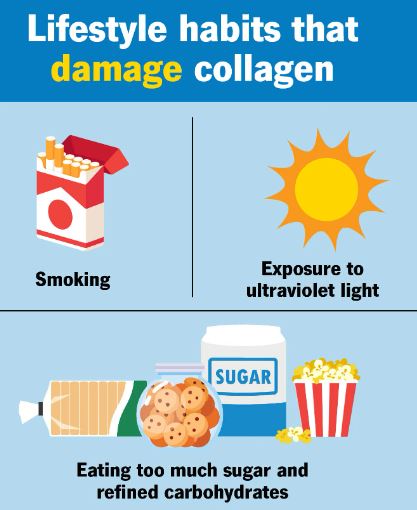
3. Smoking You've probably heard by this point that smoking, well, is bad for you and accelerates aging. The main reason it does so, however, is because collagen is directly and adversely affected. Goldenberg claims that the "main one" for collagen degradation is actually smoking. According to him, smoking reduces the amount of oxygen that is provided to cells, making it harder for tissues to repair and more probable for them to sustain damage or even pass away. In addition, tobacco smoke's chemical oxidative stress can cause premature wrinkles. According to a study done on twins, smokers had more wrinkles, crow's feet, and facial lines than non-smokers did.
If you like to have a Collagen Boosting Drink you can Check Here.
4. Diets that Cause Inflammation According to Goldenberg, "Inflammation is one of the principal adversaries of any tissue" —and collagen-fueled connective tissues are no different. According to board-certified dermatologist Joshua Zeichner, M.D., inflammatory diets—which frequently involve eating regimens heavy in sugar, simple carbs, and processed meats—activate the immune system and increase inflammation throughout the body. This could prevent the recovery of skin cells that have been destroyed by the environment, he explains. Collagen can be particularly vulnerable to Sugar3. According to Zeichner, "high sugar levels can result in collagen hardness and fragmentation, weakening the skin's support system, and encouraging premature skin aging".
5. Stress According to research, stress can lead to pro-inflammatory reactions, which, once again, can reduce your body's capacity to create collagen on its own. Additionally, stress raises levels of chemicals like cortisol, which, according to study, might reduce collagen synthesis. Due to the body's increased usage of resources to deal with stress and the resulting inflammation, less collagen is made under high-stress situations, according to Goldenberg.
For a Collagen Booster Gel you can take a look here.
6. Genetics According to Goldenberg, genetics have a significant role in determining how much collagen your body produces and degrades. Therefore, there is a good chance that your skin will continue to look wonderful as you age if your parents and grandparents had beautiful skin for many years. Of course, you have no influence over this, so Goldenberg advises concentrating on factors within your control instead, such as diet, stress management, and sun protection.
How Can You Organically Support It? There are some things you can do to assist support healthy collagen levels in your body, but you can't stop the natural decline in collagen production.
You Can Take a Collagen Supplement. Hydrolyzed collagen supplements, in particular, have been found to encourage collagen formation. Collagen peptides, which are made up of short chains of the amino acids that make up collagen yet are tiny enough to be readily absorbed by your body, are used to produce these supplements. According to Zeichner, "Hydrolyzed collagen can be absorbed as is and circulate throughout the body”.
Click here if you want to check for a Beauty Boosting Vegan Collagen Builder Supplement.
But collagen does more than just encourage your body's organic production; it also works to reduce some of the factors that contribute to collagen deterioration. Namely? Damage from free radicals and oxidative stress. "Collagen's anti-inflammatory properties are a result of its function in maintaining gut health. Inflammatory reactions can be decreased throughout the body thanks to a healthy gut. On the other side, poor gut health causes the stomach lining to become more permeable, allowing particles to enter the bloodstream and cause inflammation throughout the body "Kellyann Petrucci, M.S., N.D., a naturopathic physician, adds. Collagen contains essential amino acids for gut health and has been demonstrated to maintain the gut lining.
---------------------------------------The End---------------------------------------
About the Creator
Enjoyed the story? Support the Creator.
Subscribe for free to receive all their stories in your feed.
Comments
There are no comments for this story
Be the first to respond and start the conversation.