
Choosing the Right AI Visibility Platform: Key Differences Between Profound and LLM Authority Index
Why brands need to know whether their AI visibility tool is measuring broad presence or real buyer-choice influence

This article provides a clear, evidence-based comparison between Profound and LLM Authority Index Reporting, two leading platforms in the emerging AI visibility space.
Drawing directly from an LLM Authority Index resource, it clarifies the philosophical and practical differences between monitoring-focused operational tools and intelligence-driven reporting platforms, and explains why these distinctions matter for teams targeting AI-powered discovery, recommendation, and buyer decision moments.
The rapid evolution of search, discovery, and recommendation now demands a new class of analytics: AI visibility platforms.
Brands no longer compete solely for top spots in traditional search results; they are also battling for attention, citations, and recommendations within the answers, lists, and advice generated by large language models (LLMs) and AI-powered engines.
But not all AI visibility tools are created equal.
Drawing on insights from the LLM Authority Index article “Profound vs LLM Authority Index: Key Differences,” this article unpacks the key contrasts between Profound and LLM Authority Index Reporting.
These two platforms, while both essential to understanding AI-driven awareness, serve fundamentally different strategies: operational monitoring versus commercially focused, executive-ready intelligence.
The Two Paths of AI Visibility Analytics
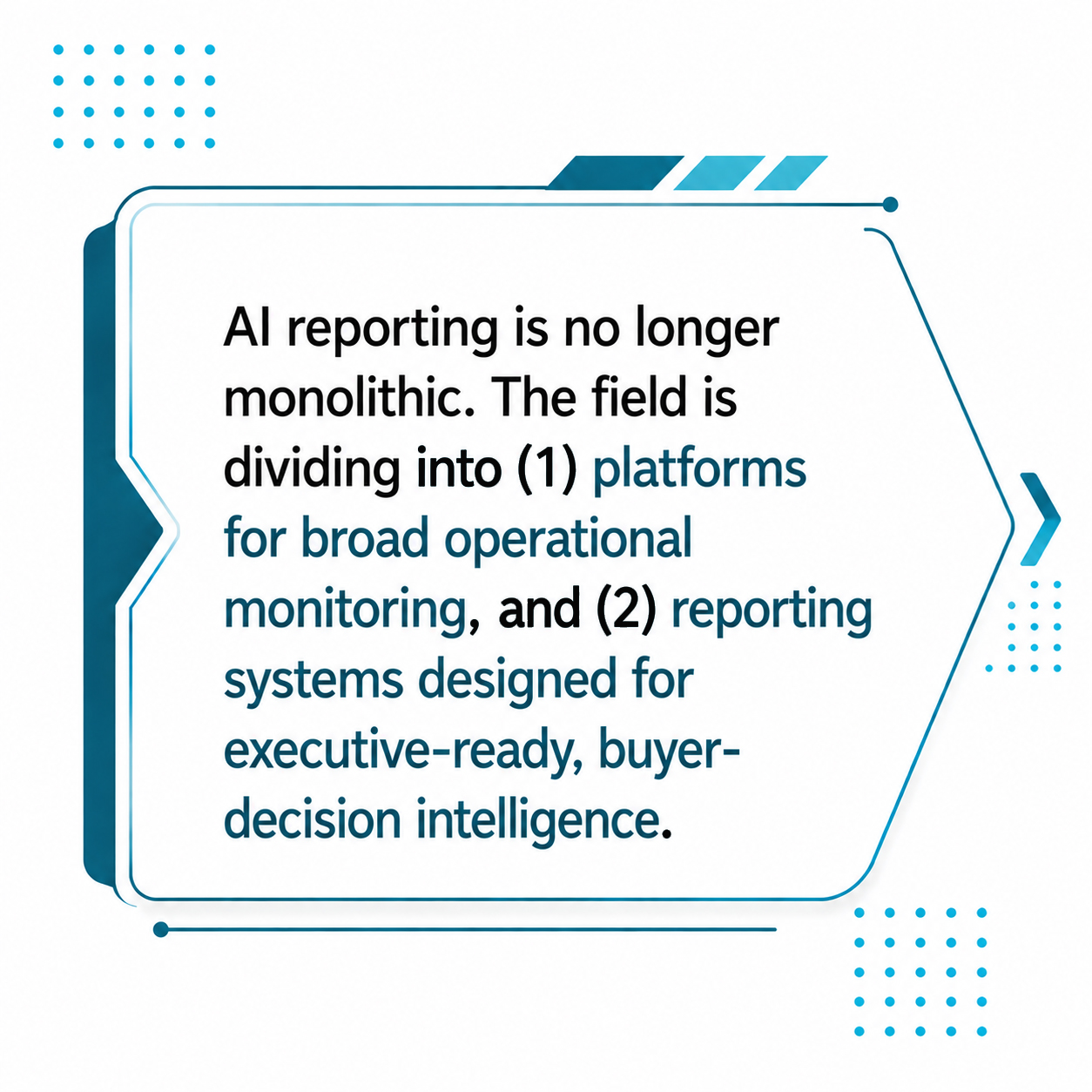
The market for AI-driven discovery insights is beginning to split into two distinct categories:
1.Visibility Monitoring Platforms: These focus on breadth tracking where your brand appears, how often it’s cited, and how you’re portrayed across the AI landscape.
2.Buyer-Choice Intelligence Platforms: These focus on depth measuring how AI-generated results influence brand recommendation, shortlist inclusion, and decision-stage ranking in the prompts that matter commercially.
Understanding this division is fundamental for anyone choosing between AI visibility tools.
For a side-by-side look at platform-style monitoring versus buyer-choice intelligence, read RankScale vs LLM Authority Index, which explains the difference between broad AI visibility tracking and high-intent recommendation analysis.
Profound: A Platform Built for AI Visibility Operations
Profound is positioned as an all-encompassing operational platform. Its core strengths include:
1. Broad Reporting Stack: Offers answer engine insights, visibility metrics, citation tracking, sentiment analysis, and more all in one interface.
2. Prompt Volumes: Provides explicit “AI-search demand intelligence” by showing what users are asking inside answer engines in real time. Uses licensed user panels and probabilistic modeling to estimate demand, intent, and sentiment.
3. Workflow Automation: Integrates reporting with execution, enabling exports into formats like CSV and JSON, plus downstream use in content brief generation, agent analytics, and workflow automation.
4. Agent Analytics & Sheets: Supports server-side monitoring and connects visibility insights to content workflows and recurring tasks.
5. Industry Benchmarking: Features a public leaderboard (Profound Index) for visibility standing by category, using real AI conversation data.
Who benefits most?
Teams aiming for continuous monitoring, data-driven workflow automation, and category-level benchmarking will find Profound a strong operational fit.
LLM Authority Index Reporting: Built for High-Intent Market Intelligence
In contrast, LLM Authority Index Reporting is optimized to address the question: “Is AI actually influencing which brands get chosen at the moments that matter most?”
Core features and differentiators:
1. Focus on Buyer-Choice Moments: Emphasizes prompts driving real commercial consideration recommendation share, shortlist formation, and high-intent prompt clusters.
2. Company-Specific Intelligence: Reporting is tailored, measuring Top 1, Top 3, and Top 10 share, mention-to-rank conversion rates, citation source mix, demand concentration, cluster query volume, and recoverability.
3. Executive-Ready Format: Includes one-page company reports, competitor analysis, in-depth dashboards (15 tabs for full analysis), and monthly updates.
4. Exportability & API Access: Designed for intelligence delivery to leadership, analyst, or client-facing environments, with direct data access and reporting exports.
5. Citation Architecture Analysis: Goes beyond raw frequency, analyzing what kinds of sources (official, editorial, community, competitor-owned, etc.) influence AI interpretation and how this shapes recommendation eligibility.
Who benefits most?
Executive teams, strategists, or marketers focused on understanding and influencing the buyer decision process in AI-generated recommendation and comparison scenarios.
Shared and Distinctive Features
Prompt Demand & AI Search Volume
Profound: Provides real-time, explicit prompt volume metrics, public insight into what users are asking, and evolving demand trends.
LLM Authority Index Reporting: Uses modeled AI query volume to weight the importance of specific high-intent prompt clusters prioritizing commercial relevance over general conversation volume.
Sentiment Analysis
- Profound: Treats sentiment as a core metric tracking sentiment prompts, themes, and nodes for downstream analysis.
- LLM Authority Index Reporting: Incorporates sentiment at the attribute level within broader buyer-choice modeling. Sentiment is one explanatory layer, not the end of analysis.
Citation Reporting
- Profound: Measures citation share, pages, and domains pushing raw data into actionable workflows.
- LLM Authority Index Reporting: Analyzes *citation architecture* examining whether the evidence layer provided by sources actually helps a brand get recommended in high-intent scenarios.
Reporting and API Access
- Both platforms support data exports and integrations.
- Profound is designed for operational flexibility and ongoing action.
- LLM Authority Index Reporting is built for intelligence delivery, executive reporting, and monthly strategic snapshots.
Public Benchmarking vs. Company-Specific Analysis
- Profound: Public leaderboards and industry-wide ranking visibility.
- LLM Authority Index Reporting: Company- and competitor-specific reporting that resonates at the boardroom and competitive-strategy level.
For a clearer explanation of why legacy search logic breaks down in a response-driven environment, read why SEO thinking fails in AI Search, which shows how AI discovery shifts competition from ranking pages to being recommended inside answers.
Why These Differences Matter: The Strategic Implications
For industry professionals, the distinctions between Profound and LLM Authority Index Reporting are more than just feature lists; they signal a strategic fork in how AI-driven discovery will define competitive landscapes.
- Operational Monitoring (Profound) is valuable for category awareness, workflow execution, and broad measurement of presence and sentiment.
- Buyer-Choice Intelligence (LLM Authority Index) is essential for brands aiming not only to be seen but to be selected by AI whether via recommendations, high-intent queries, or shortlist inclusion at the moment of decision.
Key definitions:
- AI visibility: How often and where a brand appears in AI-generated responses or summaries.
- Citation architecture: The mix and type of third-party sources supporting a brand’s mentions in AI, influencing recommendation eligibility.
- High-intent prompt clusters: Queries or prompts that signal a user is at the decision or consideration stage, not merely researching.
- Recommendation share: The proportion of times a brand is recommended (not just mentioned) in relevant AI-generated results.
Applying the Lessons: How to Choose and What to Measure
When to pick Profound:
- You need ongoing, live AI visibility monitoring.
- Workflow automation and data exports are business-critical.
- You value public benchmarking to understand category standing.
When to pick LLM Authority Index Reporting:
- Executive teams need clear, actionable answers about whether visibility translates into winning buyer choices.
- You want to assess not just performance, but the quality of your citation and evidence layer.
- You need reporting that supports board-level or strategic decision-making.
What to measure, regardless of platform:
- Not just where you appear, but whether you are *recommended* in high-intent queries.
- Not just how often you’re mentioned, but who’s supporting your citation layer (sources, types, sentiment).
- Whether your AI visibility is turning into actual competitive advantage in recommendation rankings and shortlist events.
Conclusion
As AI-driven discovery continues to mature, the tools we use must reflect not only the reality of where we’re visible, but the opportunity to shape buyer choices at the moment of decision.
Profound and LLM Authority Index Reporting both deliver immense value but with distinct philosophies and strategic priorities.
For those monitoring AI visibility across workflows and execution layers, Profound offers a comprehensive operational stack.
For those seeking targeted, commercially relevant market intelligence that answers “who wins in the AI-powered buyer journey?”, LLM Authority Index Reporting leads with depth, context, and executive clarity.
About the Creator
William Myers
Independent researcher publishing comprehensive case studies on modern market dynamics and organizational behavior.
Enjoyed the story? Support the Creator.
Subscribe for free to receive all their stories in your feed.
Comments
There are no comments for this story
Be the first to respond and start the conversation.