
China Has More PhDs Than Donkeys. The Joke Is Hiding a Harder Truth.
The viral comparison is silly. The job market behind it is not.
The Number That Started the Joke
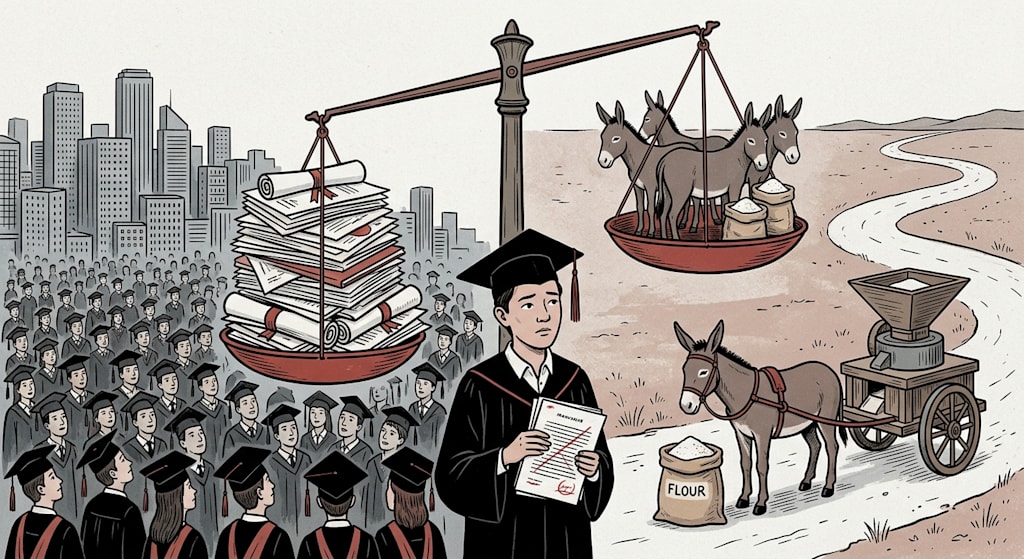
In 2025, China had close to 1.48 million people with a doctoral degree. In the same year, the national donkey inventory was expected to fall below 1.2 million. Put those numbers together and you get a viral line: China has more PhDs than donkeys. If Afanti were alive today, he might ride an old PhD instead of a donkey.
The line is a joke. It spreads because it points at something less funny. PhDs grind for years, and in the scarcity contest they lose to a donkey. That absurdity works because the reality behind it is not absurd at all. There are more PhDs now, and the job market has not kept up.
How the Number Grew
China’s doctoral system is young. The country awarded its first doctoral degree in 1983. From then to now is only a little over forty years.
The first expansion ran from the late 1990s to around 2005. In 1997, China enrolled a little over 10,000 doctoral students and graduated a little over 7,000. By 2005, both numbers had quadrupled. Undergraduate education was expanding then too, and graduate training grew with it.
After 2006, the government asked universities to slow the growth of higher education enrollment. Doctoral numbers flattened. In 2006, enrollment was 56,000 and graduates were 36,200. By 2017, enrollment and graduation had risen to about 1.5 times the 2006 level. Eleven years, a 50% increase. Not dramatic.
The turning point came in 2017. The 13th Five-Year Plan and national strategic needs pushed doctoral enrollment up again. By 2025, enrollment passed 200,000 and graduates passed 110,000. This round favored science, engineering, agriculture, medicine, basic disciplines, and emerging interdisciplinary fields. In 2022, engineering, science, and medicine students made up nearly three-quarters of all doctoral students.
By the end of 2025, China had awarded close to 1.48 million doctoral degrees. That is about the population of Kyoto, Japan. Add doctorates earned overseas, and the total grows.
So when you notice more PhDs around you, you are not imagining it.
1.48 Million Inside 1.4 Billion
“Many” depends on the denominator. The share is tiny. 1.48 million PhDs inside a population of 1.4 billion comes to a small fraction.
UNESCO data from 2020 shows that among Chinese people aged 25 and above, only 0.12% had a doctoral or equivalent education. The United States was at 2.09%. Germany was at 1.51%. The United Kingdom was at 1.08%. China’s PhD share is less than one-seventeenth of the U.S. share.
Out of every 1,000 Chinese people aged 25 and above, there are about 1.2 PhDs. Running into one by chance is as rare as drawing an SSR card.
The research workforce is thin for the same reason. China has about 1,585 researchers per million people. South Korea has 8,714. Sweden has 7,930. Denmark has 7,692. China’s share is less than one-fifth of South Korea’s.
The feeling that PhDs are everywhere comes from clustering. In 2024, China had about 680,000 doctoral students. Beijing alone had 162,000, nearly a quarter. Add Shanghai and Jiangsu, and three places held about 40% of the country’s doctoral students.
If you live in a first-tier city or work in a research institute or a knowledge-heavy company, you are seeing a group filtered by geography and profession. It is like seeing donkeys in Inner Mongolia or Liaoning. Local density hides national scarcity.
Where PhDs Go After Graduation
Once there are more PhDs, the question becomes practical: where do they work?
A university teaching post used to be the default. PhDs graduated and moved into universities or research institutes. As the number grew, that path became crowded. After 2010, the number of new university teachers often fell below the number of PhD graduates from the year before.
More PhDs now do a postdoc first. They build a publication record to compete for a faculty job. Postdocs were meant to be a short stage for deeper research. Now they look more like a waiting room. In 2025, China had about 135,000 postdocs in station.
Some PhDs skip the queue and go to industry. In 2023, of 75,200 new PhD graduates, more than one-fifth entered companies. That share has risen for three straight years.
The choice makes sense. Research work is uncertain. A donkey pulling a mill for three years still produces flour. A PhD pulling the mill for three years may end up with a few papers rejected beyond recognition. Industry offers a paycheck and a schedule.
Does the Degree Pay Off?
When PhDs become more common, “Does it pay off?” gets harder to answer.
Graduate education brings an average income advantage of about 24.6%. A higher degree does not always mean a higher return. Except in a few fields, master’s degrees often pay back better than doctorates. Doctoral study also carries more investment risk. It takes longer and costs more in lost wages. Whether the income after graduation matches those costs is uncertain.
A PhD also takes years that could have gone into a career. It can come with unstable supervision, heavy research pressure, and mental strain. A study of 2,815 Chinese doctoral students found a positive link between research pressure and depressive tendencies. Another report found that 35.5% of graduate students may show some degree of depression. For women, the long training period collides with the childbearing window.
So the answer depends on the person inside the program.
Donkeys and PhDs Do Different Jobs
One piece of good news: donkeys and PhDs do not do the same work.
A donkey is useful from head to tail. Its meat can go into huoshao. Its hide can be boiled into ejiao. A live donkey can pull a mill. A PhD is a different bundle of problems: fragile body, anxious mind, thinning hair.
Current PhD students can keep running experiments. No one is replacing donkeys with doctors of philosophy yet.
The joke hides a harder problem. Doctoral training expanded fast. The academic labor market did not expand with it. Expectations and jobs do not match. University posts are limited. Corporate demand has not fully opened. The training system still points by default toward an academic path.
PhDs end up in an odd spot. In absolute numbers, they are scarce. In local markets, they look surplus. They are told they are elites, then face ordinary job pressure. They are asked for original work, then ground down by up-or-out reviews.
Back to the Joke
“More PhDs than donkeys” is a joke, not a verdict.
It reminds us that a degree’s value is not only a numbers game. Scarcity can measure donkeys. It should not measure PhDs. A PhD’s value comes from rigorous training and the ability to think and research independently. That ability matters in any era.
A PhD should not be romanticized either. It demands years of work with no guaranteed payoff. For an individual, the choice requires an honest look at interest, ability, and circumstances. For society, the task is to offer more paths and a healthier academic culture.
Afanti rode a donkey because donkeys obey. PhDs do not obey because they think.
The joke is a joke. The anxiety is not. The question is not whether PhDs outnumber donkeys. The question is whether we leave enough roads for people who want to think.
About the Creator
Jin
Writer of reamstories
https://reamstories.com/jin
Enjoyed the story? Support the Creator.
Subscribe for free to receive all their stories in your feed. You could also become a paid subscriber, letting them know you appreciate their work.
Comments
There are no comments for this story
Be the first to respond and start the conversation.