
CGPA to Percentage Calculator Guide: Turning Numbers Into Real Results
CGPA to Percentage: A Simple Guide
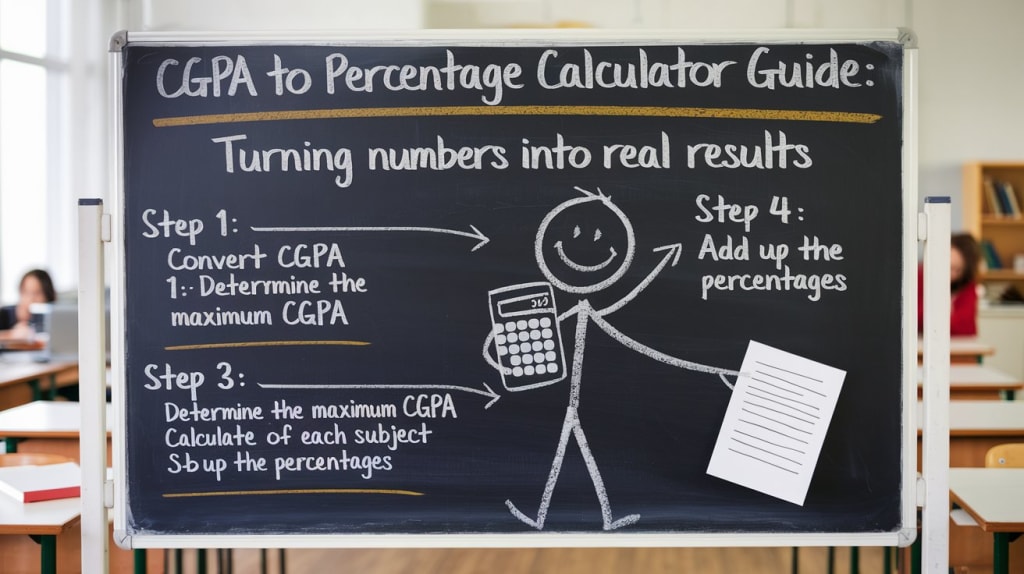
There it is, glaring at you. Your CGPA—Cumulative Grade Point Average—might feel like a label slapped on by some faceless system. But you know better. You know it holds weight. When job applications ask for percentages, that CGPA seems to stand between you and the next step. You’re left wondering, “How do I turn this number into something I can use?”
Here’s the answer, direct and unflinching: converting your CGPA to a percentage isn’t magic or guesswork. It’s simple math. And with the right steps and tools, it’s quick too.
Below, you’ll find the straightest path from CGPA to percentage. No extra steps. Just numbers, formulas, and a solid method.
Why Convert CGPA to Percentage?
Some places—India, for one—still run on percentages. Jobs, especially government positions, set percentage-based cut-offs. Scholarships and fellowships also rely on them. When you’re asked to provide a percentage but only have a CGPA, you need to translate it. Think of it as converting from one language to another. And you want the translation to be clean, clear, and accurate.
So, how do you do it? Let’s break it down.
Step 1: Understand Your University’s Formula
There’s no universal CGPA-to-percentage conversion. Each institution has its own rule. Some schools in India use a simple formula, others go for something more complex. Here are two popular methods:
- Simple Formula: Multiply your CGPA by 9.5. This rule is common in schools under the Central Board of Secondary Education (CBSE).
- Custom Conversion: Some universities or boards give specific guidelines. They might have a table or a set rule, like CGPA × 10, or (CGPA - 0.5) × 10. It pays to check your university’s website or handbook.
Example: If your CGPA is 8.0, using the CBSE formula (CGPA × 9.5), your percentage would be:
8.0×9.5=76%
Key Takeaway:
Always start with your institution’s official conversion formula. They’re the ones setting the rules, and accuracy counts.
Step 2: Do the Math
Once you have the right formula, plug in your CGPA and calculate. Here’s a quick rundown:
- Choose your formula (9.5 multiplier, 10 multiplier, etc.).
- Multiply your CGPA by the number from the formula.
Let’s walk through it with examples.
Example 1: If your CGPA is 7.3, and you’re using the 9.5 multiplier:
7.3×9.5=69.35%
Example 2: Say your CGPA is 6.5, and your school’s rule says to multiply by 10:
6.5×10=65%
Example 3: Suppose your university requires (CGPA - 0.5) × 10. With a CGPA of 8.1:
(8.1−0.5)×10=76%
Using a calculator saves you time and lowers the risk of a slip-up.
Step 3: Try a CGPA-to-Percentage Calculator
If math isn’t your thing, or you’re dealing with decimals that make you dizzy, there’s another way. Online CGPA-to-percentage calculators get it done fast. Enter your CGPA, select your conversion method (CBSE, 10-multiplier, custom), and let it spit out your result.
Look for calculators that:
- Offer conversion options (9.5 or 10 multiplier).
- Are clear on which formula they use.
- Don’t require extra clicks or inputs.
Examples include popular platforms like Solve My Day's CGPA to Percentage. Bookmark one that’s accurate and fast, and use it every time you need a conversion.
Key Takeaway:
A calculator streamlines the process. Use it, but double-check it with a manual calculation once to make sure it’s reliable.
Common CGPA to Percentage Myths
“My CGPA is low, so my percentage will be lower.”
This one’s wrong. The formula scales up your CGPA. So even a CGPA like 5.5 can turn into a respectable percentage. Just check your formula and do the math.
“All universities use 9.5 for conversion.”
Not true. Many do, but some set their own multiplier. Always verify with your institution’s guidelines.
“Converting CGPA to percentage lowers my scores.”
Conversion only translates one score format into another. It doesn’t change your academic record. You’re presenting the same results, just in a different way.
Why CGPA to Percentage Matters Beyond India
While percentage-based grading systems are most common in India, the CGPA-to-percentage conversion matters globally. Universities, especially in Europe and parts of Asia, may request a percentage score for admissions. Many foreign employers also prefer a familiar percentage when evaluating transcripts from abroad.
By mastering this conversion, you bridge academic systems and make your achievements understandable to anyone, anywhere.
Key Takeaway: Converting CGPA to percentage isn’t just about one country’s system. It’s a universal skill that opens doors across borders.
Final Thoughts: Keep It Simple, Keep It Accurate
Don’t let CGPA to percentage conversion become a mental block. Stick to your institution’s rule, use an online calculator if it helps, and double-check your results. Accuracy here matters because, in some cases, it could impact your eligibility for jobs, scholarships, or admissions.
In Summary:
- Step 1: Find your university’s conversion formula.
- Step 2: Do the math or use a reliable calculator.
- Step 3: Keep track of conversion myths and know what’s true.
Key Takeaways:
- Always use your institution’s official formula.
- Multiply carefully; double-check with a calculator if you need.
- Understand why this conversion matters, from local to global.
When you know how to convert your CGPA, you aren’t just calculating a score. You’re taking control of how your achievements are understood. You’re making sure that no matter who reads your transcript, they get a clear picture. In the end, that’s what matters: clarity and confidence, so your hard work speaks for itself.
Use the numbers. Know your score. Then move forward.
About the Creator
Amey Kulkarni
Working at Solve My Day
Enjoyed the story? Support the Creator.
Subscribe for free to receive all their stories in your feed.
Comments
There are no comments for this story
Be the first to respond and start the conversation.