
Blockchain in Healthcare 2026: HIPAA-Compliant Platform Guide
Explore how blockchain in healthcare enables HIPAA-compliant platforms, secure patient data sharing, interoperability, and AI-ready healthcare solutions in 2026.

Table of Content:
- Why Healthcare Needs Blockchain in 2026
- What Is Blockchain in Healthcare?
- Why Blockchain Is Different from Traditional Healthcare Databases
- Key Benefits of Blockchain Healthcare Solutions
- Top Use Cases of Blockchain in Healthcare
- How HIPAA-Compliant Blockchain Healthcare Platforms Work
- Building a HIPAA-Compliant Blockchain Healthcare Platform
- The Future of Blockchain in Healthcare
- Ready for the Next Era of Healthcare?
Healthcare has never had a data shortage – it has a trust and interoperability problem. Every day, hospitals, clinics, laboratories, insurers, and digital health platforms generate massive volumes of patient data, yet much of it remains scattered across disconnected systems. The result? Delayed treatments, duplicate medical records, rising cybersecurity risks, and limited patient control over sensitive health information. As AI becomes an integral part of modern healthcare, these challenges are becoming impossible to ignore. This is where blockchain in healthcare is emerging as a game-changer, enabling secure data sharing, immutable audit trails, and HIPAA-compliant collaboration across healthcare ecosystems.
In this guide, we’ll explore how blockchain healthcare solutions are transforming patient care, the architecture behind blockchain healthcare platform development, real-world enterprise use cases, and the key factors to consider when choosing a blockchain healthcare development company.
Why Healthcare Needs Blockchain in 2026
Healthcare is undergoing one of its most significant digital transformations, yet one fundamental challenge remains unresolved: enabling secure, trusted, and seamless data exchange across the healthcare ecosystem. While Electronic Health Records (EHRs), AI-powered diagnostics, telemedicine, connected medical devices, and cloud platforms have transformed care delivery, patient information still resides in fragmented systems managed by hospitals, laboratories, pharmacies, insurers, and specialist clinics. This lack of interoperability often leads to duplicate medical records, delayed clinical decisions, increased administrative costs, and a larger attack surface for cybercriminals.
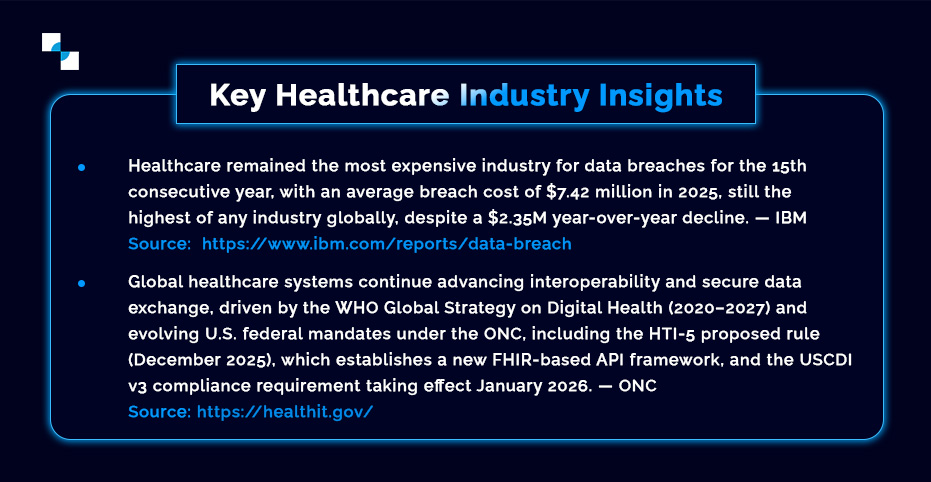
The rapid adoption of artificial intelligence has made this challenge even more pressing. AI-driven healthcare depends on accurate, high-quality, and verifiable data, but fragmented data silos limit collaboration, complicate regulatory compliance, and reduce the reliability of AI-powered insights. Discussions at HIMSS 2026 and insights from the American Hospital Association reinforce that the future of healthcare will be shaped by interoperable systems, responsible AI governance, cybersecurity, and trusted data infrastructure, not by AI adoption alone.
This is where blockchain in healthcare delivers real value. Rather than replacing existing EHR systems, blockchain acts as a secure trust layer that verifies data integrity, records immutable audit trails, automates patient consent, and enables permission-based information sharing while keeping sensitive patient data encrypted in off-chain storage. As healthcare organizations build connected, AI-ready ecosystems, investing in blockchain healthcare solutions and blockchain healthcare platform development is becoming a strategic step toward creating secure, compliant, and interoperable healthcare networks.
What Is Blockchain in Healthcare?
Blockchain in healthcare refers to the application of distributed ledger technology to create a secure, tamper-resistant, and verifiable system for managing and exchanging medical data across multiple healthcare stakeholders. It enables hospitals, clinics, laboratories, insurers, and patients to interact through a shared digital framework where data integrity is cryptographically ensured and every authorized action is permanently recorded. Unlike traditional databases, blockchain does not store or control clinical records directly; instead, it ensures that any shared or referenced data remains authentic, traceable, and resistant to unauthorized modification.
In a modern healthcare architecture, blockchain functions as a foundational trust and coordination layer that connects existing systems such as Electronic Health Records (EHRs), laboratory information systems, insurance platforms, and pharmacy networks. It works alongside APIs, FHIR standards, and secure cloud storage to enable controlled access, consent-based data sharing, and verifiable transactions without disrupting existing clinical workflows. In this setup, sensitive patient data remains stored off-chain, while the blockchain maintains cryptographic proofs, consent records, and audit trails that ensure system-wide integrity and accountability.
Why Blockchain Is Different from Traditional Healthcare Databases
One of the biggest misconceptions is that blockchain is simply another database. In reality, it serves a very different purpose.
Traditional Healthcare Database Blockchain-Enabled Healthcare Platform
Data is controlled by one organization Data integrity is shared across trusted participants
Records can be modified by authorized administrators Every transaction creates an immutable audit trail
Limited visibility into historical changes Complete transparency of authorized activities
Manual verification between organizations Cryptographic verification of every transaction
Centralized trust Distributed trust with permission-based access
Think of blockchain as the trust layer, while existing EHR systems remain the system of record. This distinction is important because successful blockchain healthcare platform development focuses on strengthening existing healthcare infrastructure rather than replacing it.
Key Benefits of Blockchain Healthcare Solutions
Healthcare organizations are increasingly adopting blockchain healthcare solutions to address critical challenges related to data security, interoperability, regulatory compliance, and operational efficiency. By establishing a trusted framework for secure data exchange, blockchain in healthcare enables providers, insurers, laboratories, and patients to collaborate with greater transparency, strengthen patient trust, and streamline healthcare operations.
The following benefits demonstrate how blockchain healthcare solutions are helping healthcare organizations build secure, interoperable, and patient-centric digital ecosystems...................to be Continue.........
For detailed information read the complete Blog: https://www.antier.com/blogs/blockchain-in-healthcare-2026-hipaa-compliant-platform-guide/
About the Creator
Laura Mitchell
Antier is a full-stack blockchain development company building secure, scalable solutions across Ethereum, Solana, and leading chains — from smart contracts, DeFi, tokenization to exchanges, wallets, enterprise-grade Web3 infrastructure.
Enjoyed the story? Support the Creator.
Subscribe for free to receive all their stories in your feed.
Comments
There are no comments for this story
Be the first to respond and start the conversation.