
Best Academies to Prepare for Loksewa in Nepal (2026)
Loksewa not just another exam—it’s a long-term goal for thousands of people.
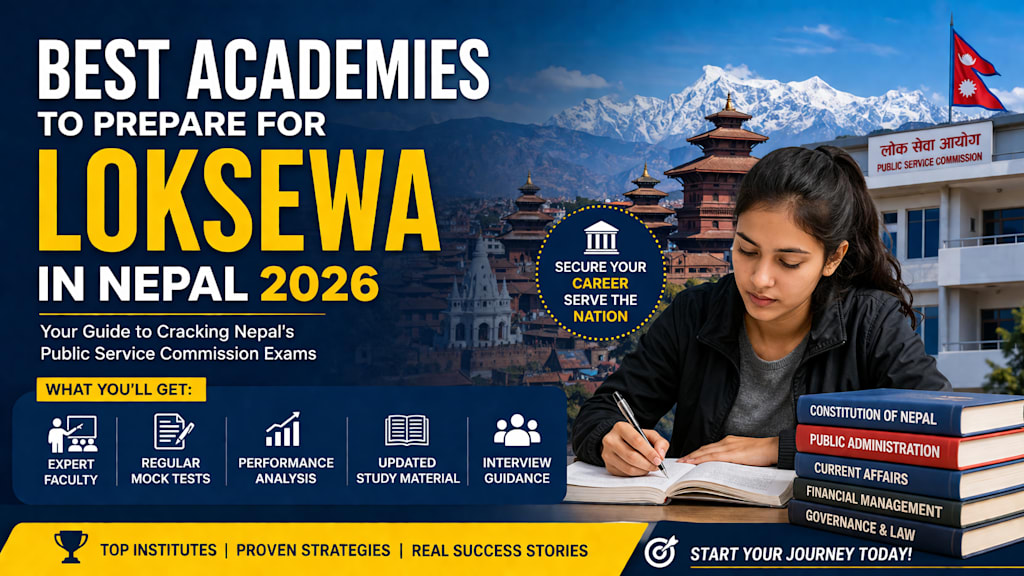
If you’ve grown up in Nepal, you already know how big “Loksewa preparation” is. It’s not just another exam—it’s a long-term goal for thousands of people. For many families, it represents stability, respect, and a secure future.
But cracking Loksewa isn’t easy. Every year, thousands of capable candidates apply, and only a small percentage make it through. And one thing most aspirants realize sooner or later is this: it’s not just about being smart—it’s about preparing the right way.
Understanding the Loksewa Exam (in simple terms)
The Public Service Commission (PSC) conducts exams for various government positions—ranging from Kharidar and Nayab Subba to Section Officer and technical roles like engineers, IT officers, and health professionals.
The structure depends on the post, but generally, it includes:
- Written exams (multiple papers)
- Sometimes skill tests or group tasks
- Final interview
The syllabus is wide. You’ll need to cover things like:
- Nepal’s Constitution and governance
- Public administration and policy
- Current affairs (both national and global)
- Subject-specific knowledge (for technical posts)
It’s not like college exams where you can study a week before and pass. Loksewa tests consistency, clarity, and how well you can present your answers under pressure.
Why coaching actually helps
A lot of students start preparing on their own—and that’s fine. But many struggle with direction.
What to study first?
How deep to go?
How to write answers properly?
Am I even on the right track?
That’s where a good institute can make a big difference. Not because they have “secret notes,” but because they give you structure, regular practice, and feedback.
Popular Loksewa Institutes in Nepal
Most well-known institutes are inside Kathmandu Valley—especially around Bagbazar, Putalisadak, Baneshwor, and Lalitpur. Here are some of the names you’ll hear often:
Line Academy — Pulchowk, Lalitpur
For technical fields—especially engineering and IT—Line Academy has built a strong reputation over the years.
They focus a lot on exams like NEA (Nepal Electricity Authority), computer officer, and engineering-level posts. What students usually like here is the structured approach—regular mock tests, rank comparisons, and detailed feedback.
It’s not the easiest place—you’ll actually have to study—but if you’re serious about technical Loksewa, many consider it one of the better options.
CEDEP Nepal — Putalisadak
CEDEP is one of the older and more established institutes. It covers a wide range—Section Officer, Nayab Subba, Kharidar, and more.
If you prefer a traditional classroom setup with a large student group and long track record, CEDEP is a comfortable choice.
Sandhi Education Academy — Bagbazar
Sandhi has become quite popular in recent years. Their focus is on structured preparation and keeping up with current topics.
Students often mention that the environment is competitive, which can be a good thing if you stay consistent.
Wave Institute — Bagbazar
Wave is especially known for banking prep, but they also run Loksewa classes.
If you’re preparing for both banking and Loksewa at the same time, this can be a practical option.
Columbia Academy — Shankhamul
Columbia offers both online and offline classes and is known for security and general preparation courses.
It’s a decent option if you’re looking for flexibility.
Other names you might hear
You’ll also come across institutes like Chaitanya, Ambition Guru, Udaan, and Zenith. Each has its own strengths—some focus more on MCQs, some on answer writing, some on online classes.
How to choose the right one
This part is important—don’t just follow the crowd.
Before joining anywhere:
- Try a demo class if possible
- See how the teacher explains, not just what they teach
- Ask current or past students honestly
- Check how often they take mock tests
Also, be clear about your goal.
If you’re preparing for a technical post, you’ll need more specialized guidance.
If it’s general Loksewa, focus more on answer writing and current affairs.
A simple study approach (that actually works)
You don’t need a complicated plan. Something like this is practical:
First 2 months:
Focus on basics—Constitution, governance, core subjects.
Next 2 months:
Go deeper into the syllabus and start following current affairs seriously.
Month 5:
Practice. A lot.
Write answers, take mock tests, time yourself.
Final month:
Revise. Fix weak areas. Stay consistent.
Most people fail not because they don’t study—but because they don’t revise or practice enough.
Final thoughts
Loksewa is tough. There’s no shortcut around that.
But it’s also not impossible. Every year, people clear it—some on their first try, many after multiple attempts.
A good institute can help, but it won’t do the work for you. At the end of the day, it comes down to discipline, consistency, and how badly you want it.
Pick a place that suits you, stick to a plan, and give it your full effort.
That’s really it.
About the Creator
Enjoyed the story? Support the Creator.
Subscribe for free to receive all their stories in your feed.
Comments
There are no comments for this story
Be the first to respond and start the conversation.