
Benthorne Scholastic of Finance: Understanding Modern Financial Education in a Digital Era
Exploring how financial education frameworks like Benthorne Scholastic of Finance reflect the growing demand for structured learning in digital finance, fintech, and global economic literacy.

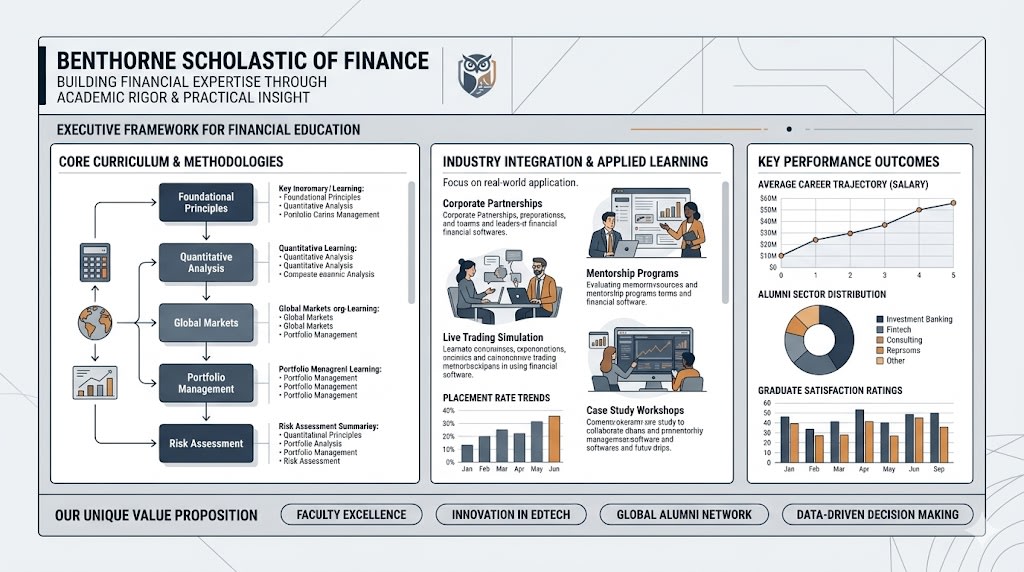
Ethan first heard the phrase Benthorne Scholastic of Finance on a quiet evening while scrolling through an online discussion forum. It was mentioned in passing, almost like a reference to a place that existed between traditional education and the rapidly expanding world of digital finance.
At first, he did not think much of it.
He was not a finance student by training. In fact, he had always considered financial systems something distant and complicated—something handled by professionals in glass buildings far away from his everyday life. But recently, that perception had started to change.
The world around him was changing too quickly to ignore.
Digital payments replaced cash. Online platforms replaced banks for many everyday transactions. Terms like blockchain, fintech, and decentralized systems appeared more frequently in conversations he could not avoid anymore.
And so, curiosity slowly replaced indifference.
The First Encounter with Financial Complexity
A few days after first seeing the term Benthorne Scholastic of Finance, Ethan decided to look deeper. He was not searching for a definition anymore—he was searching for understanding.
What he found was not a single institution or a simple explanation. Instead, it felt like a concept representing structured financial learning in a modern context. A way of thinking about finance that was not limited to textbooks or classrooms, but connected to real-world systems evolving in real time.
The more he read about digital finance, the more complex everything became.
He learned that financial systems were no longer static. They were dynamic, constantly influenced by technology, data, and global connectivity. Traditional banking was still present, but it now existed alongside faster, more flexible systems powered by fintech innovation.
For the first time, Ethan realized that finance was not just about money.
It was about systems, behavior, and technology working together.
A Shift in Perspective
Ethan began noticing patterns in everyday life.
When he paid for coffee using his phone, when he transferred money instantly to a friend overseas, when he saw global markets fluctuate in real time on news feeds—everything was connected to a larger system he had previously ignored.
This realization made him return to the idea of structured learning.
Benthorne Scholastic of Finance, whether symbolic or conceptual, represented something he now felt he needed: a way to organize scattered knowledge into something meaningful.
He started to approach financial topics differently. Instead of trying to memorize definitions, he tried to understand relationships:
How digital finance connects users across borders
How fintech platforms streamline financial services
How blockchain systems maintain transparency without central control
How financial decisions are influenced by data and algorithms
Each concept was like a piece of a larger puzzle.
Learning in the Digital Age
Unlike traditional education systems, Ethan’s learning journey was not confined to a classroom. It happened through articles, videos, discussions, and real-time market observations.
He discovered that modern financial education often blends theory with practical exposure. Platforms simulate real-world financial environments. Discussions are global. Information updates constantly.
This made learning both exciting and overwhelming.
There were moments when everything felt too technical—too fast to fully grasp. But there were also moments of clarity, where complex systems suddenly made sense when viewed from the right perspective.
In those moments, he began to appreciate why structured frameworks like Benthorne Scholastic of Finance were often mentioned in discussions about financial literacy. Not as a rigid institution, but as a way of organizing knowledge in a rapidly evolving world.
The Role of Technology in Understanding Finance
As Ethan continued learning, he realized that technology was not just changing financial systems—it was also changing how people learn about them.
Artificial intelligence tools helped analyze trends. Interactive platforms allowed simulation of financial decisions. Digital ecosystems provided access to global financial data that once belonged only to institutions.
Finance was no longer something distant. It was something observable, interactive, and continuously evolving.
But with this accessibility came responsibility.
Ethan understood that not all information online was equally reliable. The ability to filter, analyze, and critically evaluate became just as important as learning the content itself.
A More Connected Understanding
Over time, Ethan stopped thinking of finance as a separate subject.
Instead, he saw it as part of a larger system—connected to technology, economics, and human behavior.
Benthorne Scholastic of Finance, in his mind, became less of a specific entity and more of a reminder: that structured thinking is essential in a world filled with complexity.
He did not claim to understand everything. In fact, the more he learned, the more he realized how much there still was to explore.
But that no longer discouraged him.
Instead, it gave him direction.
Conclusion
Ethan’s journey into financial learning was not extraordinary. It was simply a reflection of what many people experience in the digital age—encountering complex systems and slowly learning how to navigate them.
The idea of Benthorne Scholastic of Finance remained part of that journey, symbolizing structured understanding in an unstructured world.
And as financial systems continued to evolve through digital finance, fintech innovation, and blockchain technology, one thing became clear:
Understanding finance today is not about knowing everything—it is about learning how to think within a constantly changing system.
About the Creator
Benthorne Scholastic of Finance
Exploring structured approaches to investing, decision-making, and risk in modern financial markets.
Enjoyed the story? Support the Creator.
Subscribe for free to receive all their stories in your feed.
Comments
There are no comments for this story
Be the first to respond and start the conversation.