
Beijing Has 26 Elite Universities. Four Provinces With 300 Million People Have Six.
Shandong, Shanxi, Henan, and Hebei have the population. Beijing has the Project 211 schools. Here is how history, regional policy, and the gaokao built the gap.
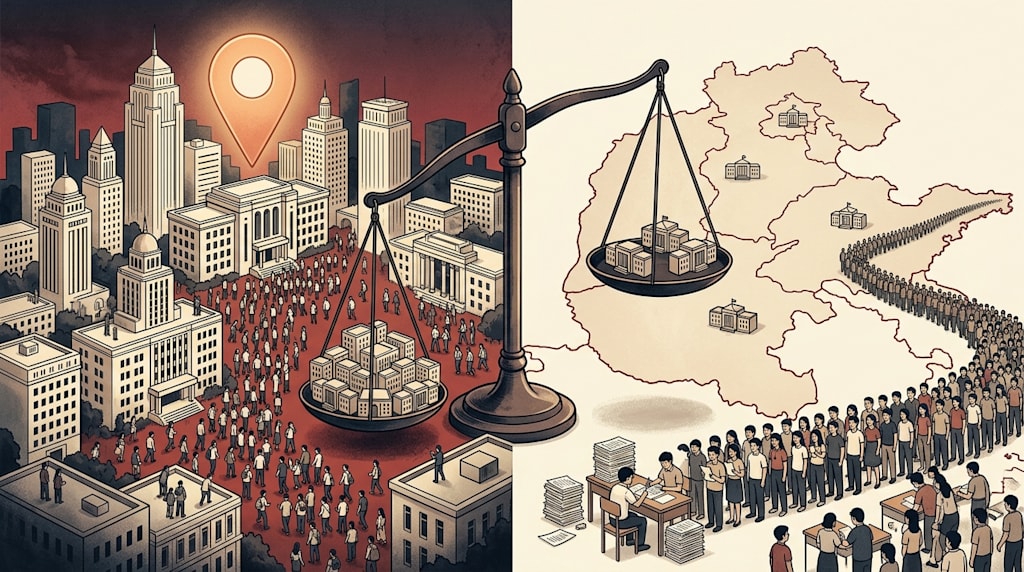
26 and 6: The higher education rift between Beijing and the four provinces
Beijing has 26 Project 211 universities.
Shandong, Shanxi, Henan, and Hebei have more than 300 million people and six.
Put these numbers together. They need no annotation.
1. First, the lists
Beijing’s 26 Project 211 universities include Peking University, Tsinghua University, Renmin University of China, Beijing Normal University, Beihang University, Beijing Institute of Technology, China Agricultural University, Minzu University of China, Beijing Foreign Studies University, Beijing Jiaotong University, University of Science and Technology Beijing, China University of Political Science and Law, Beijing University of Posts and Telecommunications, Beijing University of Chemical Technology, Beijing University of Technology, Beijing Forestry University, Communication University of China, Central University of Finance and Economics, University of International Business and Economics, Beijing University of Chinese Medicine, Beijing Sport University, Central Conservatory of Music, Central Academy of Drama, China University of Petroleum (Beijing), China University of Geosciences (Beijing), and China University of Mining and Technology (Beijing).
The six in Shandong, Shanxi, Henan, and Hebei are:
Shandong: Shandong University, Ocean University of China, China University of Petroleum (East China).
Henan: Zhengzhou University.
Hebei: Hebei University of Technology, located in Tianjin.
Shanxi: Taiyuan University of Technology.
Hebei has no Project 211 university within its own provincial borders.
Henan has a population of over 100 million and one Project 211 university.
Shanxi has a population of 35 million and one Project 211 university.
Shandong has three Project 211 universities, but its annual gaokao candidate number is usually around 800,000.
2. How these schools came about
Beijing’s Project 211 universities were not built in a day. Their origins fall into at least four categories.
The first category: schools already running in Beijing before 1949. Peking University, Tsinghua University, Beijing Normal University, China Agricultural University, Beijing Jiaotong University, and China University of Political Science and Law. Their predecessors had already taken root in Beijing in the late Qing and Republican periods. During the Republican period, universities in Beiping gave admissions preferences to North China. Graduates of Beiping Normal University entering primary and secondary schools across North China was not an isolated case.
The second category: the Yan’an system. Renmin University of China, Beijing Institute of Technology, Minzu University of China, and Beijing Foreign Studies University. They later moved to or were reorganized in Beijing.
The third category: the 1952 departmental adjustment. Beihang University, University of Science and Technology Beijing, China University of Geosciences, China University of Mining and Technology, China University of Petroleum, and Beijing Forestry University. These schools served national industrialization and recruited students nationwide. That is understandable.
The fourth category: specialized universities established at different stages by different ministries and commissions. Their founding dates differ, and their locations were not clustered.
So Beijing’s universities are not a single bloc. The responsibilities of the historical Beijing schools and the later Beijing schools are not the same.
3. North China has no center
In the early years of the People’s Republic, there were six major administrative regions. The center of Central-South was Wuhan; of the Southwest, Chengdu; of the Northwest, Xi’an; of the East, Nanjing and Shanghai. North China had no equivalent center.
Beijing is the capital, and its universities serve the whole country. Tianjin is not large enough. Hebei, Shanxi, and Inner Mongolia do not have enough centrally administered universities to rely on. North China lacks a regional center.
The result is uneven access.
Hebei and Shanxi are in North China along with Beijing, yet they do not enjoy the kind of preference Wuhan universities give to Henan.
Henan belongs to the Central-South region, but it receives quota from Wuhan universities.
Shandong belongs to the East China region and has three Project 211 universities itself, so it basically does not need special East China preference.
The most awkward case is Hebei. It is closest to Beijing, has no Project 211 university in the province, and its only Project 211 university is in Tianjin. Beijing universities’ admissions preference for Hebei is even lower than for Henan, Hunan, Zhejiang, and Sichuan.
4. Admissions data
According to public data, in 2024 Peking and Tsinghua admissions:
Beijing: about 550.
Hebei: about 270.
Shanxi: about 140.
Inner Mongolia: even fewer.
Henan, Hunan, Zhejiang, and Sichuan all had more admissions than Hebei.
For Beijing Normal University in 2024, the provinces with the most admissions: Guangdong first, Sichuan second, Henan third, Shandong fourth. The five North China provincial-level regions had low admissions numbers.
BNU built a Zhuhai campus in Guangdong and gives preference to Guangdong. The same logic could apply to North China. BNU, China Agricultural University, and others could build campuses there and expand admissions.
The quota allocation of Wuhan’s four centrally administered universities is basically Hubei first, Henan second, Hunan third. That is a regional preference pattern.
Beijing universities’ preference for North China is lower than for other regions.
5. Each of the four provinces has its own difficulty
Henan: one Project 211 university; about 1.3 million gaokao candidates.
Shandong: three Project 211 universities; about 800,000 gaokao candidates.
Hebei: one Project 211 university in Tianjin; about 860,000 gaokao candidates.
Shanxi: one Project 211 university; about 340,000 gaokao candidates.
The four provinces together have about 3.3 million candidates and six Project 211 universities.
Beijing has just over 50,000 candidates and 26 Project 211 universities.
On average, Beijing has one Project 211 university per 840,000 people.
The four provinces have one Project 211 university per more than 50 million people.
6. The capital’s function cannot explain everything
The post-1952 Xueyuan Road universities recruited nationwide. That is understandable.
But Peking University, Tsinghua University, Beijing Normal University, and China Agricultural University were in Beijing before 1949. They historically belonged to the North China higher education system. Their admissions preference for North China should not be lower than for other regions.
The capital’s function is to serve the whole country, not only Beijing. It should not siphon resources from surrounding areas.
The gaokao is the baseline of regional fairness. If the regional gap in this channel is too large, coordinated regional development lacks a foundation.
7. What can be done
Historical Beijing universities should set up North China special admissions. Peking University, Tsinghua University, Beijing Normal University, China Agricultural University, and others should give substantive preference to Hebei, Shanxi, and Inner Mongolia.
Beijing universities should build campuses in North China. If BNU can build a Zhuhai campus in Guangdong, it can also locate in Hebei, Shanxi, Henan, and Shandong. China Agricultural University, Beijing Forestry University, and others can do the same.
Xiong’an can play a role. The Xiong’an campuses of Beijing Jiaotong University, University of Science and Technology Beijing, Beijing Forestry University, China University of Geosciences (Beijing), and others should explicitly expand the proportion of North China admissions.
Ministerial-provincial co-construction should support Zhengzhou University, Shanxi University, Hebei University, and others with more doctoral programs and graduate quotas.
Incremental admissions should favor the central and western regions and populous provinces. The Ministry of Education has already required this. The four provinces should be a focus.
A North China higher education coordination mechanism could include Beijing, Tianjin, Hebei, Shanxi, Inner Mongolia, Henan, and Shandong. It could coordinate resource sharing and admissions quotas.
Quotas should be allocated according to population and candidate numbers. The regional system has been abolished, but regional thinking remains. In the future, more weight should go to population size, candidate numbers, and historical contribution.
8. Conclusion
Beijing has 26 Project 211 universities.
The four provinces have six.
The gap comes from policy choices. Those choices can change.
About the Creator
Jin
Writer of reamstories
https://reamstories.com/jin
Enjoyed the story? Support the Creator.
Subscribe for free to receive all their stories in your feed. You could also become a paid subscriber, letting them know you appreciate their work.
Comments
There are no comments for this story
Be the first to respond and start the conversation.