
AI Visibility Monitoring vs. Buyer-Choice Intelligence: Otterly.AI and LLM Authority Index Compared
Why broad AI visibility tracking is not the same as understanding who wins at the moment buyers decide


This article, adapted from LLM Authority Index’s platform comparison, examines a crucial distinction for modern digital teams: the difference between ongoing AI visibility monitoring, as exemplified by Otterly.AI, and high-intent buyer-choice intelligence, LLM Authority Index Reporting.
It outlines what each platform tracks, how their methodologies diverge, and why understanding the move from basic visibility to measurable commercial influence is vital for teams navigating the new world of AI-generated discovery and recommendations.
AI-Driven Discovery Is Changing and Here’s Why the Platform You Choose Matters
The comparison reveals a fast-growing divide in how organizations monitor, measure, and act on their AI search presence.
As brands and marketers face a future where AI-generated answers shape early discovery, shortlist formation, and buyer intent, understanding these strategic differences matters more than ever.
Two Systems, Two Philosophies: Monitoring vs. Intelligence
AI discovery now happens in two parallel ecosystems:
Search results, shaped by SEO and classic web visibility;
AI-generated answers and recommendations, which synthesize from multiple sources to directly answer user prompts.
For a complete overview of the topic, check out this video.
Otterly.AI and LLM Authority Index’s reporting are both players in the new AI visibility software category, but their philosophies and the strategic problems they solve could not be more distinct.
Otterly.AI: Primarily an AI search monitoring platform, built for broad visibility tracking across brands, prompts, and AI engines.
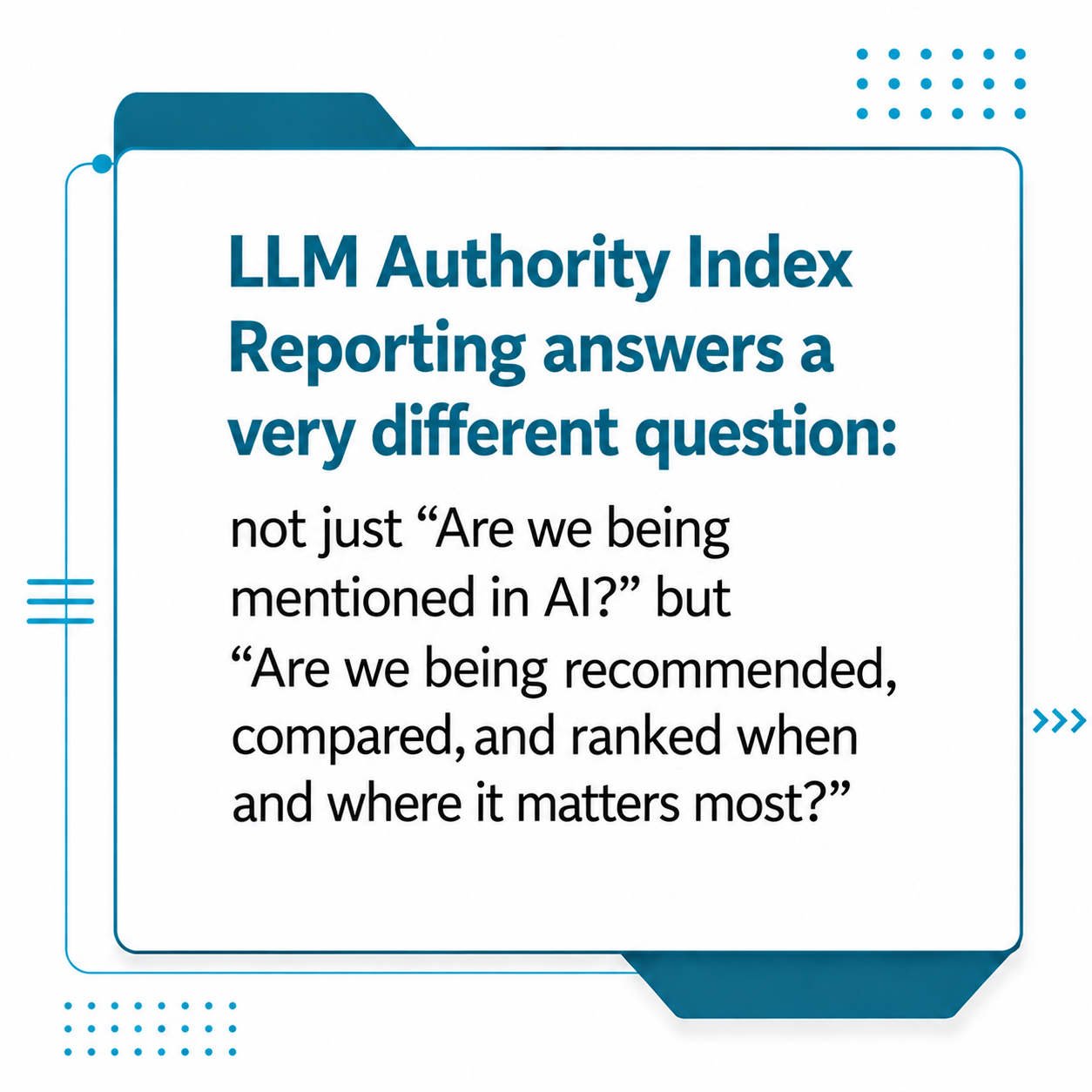
LLM Authority Index Reporting: A high-intent buyer-choice intelligence system, engineered to measure not just visibility, but the commercial moments where AI genuinely influences decision-making comparison, recommendation, ranking, and inclusion in buyer shortlists.
What Otterly.AI Measures: The Monitoring Layer
Otterly’s stack is all about operational monitoring:
- Visibility and Mention Tracking: Frequent updates on brand coverage, mentions, share of voice, position, and domain citation across multiple AI engines.
- Sentiment Analysis: Uses a Net Sentiment Score to report the emotional tone with which AI systems mention or recommend a brand.
- Citation Analysis: Details which domains and URLs AI engines cite, highlighting content gaps for competitive insights.
- Prompt Research: Generates prompt ideas and relevance scores based on SEO keywords or URLs, though without public access to specific AI query volumes.
- Continuous Reporting: Unlimited branded reports, daily data refreshes, and compatibility with reporting connectors like Looker Studio ideal for agencies running multi-brand monitoring.
For agencies or teams who need to track “Are we being seen?” across a wide landscape, Otterly is positioned as a reliable and scalable workflow solution.
For a clearer view of why raw visibility can mislead, read SOV is broken in AI Search, which explains why share of voice alone does not show whether a brand is actually winning recommendation-stage demand.
What LLM Authority Index Measures: The Intelligence Layer
LLM Authority Index Reporting digs deeper into commercial impact:
- High-Intent Prompt Focus: Instead of measuring general presence, it tracks whether a brand is surfaced in the specific prompts that drive buying decisions.
- Recommendation Share: Quantifies how often a brand is recommended by AI in comparison or selection environments not just mentioned.
- Ranking Capture: Reports not just on presence but on actual Top 1, Top 3, and Top 10 ranking positions in AI-generated results.
- Citation Architecture: Goes beyond mere frequency to model how different sources (official domains, reviews, trusted third parties, competitors) underpin credible recommendations.
- Prompt Demand Modeling: Estimates the commercial importance of specific prompts, capturing where economic opportunity is concentrated.
- Recoverability: Identifies where brands could realistically reclaim lost influence in decision-stage AI moments.
For executive and strategic teams, LLM Authority Index answers the question, “Is our AI visibility helping us win the moments that matter commercially, not just showing up in the background?”
Defining the Metrics
- Visibility Tracking: Monitoring mentions, citations, and sentiment. Useful for understanding the overall footprint.
- Recommendation Share: How often AI systems actively recommend (not just mention) a brand in buying contexts.
- Citation Architecture: The structural mix of sources that influence AI’s answers beyond simple mentions to understand if a brand’s ecosystem supports or undermines its authority.
- Blended vs. Separated Decision Metrics: Otterly aggregates visibility into a single ‘Brand Visibility Index’ good for headlines, but can oversimplify. LLM Authority Index keeps layers distinct for diagnosis and improvement.
Why This Distinction Matters Now
With AI systems drafting answers for users who no longer scroll through ten blue links, visibility alone doesn’t guarantee commercial impact.
A typical monitoring view, however sophisticated, may miss whether those “mentions” are actually generating recommendations or rankings in buyers’ real moments of decision.
Brands should ask:
- Are we present in high-intent prompts that shape shortlists?
- Does our citation ecosystem position us as a top recommendation, or just another footnote?
- Is our AI visibility converting into real buyer influence?
The article explains that while both Otterly and LLM Authority Index offer reporting, exports, dashboards, and sentiment analysis, only the latter is intentionally engineered to answer these executive questions.
LLM Authority Index avoids generic “AI Visibility Scores” in favor of granular, board-level strategic reporting.
To understand where brands often lose ground before the click, see the AI discovery gap, which breaks down why being present in AI-generated answers is not the same as being meaningfully discoverable.
When to Choose Each Platform
Choose Otterly.AI if:
- You need continuous, cross-brand AI search monitoring.
- Your team prioritizes daily updates and broad coverage.
- You’re an agency managing multiple brands and need workflow-friendly exports, dashboards, and connectors for client reporting.
Choose LLM Authority Index Reporting if:
- You require insights on whether visibility is generating shortlist presence, recommendations, and competitive advantage.
- Executive stakeholders care about the “why” behind rankings, not just the “what.”
- Strategic reporting on high-intent AI prompts, ranking capture, and recoverable market share are central to your decision-making.
Practical Takeaways for Marketers and Growth Leaders
- Expand Beyond Mentions: Don’t confuse being present with being influential. AI engine mentions may not lead to actual recommendations.
- Audit Your Citation Architecture: Scrutinize not just how often, but where and why you’re being cited.
- Prioritize Decision-Stage Metrics: Focus analytics on high-intent queries and prompt environments that translate directly into buyer action.
- Use the Right Tool for the Right Question: Monitoring platforms shine for workflow management; intelligence platforms answer business-critical questions about recommendation architecture and market share.
Conclusion: Monitoring Is Not Enough
Otterly.AI is an effective monitoring platform for the AI search era. LLM Authority Index Reporting is a decision-stage intelligence system for commercial impact in AI-driven buyer journeys.
As brands increasingly compete in the mixed reality of search and AI answer systems, the move from measuring presence to measuring recommendation-stage influence will define future category leaders.
About the Creator
Diana Brooks
A data nerd sharing case studies and observations on modern buying behavior, product discovery, and digital trust.
Enjoyed the story? Support the Creator.
Subscribe for free to receive all their stories in your feed.
Comments
There are no comments for this story
Be the first to respond and start the conversation.