
AI Visibility Can Look Strong Right Up Until It Fails to Influence the Decision
Why being mentioned in AI answers is not the same as actually influencing the choice


A lot of companies think AI visibility means one thing.
Being mentioned.
That is exactly where the misunderstanding starts. LLM Authority Index makes a sharper distinction: in AI-driven discovery, presence alone does not tell you whether your brand is influencing the outcome.
AI does not simply expose users to options the way old search did. It organizes them, frames them, and often implies hierarchy. That means a company can be visible in the output without being competitive in the recommendation layer.
Why “visibility” is such a slippery metric
The source article argues that the phrase “AI visibility” compresses too many different ideas into one soft label.
When most people say a brand has AI visibility, they usually mean one of three things: it appears somewhere in AI-generated responses, it is mentioned across platforms like ChatGPT, Perplexity, Google AI Overviews, Gemini, or Copilot, or it shows up for prompts related to its category, products, or services.
That sounds useful, but it blurs inclusion, ranking, framing, and recommendation into one vague concept.
That blur creates the real risk.
A company can be included without being competitive. Visible without being preferred. Present without having much influence over what the user chooses. That is the illusion of AI visibility.
The three levels that separate weak presence from real influence
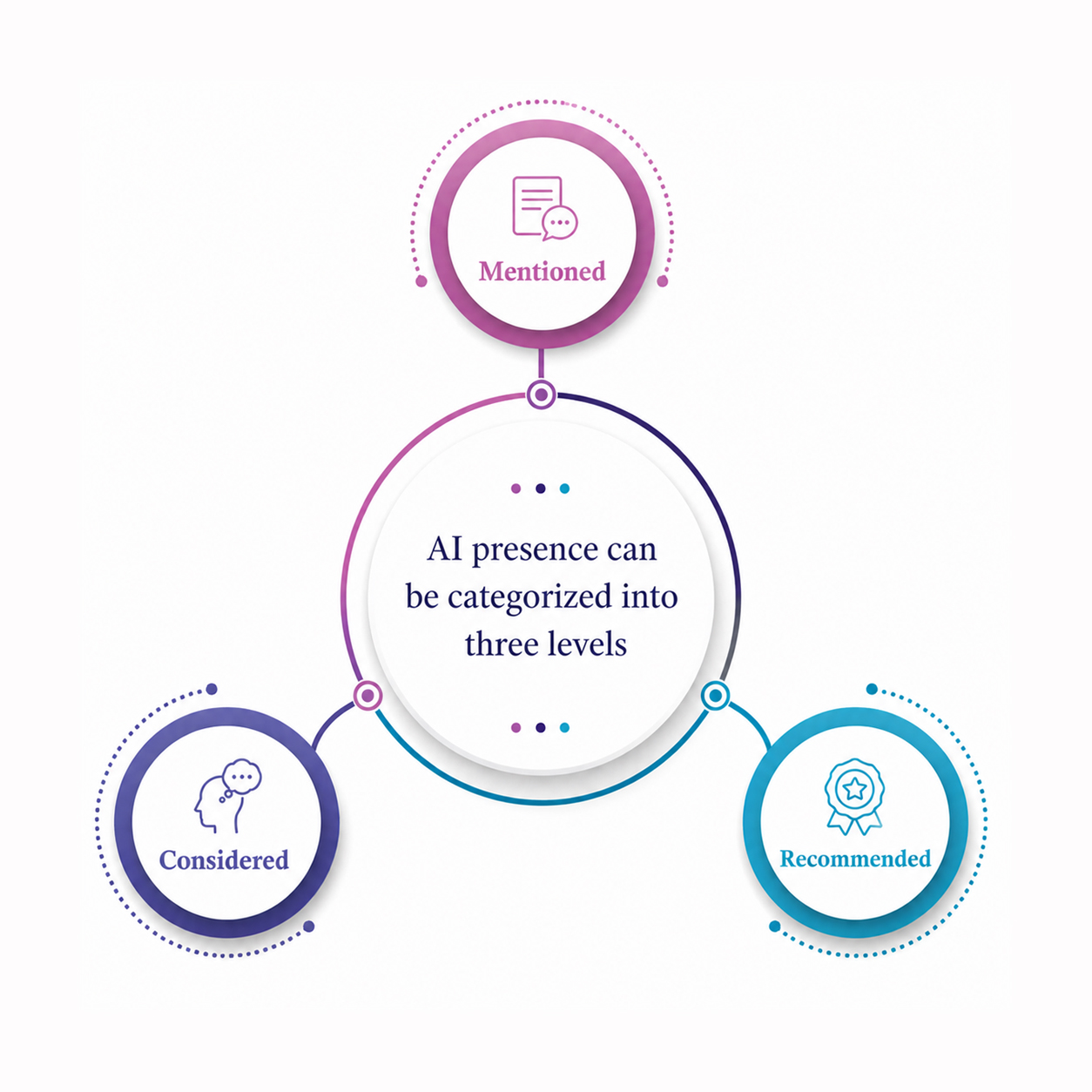
LLM Authority Index breaks presence in AI responses into three levels: mentioned, considered, and recommended. At the lowest level, a company is merely present somewhere in the answer.
At the next level, it is described, compared, or evaluated as a real candidate. At the highest level, it is framed as a top choice, often first, with the strongest language and clearest fit to the user’s need.
The article makes the commercial point plainly: most companies celebrate level one, but the companies that actually win care about level three.
That is why inclusion alone can be a false positive. The source gives a sharp example of a company that appears in 60 percent of relevant AI responses, but is usually the third or fourth option, rarely described in depth, often follows a stronger competitor already framed as the best choice, and is mentioned without recommendation language.
On paper, that looks visible. In practice, it is peripheral.
Know more about this topic from this video.
Why users do not read AI answers like search results
This is where the old search instinct breaks.
The source article says people do not interact with AI answers the way they interact with a page of links. In traditional search, users scan titles, compare snippets, open multiple tabs, and evaluate options themselves.
In AI responses, users tend to trust the structure of the answer, assume the ordering reflects relevance or confidence, and spend disproportionate attention on the first recommendation or first few options. That makes lower-ranked mentions far less commercially meaningful than many dashboards imply.
That logic connects directly to LLM Authority Index’s related article AI Ranking: The Metric No One Is Tracking. That piece argues AI still ranks, even if it does not look like traditional search.
The new competitive question is which company is positioned first in the answer, how often, and under what prompt types. Presence tells you whether you appear. Ranking tells you whether you are preferred.
The metric shift that changes everything
The source article says the key measurement question in AI search is no longer “Are we being mentioned?” It is “How often are we being recommended?”
A recommendation-based model looks at first-position frequency, top-three placement consistency, average ranking within the answer, how often the company is described as the best fit for a prompt, and how often it is favored over specific competitors.
Mention counts tell you whether you are visible. Recommendation frequency tells you whether you are competitive.
That distinction also changes budget decisions. If a company believes broad AI presence is enough, it may invest in tactics that increase mention frequency without improving recommendation strength. The article warns that this can turn spend into visibility theater rather than influence.
Why framing matters as much as rank
A brand can appear in the answer and still be framed weakly. The source article says a company may be described as better for niche cases, lower in quality, more expensive, harder to use, less trusted, or less complete, while another brand is framed as the safest or most proven choice.
AI is not just listing names. It is constructing meaning around them. That is why strong AI measurement needs to examine framing, not just mentions or placement.
This becomes even more concrete in the related Life Alert case study, Life Alert’s Citation Architecture in AI Search.
In the April 2026 baseline, Life Alert appeared in 51.6% of measured AI responses across 1,026 prompts, 10 high-intent clusters, and 6 AI platforms, yet captured 0.0% AI recommendation share and 0.0% Top 1, Top 3, and Top 10 share.
The core finding was that external editorial, nonprofit, review, and trust domains shaped recommendation eligibility more than Life Alert’s own domain. It was visible, but not recommendation-qualified.
The better model for measuring AI presence
LLM Authority Index says a more accurate model of AI presence should distinguish at least four layers: inclusion, coverage, ranking, and framing. Inclusion asks whether you appear at all. Coverage asks how many relevant, high-intent prompts you appear in.
Ranking asks where you appear within the response. Framing asks how the AI describes you relative to others. Only when those layers are combined do you start to see your true discovery position.
That is the hidden strategic risk in the whole article. A company that mistakes mentions for strength can react too slowly, miss rising competitors, keep investing behind the wrong assumptions, and fail to notice that while it remains broadly present, it is being systematically outranked where purchase intent is highest.
About the Creator
Diana Brooks
A data nerd sharing case studies and observations on modern buying behavior, product discovery, and digital trust.
Enjoyed the story? Support the Creator.
Subscribe for free to receive all their stories in your feed.
Comments
There are no comments for this story
Be the first to respond and start the conversation.