
AI Ranking May Be the Missing Metric That Explains Why Visibility Still Fails
How AI answer position is becoming a more important signal than brands realize


A lot of companies think they understand AI visibility because they can see themselves in the answer.
That may be the problem.
As LLM Authority Index argues, AI ranking still exists. It just does not rank the way search engines did. In traditional search, the ranking unit was the page.
In AI-driven discovery, the ranking unit is increasingly the answer itself, and what matters is where your company appears inside that response, how often, and in which prompt types.
That is a very different measurement problem, and one most teams are still not treating like a primary commercial metric.
The shift is bigger than it looks
The source article makes a sharp distinction: broad inclusion is not the same as preference. A company can appear in many AI-generated responses and still be weakly positioned where user trust is highest.
In that sense, presence tells you whether you are included. Ranking tells you whether you are preferred. That difference is not cosmetic. It is the difference between participating in the answer and shaping the answer.
That matters because AI answers are not structured like search result pages. They often return a leading recommendation, one or two supporting options, and then secondary mentions or alternatives.
Even when the response is conversational, it still implies hierarchy. The first company often gets the strongest framing and the clearest recommendation language, while later companies are contextualized as backups rather than leaders.
Why position matters more than many dashboards suggest
One of the strongest sections in the source article is its example of two companies in the same category. Company A is mentioned in 65 percent of relevant AI responses, but rarely recommended first and frequently appears third or fourth.
Company B is mentioned in 30 percent of relevant AI responses, but is frequently recommended first and usually appears in the top one or two positions. If you only look at visibility, Company A appears stronger.
But from a commercial perspective, Company B may be far more influential because it shows up where user trust is concentrated.
That is the heart of the argument.
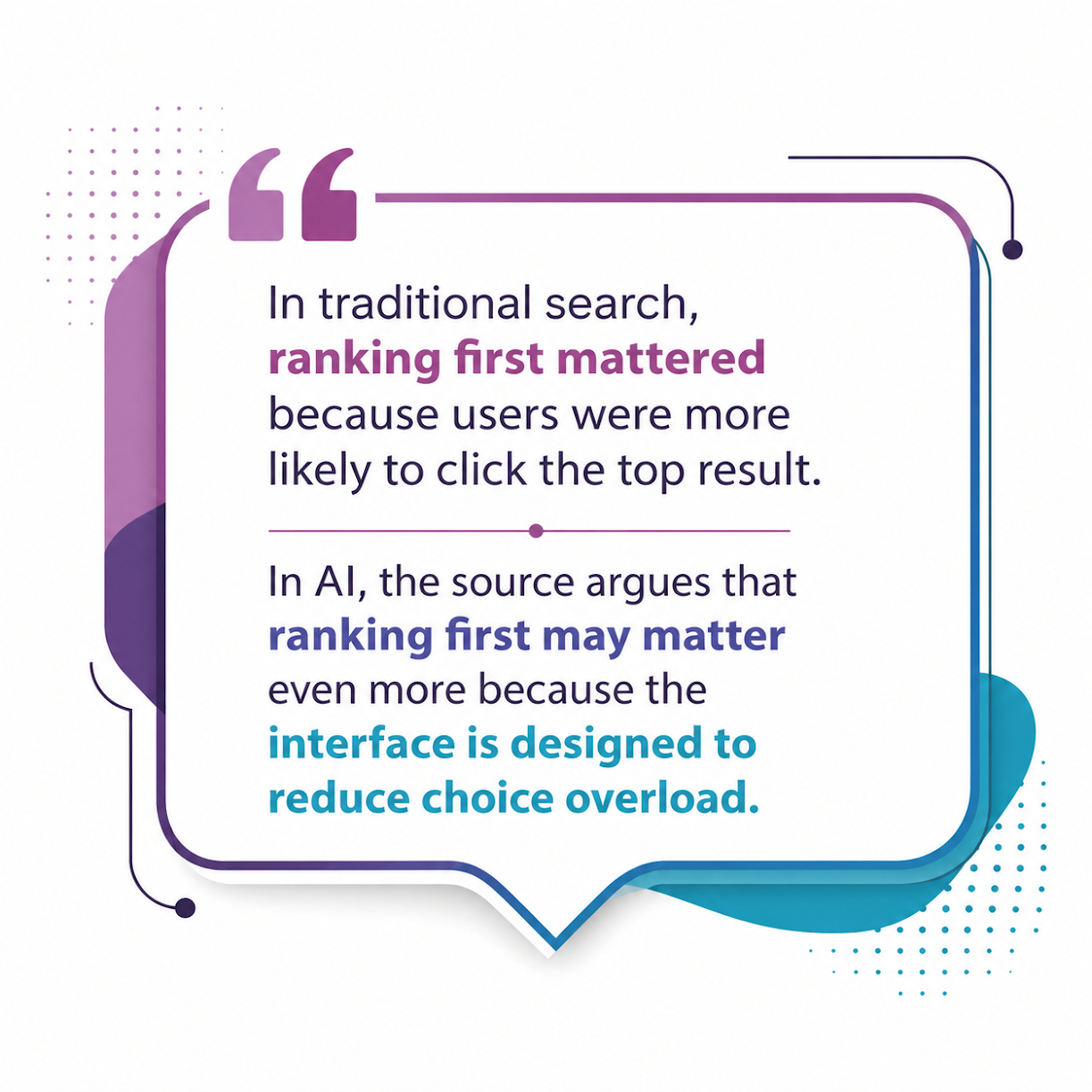
The top position inside an AI answer may carry disproportionate commercial force because the whole interface is designed to reduce choice overload and help the user decide faster.
LLM Authority Index describes this as the top-position advantage: position one attracts the most trust, positions two and three retain some attention, and lower positions often become secondary or disposable. Exact behavior varies by platform and prompt, but the logic is consistent.
Here’s a quick video overview of the topic.
Why “being mentioned” can be a false comfort
This is where the related article on The Illusion of AI Visibility adds an important warning. That piece argues that many brands mistake mention for competitive strength.
A company can be included in AI outputs, look visible on a dashboard, and still have little influence over the final recommendation. In its framing, brands need to think in levels such as being mentioned, being considered, and being recommended, because those are not commercially equivalent states.
That makes AI ranking more useful than broad appearance metrics alone. The source article says a serious AI ranking framework should include first-position frequency, top-three rate, average answer position, position by platform, and position by prompt cluster. Those dimensions reveal something much more actionable than surface visibility: where the company is actually strongest, where it is visible but consistently outranked, and which competitors dominate the most valuable prompts.
The risk is not low visibility. It is false confidence
The source article is especially strong on this point. The biggest danger of not tracking AI ranking is false confidence. A company can look healthy on visibility metrics, conclude it is “showing up in AI,” and still miss the fact that one competitor is outranking it in the prompt clusters that matter most.
By the time that pattern shows up through traffic shifts, conversion pressure, or revenue impact, the competitive order may already be established.
That warning lines up with The AI Discovery Gap, which frames a broader competitive risk: companies can still look strong in traditional marketing systems while becoming weak in the AI-mediated discovery layer where customers increasingly form shortlists and make early decisions.
The gap is not always obvious because the surface metrics can remain stable while recommendation power is quietly shifting elsewhere.
What this changes strategically
Once ranking becomes the focus, the strategic questions change fast.
The source article says teams should stop asking only whether they appear and start asking where they are recommended first, where they are consistently outranked, and which competitors dominate first position across high-value use cases.
They should also ask which platforms favor them or weaken them, and which prompt clusters reveal the largest gap between presence and preferred positioning.
Those are better questions because they reflect decision influence, not just exposure.
The article also makes a clean comparison between old and new measurement logic. Traditional SEO centers on page ranking, search results page position, click-through rate, keywords, link authority, and user browsing.
AI discovery centers on answer ranking, response position, recommendation influence, prompts, citation and contextual reinforcement, and AI-guided selection. That is why AI ranking is not simply a new label for old search metrics. It is measuring a different competitive order.
The more useful measurement stack
LLM Authority Index does not argue that visibility metrics should be discarded. It says companies need at least two layers together: Share of Voice for inclusion and presence, and AI Ranking for preference and recommendation power.
Together, those answer two different questions: Are we showing up? And are we being chosen?
That is the bigger strategic picture behind the article. As AI becomes a more common layer for discovery, answer position may matter more than many companies expect. Brands at the top of AI responses may capture more trust, attention, and consideration.
Brands that are only weakly present may still appear in internal reports while losing real-world influence.
About the Creator
Amber Hughes
Breaking down how brands are discovered, compared, and recommended in an AI-shaped internet.
Enjoyed the story? Support the Creator.
Subscribe for free to receive all their stories in your feed.
Comments
There are no comments for this story
Be the first to respond and start the conversation.