
AI Proved 370 Theorems Overnight. The Math Department Went Silent.
A story about correct proofs no one has read, and the slow human work of turning them into knowledge.
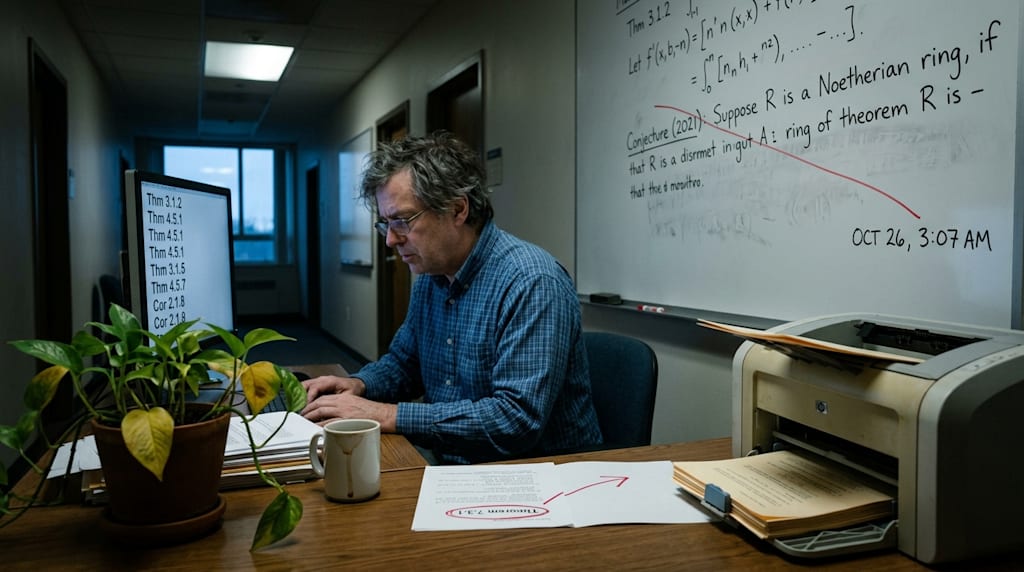
Three in the morning, fourth floor of the math department. One corridor light was out. The other made the whiteboard look gray. Lao Chen refreshed arXiv. The list had grown by three hundred seventy proofs. The numbers ran one after another, like parts coming off a line. He clicked the first one. Two lines of definitions. One lemma. He scrolled. On the third page, he stopped. The whiteboard still held the problem he had written three years ago. The same conjecture. Its corner was smudged from his sleeve. He closed the page. The screen went dark and showed the stubble on his chin.
He had seen AI proofs before. Over the past year, the model had tossed out small results. Mathematicians treated them as noise. Today was different. Three hundred seventy. Some problems he knew. Some he had tried. Some his students were working on. He pushed his coffee cup to the corner of the desk. A dried brown ring sat at the bottom. The pothos beside it had yellowed another leaf.
Mathematical knowledge was never just proof. It runs in a cycle. People pose problems. People look for patterns. People prove. People understand. People talk. The work becomes common knowledge. The next generation continues. The cycle is slow and noisy and full of mistakes. Someone tapes a preprint to an office door. Someone argues in red marker on a corridor whiteboard. A theorem survives only if it gets cited, simplified, written into textbooks, cursed by graduate students in problem sessions. Proof is the entrance. Understanding is digestion. Talking is absorption. Teaching is inheritance.
AI added a branch line. People pose problems. AI looks for patterns. AI proves. People understand? People talk? Common knowledge? Next generation? The question marks sit at the end. The speed is hard to ignore. OpenAI says three hundred seventy items. Formal verification passed. Then what?
If mathematicians do not check them, these proofs do not enter the human knowledge community. They do not enter the axiom and theorem system. They do not enter textbooks. They do not enter surveys. They do not become steps for the next generation. They stay in company documents, in model logs, in the databases of a few engineers. Correct, but suspended.
What is suspended knowledge like? A preprint no one has read. It may be right. No one cites it. No one tests it. No one improves it. It has not entered the academic family tree. It is only bytes on a server. A few years later, a graduate student needs the result, cannot find it, and proves it again. A few years after that, an engineer uses it in chip wiring, and the math department does not know. Knowledge moves in the dark. Public math and private math split.
Lao Chen closed arXiv and opened his email. His collaborator had written: “Did you see today’s thing?” He replied: “I saw it.” The other person typed: “Do you think it’s real?” He stared at the screen. Typed a few words. Deleted them. Finally replied: “I don’t know. No one has checked it.” The chat went quiet. Birds called outside. It was almost dawn.
The mathematicians’ feeling is not fear of AI. They fear that years of work will be erased in bulk, and that the erasure will not enter the community’s system of meaning. A mathematician spends ten years solving a problem. He is not just chasing the word “correct.” He builds understanding. He looks for connections. He creates language. He trains intuition. The detours, the middle conjectures, the tools he invents often matter more than the final theorem. The history of math is a line of problems, concepts, and methods. Answers are only signposts.
AI throws out three hundred answers without a human path. Answers arrived. The process was skipped. Mathematicians cannot judge which proof is beautiful, which is deep, which opens a field, which is just brute force. They cannot break the AI proof into parts that can be taught, generalized, or used to spark new work.
Priority also hurts. Mathematicians care about priority. Resources, jobs, reputation, future directions. An AI company announces solutions to a large set of problems all at once. It does not open the details. It does not join peer review. It does not build collaboration. Years of a mathematician’s work get discounted by one sentence: “AI already proved it.” Someone in the group chat wrote: “Then what have these years been?” No one replied. The message was pushed up by new messages. Like formulas on a whiteboard, erased by the next class.
The problem sits between AI companies and the math community. OpenAI, Anthropic, DeepMind hold frontier models. They need mathematicians. Mathematicians need them to be open. Formal verification can handle the first layer. Lean and Coq check that a proof has no gaps. But machine verification solves correctness, not meaning. Lean tells you the proof has no holes. It does not tell you why the theorem matters, which fields it connects to, where it belongs on the map of math.
If no one does the second layer for a long time, math becomes a subject machines can do and humans cannot explain. In the short term, the math community runs as usual. Conferences go on. Papers come out. Companies use internal teams to verify and apply the results to engineering, finance, military work, and drugs. Public math and private math split. In the medium term, the math community stratifies. A few important, beautiful, formalizable proofs get studied carefully by humans. Many task-driven proofs get checked only by machines. Mathematicians turn to posing problems, defining concepts, designing verification rules, explaining meaning. Formal proof libraries become the new trust boundary. In the long term, math may become a hidden step.
Task, exploration, mathematical discovery, proof, algorithm, execution, task complete. To finish a task, AI temporarily proposes a mathematical statement, proves it, compiles it into an algorithm, and solves the problem. Humans see only the completed task. Drug molecules designed. Logistics networks optimized. Ciphers broken. Chip layouts improved. What was the math in between? Unknown. Newton invented calculus for classical physics. Later, people explained calculus, taught it, spread it. If Newton had only used calculus for physics and never written The Mathematical Principles of Natural Philosophy, the history of math would be different. If AI skips the explanation, math becomes dark knowledge. Unauditable. Uninheritable. Unexplainable. The next generation of mathematicians sees results, not paths.
Lao Chen stood up and walked to the whiteboard. He erased a small patch and wrote today’s date. Then he drew a line. The line connected to the edge of the conjecture from three years ago. He took out his phone and took a picture. In the photo, the whiteboard was gray. The handwriting was messy. The pothos’s yellow leaf sat in the corner. He sent the photo to his collaborator. A note: “Start looking from this line.” The other replied: “Which line?” He typed: “The AI one. We check it.” Then he put down the phone. The coffee was cold. The stomach medicine was in the drawer. He did not take it. Outside, dawn broke. In the corridor, someone pushed a cart past. The wheels creaked. He clicked the first proof. Print. The paper came out warm. In the margin he wrote: “Why does this hold?” Red pen. Small letters.
He was just a mathematician reaching for a sheet of paper. On the paper was a proof written by a machine. He could not understand all of it. He was ready to spend an afternoon. Maybe a week. Maybe longer. He turned the paper over. The back was blank. He drew an arrow pointing to the whiteboard. The arrow was crooked. Like a line just learning to walk.
Math can survive and still go quiet. If no one checks, no one understands, no one talks, math does not end. It splits. Machine knowledge moves fast and stays dark. Public knowledge moves slowly and stays human. If the gap grows, fewer people can check what the machines are doing. Mathematicians cannot opt out. AI companies have to open their work. Institutions should stop pretending this is not their problem. The bridge needs work. Machines can check the first layer. Humans have to build the second, and mathematicians are the ones who translate. They turn the machine’s chain of logic into concepts people can hold. They turn private knowledge into public knowledge. They connect suspended proofs back to the mainland of math.
Lao Chen’s printer spat out another sheet. He picked it up and held it to the light. A theorem number sat on the paper. He picked up the red pen. Drew a circle beside the number. Then he turned to the next page. Outside, the light moved an inch. The shadow of the pothos fell on the paper. He did not smile. He did not sigh. He kept reading.
About the Creator
Jin
Writer of reamstories
https://reamstories.com/jin
Enjoyed the story? Support the Creator.
Subscribe for free to receive all their stories in your feed. You could also become a paid subscriber, letting them know you appreciate their work.
Comments
There are no comments for this story
Be the first to respond and start the conversation.