
AI in Healthcare: Revolutionizing Medicine and What It Means for Your Job
From diagnostics to patient care: How AI is shaping the future of health care and how professionals can thrive in the age of technology.
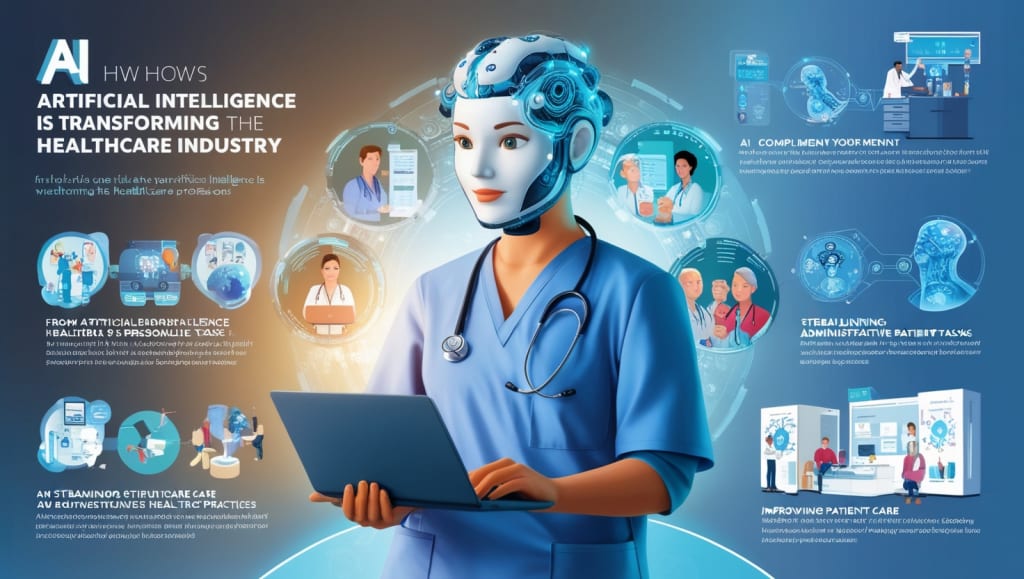
How AI is Changing Healthcare and What It Might Mean for Your Job
Artificial Intelligence, considered years ago as something that only existed in movies, is here to revolutionize the industrial world. Healthcare is notably undergoing a very drastic transformation with advancements in machine learning, data analytics, natural language processing, robotics, and even other AI technologies. With improvements in diagnostics and personalized medicine, reductions in administrative hassle, and general care for patients, AI looks ready to make over just about every part of the healthcare ecosystem.
In this article, we’ll explore how AI is changing the healthcare industry, the potential benefits and challenges associated with these shifts, and what this transformation means for the people working in the sector.
1. AI in Diagnostics: Improving Accuracy and Speed
AI-Assisted Imaging
It has, for a long time, been a required equipment in the determination of diseases such as cancer, heart disease, or neurological disorders. Doctors called radiologists formerly interpreted X-rays, MRIs, CT scans, and other data. But nowadays, AI-powered image recognition systems can make sense of medical images with astonishing speed and accuracy and usually spot patterns that experienced clinicians might overlook.
For instance, AI algorithms have successfully identified early-stage cancers in breast, lung, and skin cancer through patterns in medical images. Thousands of images can be analyzed within minutes by these systems, but a human radiologist may take hours to accomplish the same amount of work. This not only makes diagnosis faster but also ensures accuracy, thereby minimizing human error.
Early Detection through Predictive Analytics
The ability of AI to process volumes of data drawn from various sources, such as electronic health records, genetic information, and wearables, helps healthcare professionals predict and detect diseases before its manifestations occur. Predictive models identify populations at risk, including those prone to diabetes, heart disease, or stroke so that doctors can intervene early.
For example, artificial intelligence algorithms can ingest data from EHRs and wearable devices like heart rate monitors and activity trackers to predict which patients at risk are most likely to develop cardiovascular diseases. Models in this category learn with experience, implying that they become more accurate as more data is received.
2. Personalized Medicine: Tailoring Treatment Plans
Genomics and Precision Medicine
AI is also important to the genomics field and underlies more personalized medicine: AI enhances the analysis of genetic data with doctors being able to understand specific mutations or genetic markers that can influence a subject's response to certain treatments; this leads to even more precise treatments as customized to each patient according to his unique genetic profile, defined as precision medicine.
For example, AI is used in the analysis of DNA sequences in order to identify mutations associated with a particular disease, for example, cancer. From there, doctors can prescribe targeted therapies, which are more likely to work out better instead of trying and failing, frequently becoming a trademark of conventional treatments.
Optimizing Drug Development
While artificial intelligence has sped up the process of finding new drugs in drug discovery- a process, by traditional designs that can take years of research and trials- AI is helping a researcher predict which compounds would be most effective against the disease in question thus significantly reducing the length and cost of time involved.
Machine learning algorithms can be applied to analyze huge sets of chemical compounds, biological information, and the results of past clinical trials to determine potential drug candidates. Indeed, AI has already been applied to discover promising candidates for Alzheimer's disease, cancer, and COVID-19.
3. AI in Patient Care: Improving Treatment and Monitoring
Virtual Health Assistants
Probably one of the most interesting applications of AI in healthcare has been virtual health assistants—AI-powered chatbots and virtual nurses talking to patients to advise on medical questions, schedule appointments, and assist in every respect. These health assistants are designed to augment, rather than replace the human work of health professionals.
They may answer everyday patient queries through AI chatbots, for instance, prompting on symptoms and providing general advice, reminding of medication.
This may free up health services providers to focus on more demanding cases while improving access to information and support through better patient empowerment.
Remote Monitoring and Telemedicine
The COVID-19 pandemic accelerated the adoption of telemedicine, and AI is further enhancing virtual consultations by giving insights and recommendations in real-time based on patient data. AI systems can monitor patients through their vital signs without having them physically present, using sensors and wearable devices to keep track of heart rate, blood pressure, and oxygen levels.
For patients with chronic conditions like diabetes or hypertension and asthma, AI-based systems will inform the healthcare providers about changes in the condition of a patient and enable early intervention. The system will also decrease the number of visits to the hospitals.
In rural or underdeveloped areas, due to scarcity, the availability of health professionals will be inadequate; AI-based telemedicine services can sometimes bridge the gap by offering remote consultation and diagnostic services.
4. AI for Administrative Work: Relieving the Burden and Increasing Productivity
Automate Administrative Work
Administrative work is a significant portion of a healthcare provider's time, including in patient record maintenance, billing, and scheduling. The administrative burden takes away from the time that a healthcare provider can spend on patients. AI is assisting in eliminating these tasks by automating data entry, insurance verification, and appointment setting.
Such systems include automatic updating of patient records, clinical event flagging, and all that entails about documentation completion. AI can also speed up the processing of insurance claims, reduce errors, and accelerate reimbursement.
NLP for Medical Documentation
NLP, in fact, is an application of AI about interpreting human language, and is being used in medicine also for documenting medical records. Most providers use voice recognition software to dictate patient notes, and NLP algorithms help organize and categorize that unstructured data into meaningful insights.
For example, NLP can read a doctor-patient conversation, extract relevant information, and automatically generate structured medical records for EHRs. Not only is it time-consuming, but it also avoids such chances of error and inconsistency in patient records.
5. What Does This Change Mean for Your Work
While there is no doubt that AI has a positively impactful effect in healthcare, it throws open certain important questions regarding the jobs of the future. And this is so because it is meant to automate data analysis, diagnosing, and administrative work, which likely scares the wits out of human workers. What is overlooked here is the fact that AI tends to complement the professionals more than it intended to displace them.
These are the implications for different healthcare professions:
1. For Doctors and Nurses: Collaboration with AI
AI is most likely to augment the work of doctors and nurses by relieving them from repetitive work, offering instant diagnostic support, and working out treatment plans. No more hours spent on administrative work or analysis; healthcare workers can focus much more on patient care, decision-making, and empathy-the things that machines cannot mimic.
Second, AI will act as a second opinion, helping clinicians arrive at more accurate diagnoses and treatment decisions. Physicians and nurses will need to learn new skills to work with AI systems, including how to interpret AI recommendations and make decisions based on the information provided by AI.
2. For Radiologists and Medical Imaging Specialists: AI as a Tool
There is vast potential in AI already allowing it to become a tool for medical imaging assistance. However, radiologists will not be the first casualty of this development since they will apply more AI tools for themselves to analyze medical images more efficiently. AI can do initial screening, flagging abnormalities to be further scrutinized, and radiologists are free to tackle more complex cases or improve their diagnostic accuracy overall.
Radiologists would need to be aware of all the newer AI technologies and learn how to incorporate them into their workflow. They are likely to see a more collaborative relationship between human experts and AI systems in the future.
3. For Healthcare Administrators: Embracing Automation
AI is most likely to revolutionize healthcare administrator roles in that most of the administrative tasks such as scheduling, data entry, and billing will be automated. When these burdens are streamlined, the roles of the healthcare administrator will become much more focused on higher-level strategic activities like patient satisfaction, team management, and operational efficiency.
Healthcare administrators are going to have to adapt new technologies and learn how to apply AI tools so as to benefit workflow and reduce costs.
4. IT and Data Professionals: Emerging AI Knowledge Base The advancement of health care institutions in AI technologies is very likely to lead to increasing demand for professionals equipped with knowledge and skills in AI, machine learning, and data science. Two groups of people will play a crucial role in developing, implementing, and maintaining health care AI systems, namely, IT specialists and data analysts.
For the IT professionals, this would translate to the opportunity for specialization in AI-related roles such as AI system management and integration of data and cybersecurity of AI-driven applications, among others.
Conclusion: AI is Here to Stay—The Future of Healthcare
It is no doubt that AI is revolutionizing healthcare at its core-from enhancing diagnostic precision, enabling personalized treatment, up-gradation of patient care, and streamlining administrative workflows. Such transformations, however, make new demands on the health care professionals to adapt and acquire the new skills with which they can collaborate effectively with AI.
Rather, AI will be an augmenter to help and support human expertise, not a destroyer of jobs. The future of healthcare will be human compassion, expertise, and judgment delivered in partnership with the speed, accuracy, and data-processing power of AI. A big chunk of that will involve embracing this partnership so that the health system can continue providing high-quality care for a very fast and increasingly complex world.
About the Creator
Enjoyed the story? Support the Creator.
Subscribe for free to receive all their stories in your feed.
Comments
There are no comments for this story
Be the first to respond and start the conversation.