
AI in Functional Medicine: Unlocking Next-Level Patient Care
Discover how AI in functional medicine enhances patient care with personalized plans, predictive insights, and smarter data analysis while keeping the human touch.

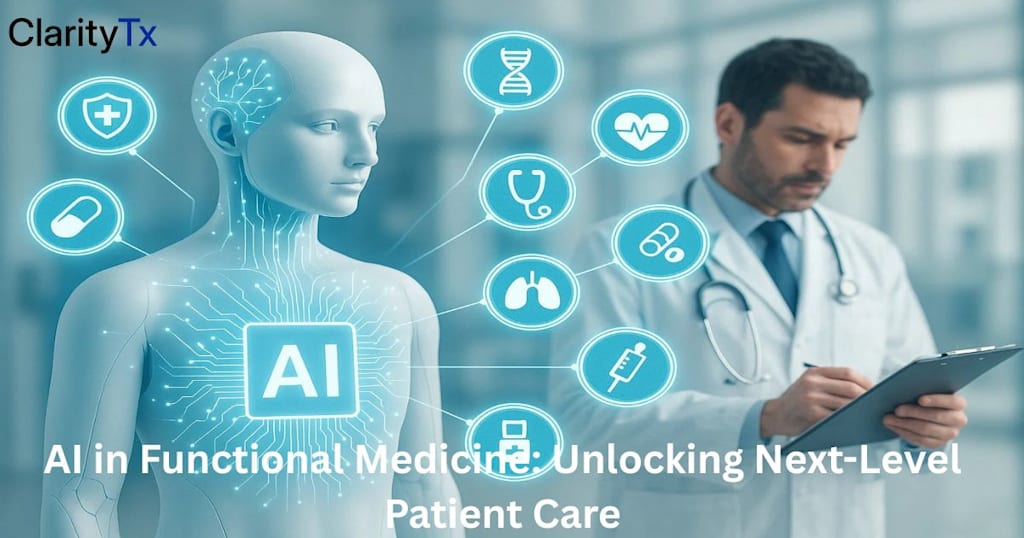
Modern healthcare is at a crossroads. Patients are coming to clinics with complex, chronic conditions – fatigue that just won't go away, flares of autoimmune issues with no apparent causes, gut problems that are not picked up during regular testing. Conventional medicine that relies on pattern matching and population statistics may have a difficult time finding an answer to this more fundamental question: why is this particular person sick? That's what functional medicine was created to do! And now, a powerful new partner has entered the room — artificial intelligence.
The Promise of Functional Medicine — and Its Limits
A root cause approach to health is functional medicine. Instead of merely managing symptoms, practitioners explore the root cause of the issues – nutrition, genetics, gut health, hormones, stress, sleep patterns, environmental factors and more. There are dozens of data points that can be collected during each individual visit within these areas, and a comprehensive intake form can be 20 pages long.
This is the one thing that is really strong in functional medicine and the one thing that is really difficult in functional medicine. Even a well-trained human brain can't have that many variables in the background. A doctor's mind has to have a certain level of cognitive flexibility to tie together a patient's SIBO diagnosis, their thyroid antibodies, their HRV trends, their dietary log, and their childhood trauma history, and do it consistently, during a forty-five minute appointment.
This is exactly where technology steps in to help.
What AI Actually Does in the Clinic
When people hear "AI in healthcare," they often picture robots performing surgery or algorithms replacing doctors. The reality in functional medicine is far more collaborative — and far more useful.
Pattern recognition at scale. The tools can analyse the patient's lengthy intake interview, identify themes, highlight any areas of particular concern, and even create a summary for the practitioner prior to the visit. This will include the doctor entering the room already oriented, not having to read through paperwork for the first 15 minutes after arriving at the appointment.
Personalized protocol generation. Once patterns are found, AI can be used to develop customized care plans using the most recent studies on nutritional genomics, integrative oncology, or gut-brain axis research. An AI tool can pull up relevant studies in seconds rather than hours, and highlight contraindications when given the patient's medication list, as opposed to having a clinician do this manually.
Predictive risk modeling. By its nature, functional medicine is preventive. This is where AI in functional medicine really excels — diagnosing patients who are already on a path to metabolic syndrome, adrenal dysregulation or cardiovascular risk before they reach the point that traditional diagnostics would trigger an alert. This represents a paradigm change from a reactive care-centric approach to a true proactively oriented health optimization approach.
Real-World Applications Already in Practice
In both integrative and functional health practices, AI-driven tools are already helping to transform how care is delivered to patients every day.
Automated intake analysis. Natural language processing (NLP) tools can read a patient's lengthy intake form and extract key themes, flag high-priority concerns, and even generate a pre-visit summary for the practitioner. This means the doctor walks into the room already oriented — not spending the first fifteen minutes reading through paperwork.
Continuous monitoring and alerts. Wearables now capture heart rate variability, glucose trends, sleep architecture and activity data continuously. AI systems can be designed to track these flows and notify practitioners—or patients—when a trend is emerging that needs to be addressed. The rise in nighttime glucose and the 3-day decrease in HRV may be a warning sign of an inflammatory flare without the patient being aware of it.
Genomic interpretation. Genetic panels (SNP) are often ordered by functional practitioners to gain insight into a patient's methylation capacity, detoxification pathways or histamine tolerance. It is difficult to make meaningful sense out of these panels and it takes a long time. AI tools trained on nutrigenomic research can translate raw genetic data into actionable, individualized dietary and supplementation guidance.
Documentation and administrative relief. Burnout is an issue in medicine, and this includes functional medicine. AI-powered note-taking, coding and follow-up drafting frees up practitioners to use their mental energy to best effect: with the patient in front of them.
The Human Element Remains Essential
It is important to emphasize that there is no algorithm that can substitute for the therapeutic relationship. The force of functional medicine is not only in the numbers but also from its practitioner's capacity to hold space, establish trust, interpret body language and incorporate the patient's lived experience into a coherent healing story. If a patient comes to you with the story of an early injury, or a loss that feels trapped in the chest, you must respond with a human response: empathy, presence and wisdom.
AI is a tool. A sophisticated, increasingly powerful tool — but a tool nonetheless. The most effective functional medicine practices of the next decade will be those that harness AI to handle data complexity while protecting and deepening the human dimensions of care.
There are also legitimate questions that deserve serious, ongoing attention from the field:
Data privacy — patient health data is among the most sensitive information that exists, and AI systems must be held to the highest standards of security and consent.
Algorithmic bias — AI systems are only as good as the data they are trained on. If that data reflects existing health disparities, the outputs will too.
Over-medicalization — when every data point is flagged for intervention, one wonders how to avoid pathologising normal human variation.
Critical oversight is required for responsible implementation, and enthusiasm isn't enough.
Looking Ahead
AI's integration into functional medicine is one of the most groundbreaking advancements in personalized medicine in recent years. Those who use these tools with understanding will be able to:
Serve more patients without sacrificing depth or quality of care
Go deeper on complex cases by offloading data analysis to AI systems
Stay current with a rapidly evolving evidence base in integrative health
Prevent burnout by automating repetitive documentation and administrative tasks
Deliver care that feels more personalized, not less — because the practitioner's full attention stays on the human in the room
The future of health is personalized. The future of personalized health is intelligent.
And the future is already here.
About the Creator
Clarity Tx
ClarityTx empowers clinicians with AI-assisted, evidence-synthesized clinical insights and personalized treatment planning across conventional and integrative therapies helping you build safer, research-backed protocols faster.
Enjoyed the story? Support the Creator.
Subscribe for free to receive all their stories in your feed.
Comments
There are no comments for this story
Be the first to respond and start the conversation.