
AI Discovery Economics Explains Why a Recommendation Can Be Worth More Than a Click
Why AI recommendations may now carry more commercial value than traffic ever did


For years, digital visibility was easy to explain.
Get seen, earn the click, win the conversion.
That logic is starting to break. LLM Authority Index argues that AI changes what happens before the click even exists.
Instead of users browsing through options and narrowing the field themselves, they increasingly ask a direct question and receive a synthesized answer that reduces complexity, structures the shortlist, and sometimes frames one company as the obvious fit.
That is why AI discovery has to be valued differently from traditional traffic visibility. A click creates a chance to influence a decision. A recommendation influences the decision before the click happens.
The commercial shift happens earlier now
The source article lays out the contrast clearly. In traditional digital marketing, the sequence usually looked like visibility -> clicks -> visits -> conversions -> revenue. In AI-driven discovery, it increasingly looks like visibility -> recommendation -> consideration -> decision -> revenue.
The wording change is small. The commercial effect is not. AI is moving part of the influence layer upstream, earlier in the journey, before standard analytics systems have much to register.
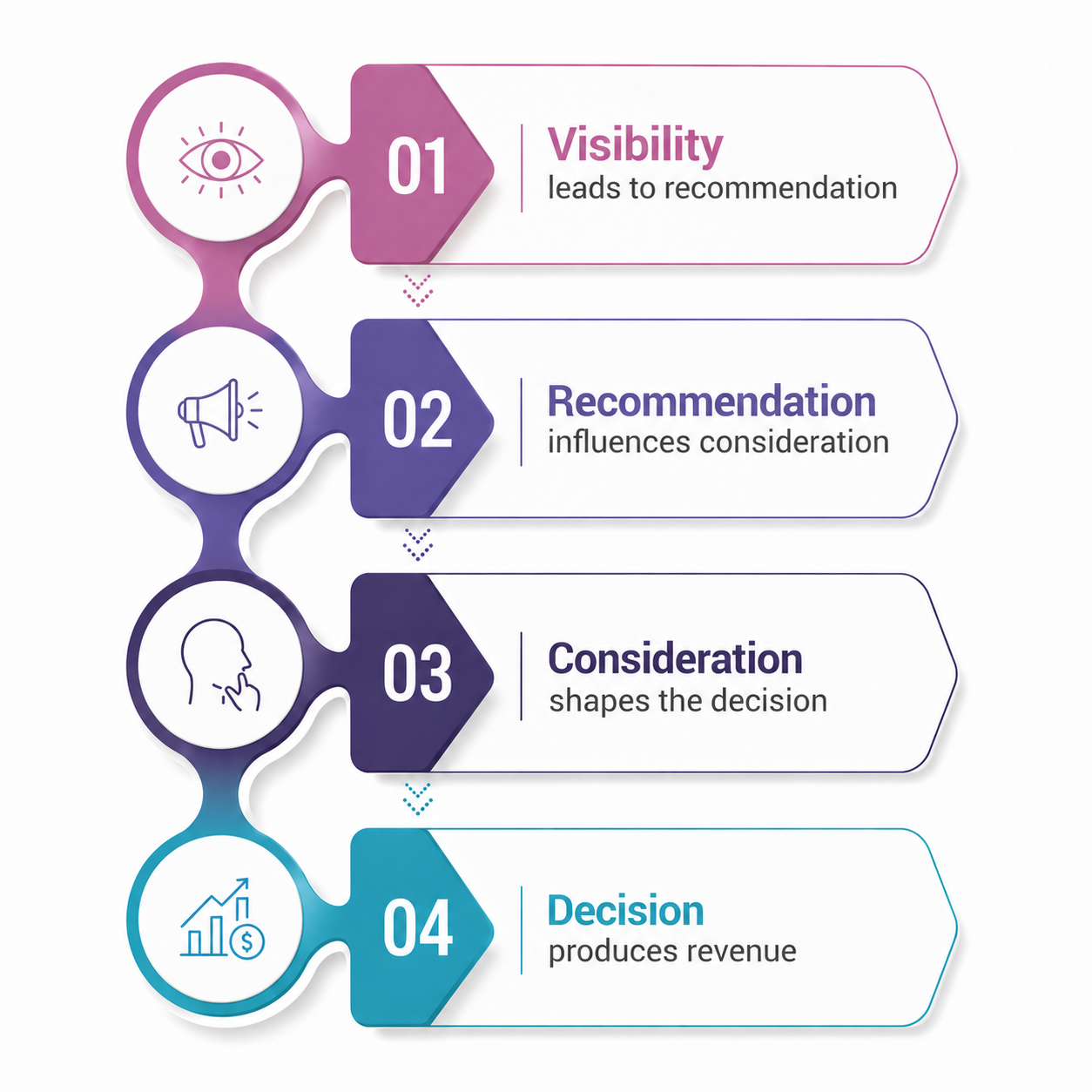
That is the real reason AI visibility may be more valuable than traffic. Traffic is still an opportunity. The company still has to persuade the visitor. But when an AI system says, in effect, here are the best options, it has already reduced the field and implied a hierarchy.
The companies included, especially those ranked highest, benefit from stronger leverage than raw exposure alone.
Here’s a short video that breaks down the topic:
Not all AI visibility is worth the same amount
One of the strongest ideas in the article is that many companies flatten all AI presence into one bucket.
That is a mistake.
LLM Authority Index separates AI visibility into at least three levels: mentioned, included in comparisons, and recommended. A mention has awareness value, but limited direct commercial force. Inclusion in a comparison has stronger consideration value because the company is treated as a real option.
Recommendation is the most economically important layer because it has the greatest influence over actual choice.
A company can be broadly visible and still underperform if it is seldom recommended. Another can have narrower presence but stronger first-position frequency and influence more decisions.
That is also why the related article Mentions Are the New Page Two matters here. It argues that a mention can be technically visible but commercially weak, just like a page-two ranking in old search.
In AI answers, a brand can be present, but not persuasive. Present, but not recommended. Present, but below the real shortlist.
Discovery Value is the concept that makes this usable
The source article gives this economic layer a name: Discovery Value. It defines Discovery Value as the economic impact of being visible, and preferably recommended, in AI-generated responses to commercially meaningful prompts.
The value does not come from visibility in the abstract. It comes from being positioned inside prompts that actually influence high-value decisions.
Two factors shape that value more than almost anything else: prompt intent and position inside the answer. A company recommended in a high-intent commercial prompt is more valuable than the same company being mentioned in a broad informational prompt.
A company listed first in a buying-oriented answer is more valuable than the same company listed fourth in a general explanation.
That is why AI discovery economics has to be grounded in prompt-level commercial logic, not generic visibility counts.
High-intent prompts carry the real economic weight
The article makes this concrete with a simple contrast between an informational prompt and a buying-oriented one. A broad question like “What is payroll software?” does not carry the same commercial value as “What is the best payroll software for a small business with hourly employees?”
The second prompt reflects clearer intent, clearer constraints, and a stronger likelihood that the user is close to evaluating vendors. That changes the economic value of being recommended.
This point lands even harder when paired with Why SEO Thinking Fails in AI Search. That article says traditional SEO was built around pages, while AI search is built around answers. Once the answer becomes the primary surface, companies are no longer only competing to rank a page.
They are competing to be included, framed, and recommended inside a generated answer. SEO taught page visibility. AI requires decision visibility.
The model is simple. The implication is not.
LLM Authority Index offers a simplified formula: Discovery Value = Visibility × Intent × Conversion Potential. It is not meant to produce a perfect number. It is meant to push companies away from vague awareness thinking and toward commercially weighted visibility.
Being recommended for a high-intent CRM prompt may be far more valuable than being mentioned in a general educational query, even if both count as positive presence.
The article also points to useful proxies for estimating value, including paid-search CPCs in similar high-intent queries, revenue-per-click or revenue-per-lead benchmarks, historical conversion rates, average contract value or lifetime value, and prompt-level commercial weighting using search demand and CPC proxies.
These are directional tools, not perfect substitutes, but they help executives think about AI discovery as part of a commercial system rather than a vanity metric.
The hidden revenue layer is the part most teams are not measuring
Most companies still measure paid acquisition cost, SEO traffic, conversion rate, CAC, pipeline contribution, and attributed revenue. The article is clear that these are useful, but mostly operate after the click or after the visit.
What many firms are not measuring is the revenue influence happening before those events: which competitors are being recommended instead of them, how often they are excluded from the most valuable prompts, what percentage of high-intent AI discovery they are capturing, and how much economic value is shifting before traffic is ever generated.
That is where the article introduces Discovery Loss: the commercial value lost when a company is excluded from recommendation-driven discovery and a competitor is surfaced instead.
The exact amount may be hard to calculate neatly, but the strategic logic is straightforward. Every time AI recommends a competitor in a high-intent prompt where your company should plausibly be considered, some portion of future revenue may be redirected away from you.
About the Creator
Gerald Gonzale
I break down how AI is reshaping brand discovery, market share, and competitive positioning through research-driven analysis.
Enjoyed the story? Support the Creator.
Subscribe for free to receive all their stories in your feed.
Comments
There are no comments for this story
Be the first to respond and start the conversation.