
AI and Education
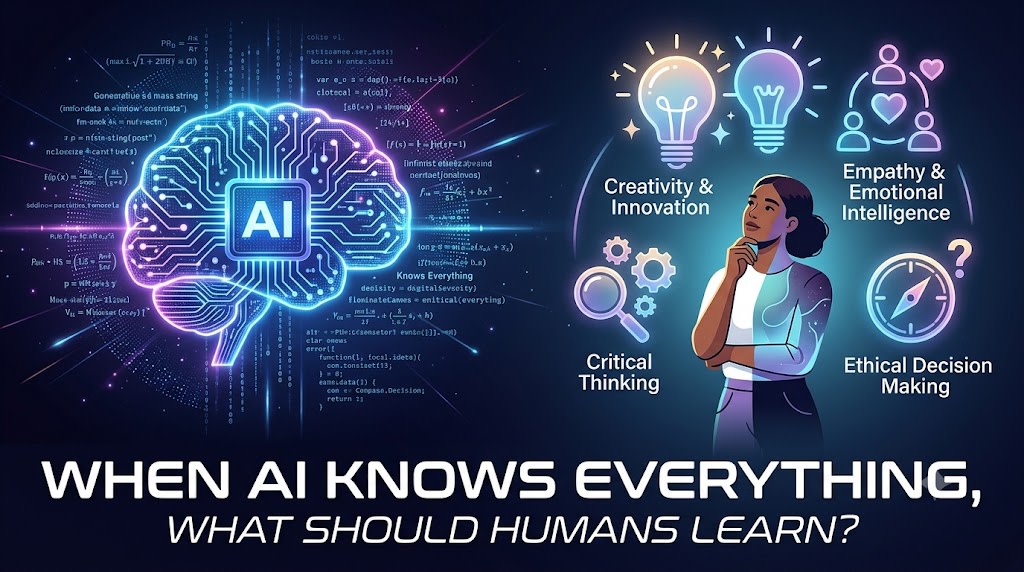
When AI Knows Everything, What Should Humans Learn? by Kristina Kallas from TEDx TALKS.

Disclaimer: The following article is largely informed by the insights shared by Kristina Kallas during her TEDx talk at the University of Tartu, seamlessly integrated with the author’s personal reflections. Readers are encouraged to consult the original presentation for full context.
In recent years, the intersection of Artificial Intelligence (AI) and academia has sparked fierce debate. The discourse typically oscillates between polar extremes: “Should educational institutions ban AI entirely?” versus “Should schools mandate that teachers incorporate AI into their pedagogy?” Alternatively, a more pragmatic faction argues that rather than focusing on AI as a mere teaching tool, educators ought to instruct students on how to navigate the AI landscape — specifically, how to discern precise, credible information amidst a sea of synthetic data.
However, a profoundly refreshing perspective emerged from a recent TEDx talk by Mrs Kristina Kallas at the University of Tartu. Rather than viewing AI merely as a tool to be managed, Kallas explores the profound implications of AI on human cognition and the necessary evolution of our educational systems. She posits that humanity is currently on the precipice of a momentous cognitive evolutionary leap, comparable in scale to the invention of the printing press.
The Economics of the Human Brain: Lower vs. Higher Cognition
To understand this paradigm shift, one must look to cognitive psychology, which delineates human brain function into two distinct modalities:
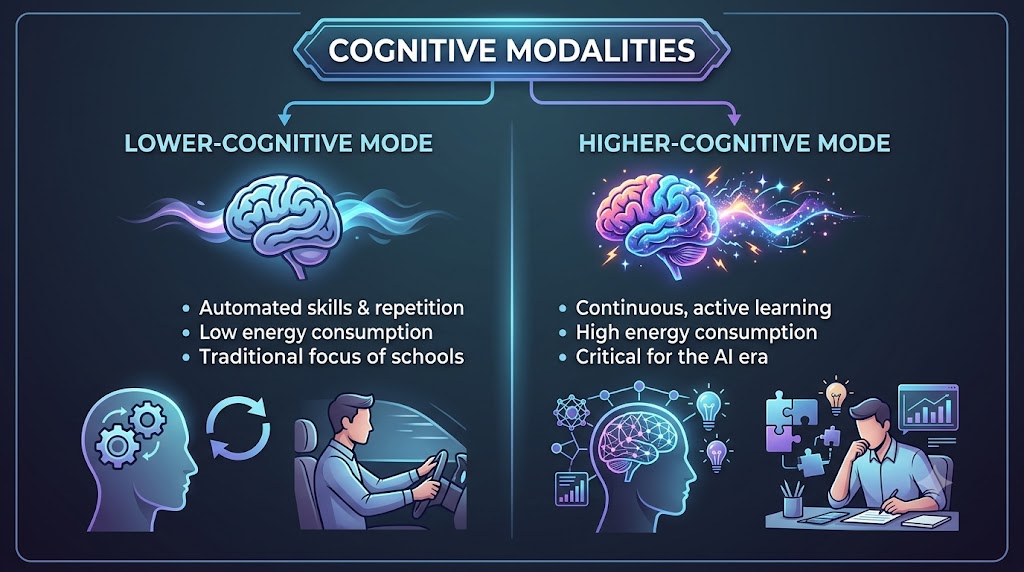
1. The Lower-Cognitive Mode
This modality governs automated skills and habitual processing. Once a skill is internalised, the brain defaults to this mode to execute tasks without conscious re-learning.
Example: When acquiring a language such as English, an individual invests initial effort to master it. Once fluency is achieved, they communicate seamlessly without consciously re-analysing grammatical structures every time they speak.
Biologically, the brain heavily favours this mode because it is highly energy-efficient. Despite accounting for only a fraction of body mass, the brain is our most gluttonous energy consumer. To prevent metabolic exhaustion, it naturally seeks the path of least resistance: automation.
Throughout history — including the Industrial Revolution and the digital dawn — humanity experienced a brief spike in higher-cognitive engagement to adapt to new environments. However, once the novelty dissolved into familiarity, the brain promptly reverted to its lower-cognitive, repetitive baseline.
2. The Higher-Cognitive Mode
Conversely, this mode demands active, continuous learning. It is triggered when yesterday’s knowledge proves inadequate for today’s novel challenges, forcing the brain to expend immense metabolic energy to synthesise new concepts.
Crucially, the AI era presents a historical anomaly: we no longer have the luxury of retreating into a low-cognitive baseline. The rapid, unpredictable evolution of AI dictates that humans must train and engage their higher-order cognitive faculties far more frequently than ever before.
Upending the Pedagogical Status Quo
For over two centuries, industrialized education has focused disproportionately on lower-order cognitive skills, mirroring the lower tiers of Bloom’s Taxonomy: Remembering, Understanding, and Applying.
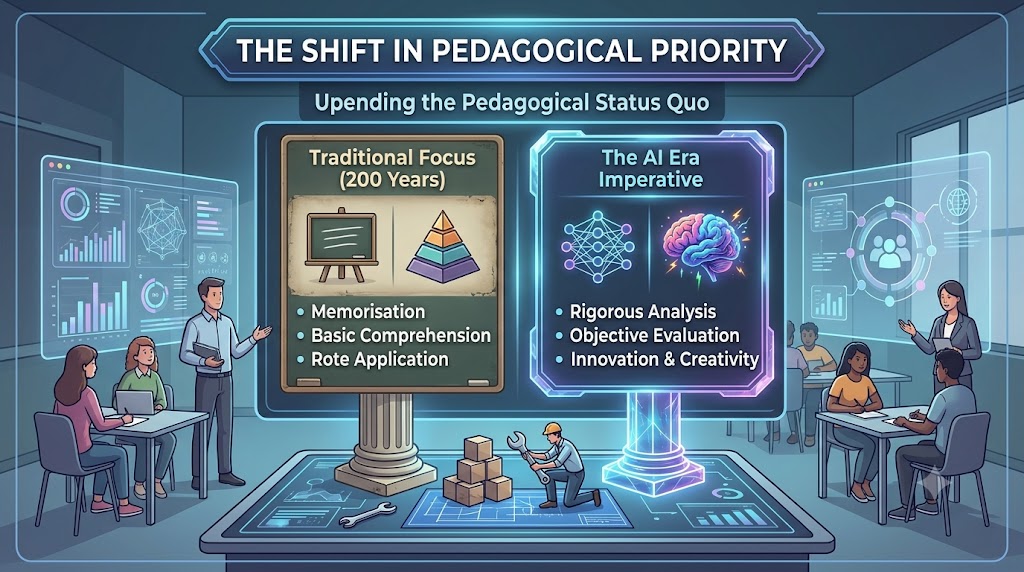
Under the traditional model, students memorise facts, demonstrate basic comprehension, and apply this knowledge in highly controlled examination settings. Teachers act primarily as invigilators and evaluators of this rote process. Historically, higher-order cognitive skills — such as rigorous analysis, objective evaluation, and creative innovation — were reserved almost exclusively for postgraduates and career researchers.
In the contemporary landscape, AI exhibits a terrifyingly superior capability to memorise, comprehend, and apply data at a scale no human can match. Yet, the distinct human advantage remains firmly rooted in our capacity for creative synthesis, nuanced analysis, and ethical evaluation — domains that lie far beyond the reach of current artificial systems.
Consequently, our educational systems must undergo an urgent evolutionary overhaul regarding what is taught and how it is assessed.
A Blueprint for the Future
Estonia has already taken a pioneering step in this direction, launching initiatives that integrate AI into classrooms not as a shortcut to answers, but as a Socratic-style tutor. Instead of outsourcing human intellect to machines, this approach leverages AI to challenge students, prompting deeper inquiry, debates, and critical analysis.
While forward-thinking nations forge ahead, many countries remain immobilised, struggling to devise actionable strategies to modernise their curricula. However, we cannot afford to wait for institutional bureaucracy to catch up.
As individuals, parents, and mentors, the onus is on us to foster these higher-order faculties in the next generation. We must consciously pivot our parenting and informal teaching methods away from mere fact-retrieval, encouraging our children to question assumptions, evaluate biases, and cultivate the irreplaceable human gift of original thought.
About the Creator
Whitestone Yong
Introverted mind. "Amateur" philosopher & musician. I write to share thoughts that might spark curiosity or comfort, especially in times when we need it most.
Enjoyed the story? Support the Creator.
Subscribe for free to receive all their stories in your feed.
Comments
There are no comments for this story
Be the first to respond and start the conversation.