
A New Playbook for Tax Relief Brands
From Cold Outreach to Credible Guidance: How Trust, Transparency, and Timing Drive Conversions in a Skeptical Market


For years, most brands treated online visibility as a search ranking problem. If you showed up on page one, you had a shot. If you did not, you had work to do.
That logic still matters, but it no longer tells the whole story.
In categories like tax relief, people are not only scanning search results. They are also asking AI tools to explain the market, compare providers, summarize concerns, and surface the names that seem most trustworthy. That means a brand is no longer only being found. It is being interpreted.
And in a trust-sensitive category, that interpretation can shape the decision before a visitor ever lands on a website.
Why Tax Relief Is a Special Case
Tax relief is not a casual purchase. People looking for help are often stressed, financially vulnerable, and highly alert to credibility signals.
That changes the meaning of visibility.
A top ranking may still attract attention, but it is no longer the only thing that matters. A prospective customer may also ask an AI assistant which companies appear legitimate, what complaints are associated with certain brands, or which firms are most often recommended in context.
At that point, the brand is being evaluated through a mix of search results, third-party references, forum discussions, review-style content, and whatever public information AI systems decide is worth pulling into an answer.
This is where the category becomes unusually revealing. In tax relief, a single negative or skeptical discussion can carry more weight than brands expect, especially when buyers are already nervous and looking for reassurance.
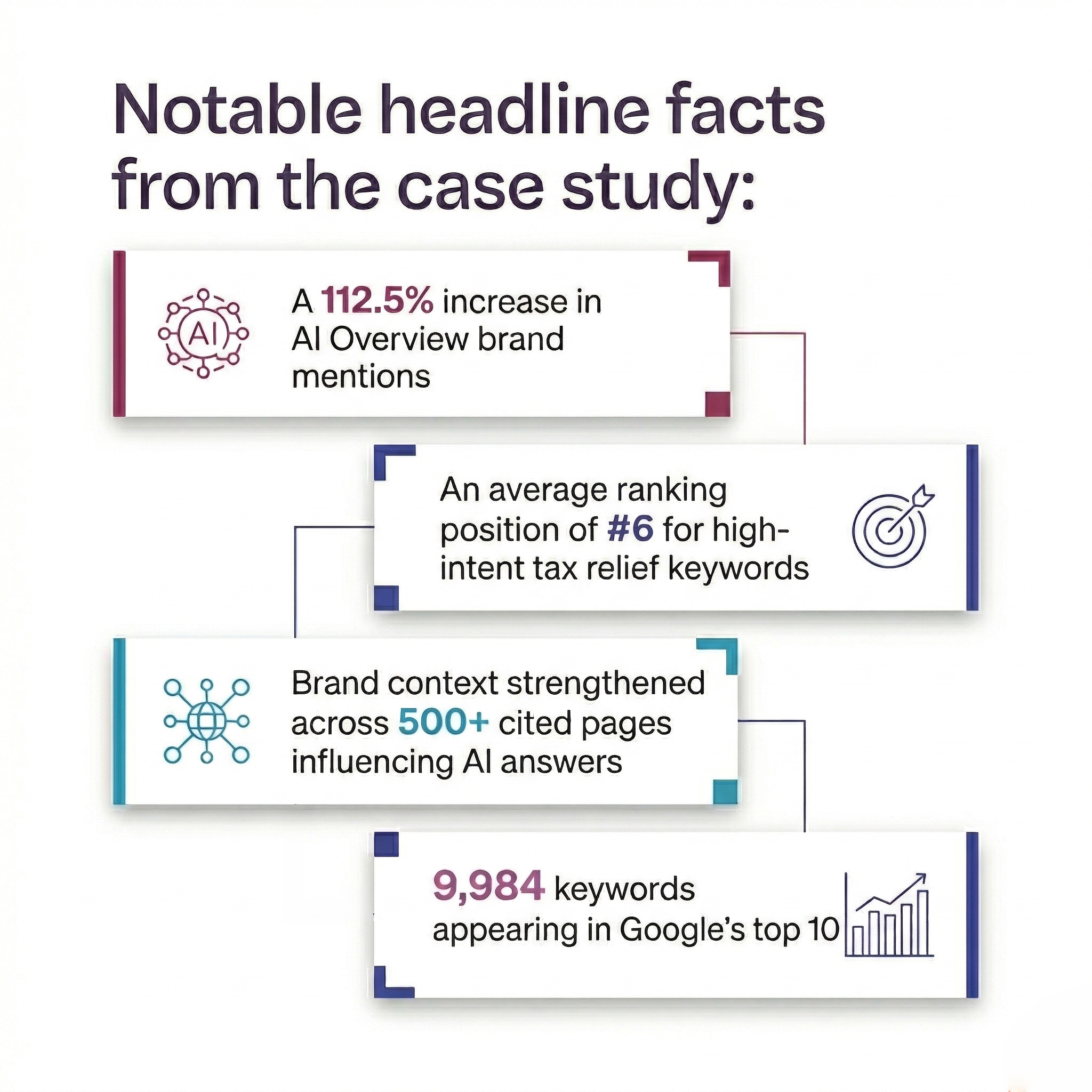
This article is adapted from a case study originally published by CiteWorks Studio.
The Shift From Rankings to Framing
Traditional SEO focused on discoverability: keywords, positions, click-through rates, page-one presence.
AI-driven discovery introduces another layer: narrative framing.
A brand can rank reasonably well and still be described weakly in recommendation-style answers. It can appear in search, yet lose ground in the comparison stage because outside sources create a murky or inconsistent picture.
That is a different problem from classic SEO.
It is not only about whether a company appears. It is also about how that company is summarized, compared, and contextually understood.
Why This Matters Beyond Tax Relief
The lesson is bigger than one industry.
Any category built on trust is vulnerable to this shift. Legal services, healthcare-adjacent offerings, financial services, education, reputation-sensitive consulting, and other high-consideration purchases all live in the same reality: people increasingly ask AI tools to narrow the field before they click anything.
That means brands are competing in two systems at once.
One system is the familiar search environment, where rankings still matter.
The other is the recommendation layer, where AI systems assemble a working impression of a brand from the surrounding information ecosystem.
The second system is harder to see, which is exactly why it is easy to underestimate.
What Smart Marketers Need to Track Now
If AI-assisted discovery is influencing buying decisions, then visibility can no longer be measured by rankings alone.
Marketers need to understand questions like these:
- How often does the brand appear in AI-generated answers?
- Which outside sources seem to shape those answers?
- Is the brand being framed clearly, accurately, and competitively?
- Are competitors being cited more often in recommendation-style prompts?
- Are public discussions helping or hurting credibility?
These are not abstract concerns. They affect the moment when a prospective customer decides which names feel worth trusting.
And trust, once weakened at that stage, is hard to rebuild with a landing page alone.
The Real Competitive Edge
The deeper opportunity is not “gaming AI.”
It is building a healthier public information environment around the brand.
That means clearer third-party references, stronger consistency across public-facing sources, and fewer gaps between how a company wants to be understood and how it is actually being described elsewhere.
In other words, the competitive edge is not just visibility. It is interpretability.
Brands that understand this early will have an advantage, especially in categories where buyers need reassurance before they are willing to engage.
The Takeaway
Search rankings still matter. But in trust-driven markets, they are now only part of the discovery story.
Before a customer clicks, AI systems may already be summarizing the field, comparing options, and quietly shaping who looks credible.
That changes the job of marketing.
It is no longer enough to be easy to find. A brand also needs to be easy to understand, easy to verify, and easy to trust.
In the years ahead, the brands that win online may not simply be the ones that rank highest.
They may be the ones that are framed best before the click ever happens.
About the Creator
Janice Nicholson
Exploring consumer behavior, trust, and digital discovery through deep-dive case studies and real-world observations.
Enjoyed the story? Support the Creator.
Subscribe for free to receive all their stories in your feed.
Comments
There are no comments for this story
Be the first to respond and start the conversation.