
A Comprehensive Guide to Tuples Comprehension in Python
Mastering Tuple Comprehension in Python


Have you ever wanted to efficiently manipulate and iterate over many in Python? Tuple comprehension is a powerful technique that allows you to concisely create and manipulate tuples. In this article, we'll explore the concept of tuple comprehension, its syntax, and its Python code implementation.
1. Introduction to Tuple Comprehension
Tuple comprehension is a concise and elegant way to create tuples in Python. Similar to a list comprehension, it allows you to generate tuples by iterating over an iterable and applying expressions or conditions. Tuple comprehension provides a compact and readable solution for creating and manipulating tuples, making your code more expressive and efficient.
2. Syntax of Tuple Comprehension
The syntax for tuple comprehension is similar to list comprehension. The basic syntax:

The expression represents the operation or transformation to be applied to each item in the iterable. An item refers to a single element of an iterable, and the iterable is a collection or sequence of values.
3. Examples of Tuple Comprehension
Let's look at some code examples to better understand how tuple comprehension works.
Example 1: Creating a Tuple of Squares

In this example, we use tuple comprehension to create a tuple of squares from 1 to 5. The expression x**2 calculates the square of each number x in the range.
Example 2: Filtering Even Numbers
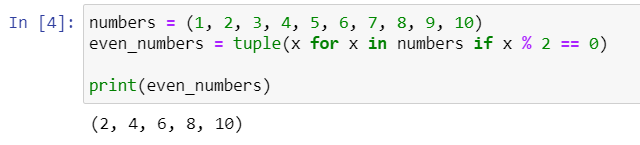
In this example, we filter out the even numbers from the given tuple numbers using a conditional statement if x % 2 == 0.
4. Conditional Tuple Comprehension
Tuple comprehension also supports conditional statements, allowing you to include or exclude items based on specific conditions. Let's look at an example:
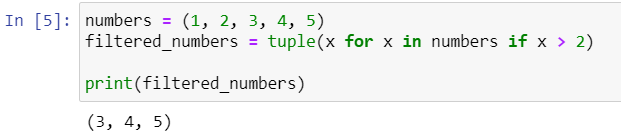
In this example, we create a new tuple filtered_numbers by selecting only the numbers greater than 2 from the original tuple.
5. Nested Tuple Comprehension
Tuple comprehension can be nested to handle more complex scenarios. This allows you to create tuples with multiple levels of iteration and conditions. Let's see an example:

In this example, we have a nested list matrix containing sublists. By using nested tuple comprehension, we flatten the matrix and create a single tuple flattened_matrix that contains all the elements.
6. Benefits of Tuple Comprehension
Tuple comprehension offers several benefits:
Concise and Readable Code : Tuple comprehension allows you to express complex operations in a concise and readable manner. Using a single line of code allows you to create and manipulate tuples, making your code more compact and easier to understand.
Improved Performance : Compared to traditional looping techniques, tuple comprehension often results in faster execution times. This is due to the optimized nature of comprehension constructs in Python.
Expressive and Functional Programming : Tuple comprehension promotes a more functional programming style by focusing on data transformation rather than explicit looping. It enables you to express your intentions clearly and declaratively.
7. Limitations
While tuple comprehension is a powerful way of creating a tuple, there are a few limitations that we should keep in mind:
Immutability: Tuples are immutable, which means that they cannot be modified once you have created them. Therefore, tuple comprehension is suitable for scenarios where you need to generate new tuples or perform read-only operations.
Limited Functionality : Tuple comprehension is not as versatile as a list comprehension. For example, you cannot use tuple comprehension to append or remove elements from an existing tuple. If you want to perform such operations then you should use List Comprehension.
8. Best Practices for Using Tuple Comprehension
Below are a few of the best practices to follow:
Maintain Readability : While tuple comprehension allows for concise code, prioritize readability. Use descriptive variable names and avoid complex expressions that may hinder code comprehension.
Keep it Simple : Avoid nesting multiple levels of tuple comprehension unless necessary. Excessive nesting can make the code harder to understand and maintain.
Test and Verify : Always test and verify the results of your tuple comprehension code. Ensure that it produces the desired output and handles edge cases correctly.
9. Tuple Comprehension vs. List Comprehension
Tuple comprehension and list comprehension share a similar syntax and purpose, but they differ in their output. Tuple comprehension creates tuples, while list comprehension creates lists. Choose the appropriate structure according to your specific needs.
10. Conclusion
Tuple comprehension is one of the powerful techniques that help you to efficiently create and manipulate tuples in Python. After understanding its concise syntax and capabilities, you will be able to write cleaner and more efficient code.
I hope this article has been helpful to you, thank you for reading this article.
About the Creator
Naveen Pandey
I'm a Data Scientist who loves working with numbers and trends | Ex- Jr. Data Scientist | Ex- Deep Learning Application Developer | Reader | Writer | Founder
Enjoyed the story? Support the Creator.
Subscribe for free to receive all their stories in your feed.
Comments
There are no comments for this story
Be the first to respond and start the conversation.