
A Comprehensive Guide to SHAP Values in Machine Learning
SHAP VALUES
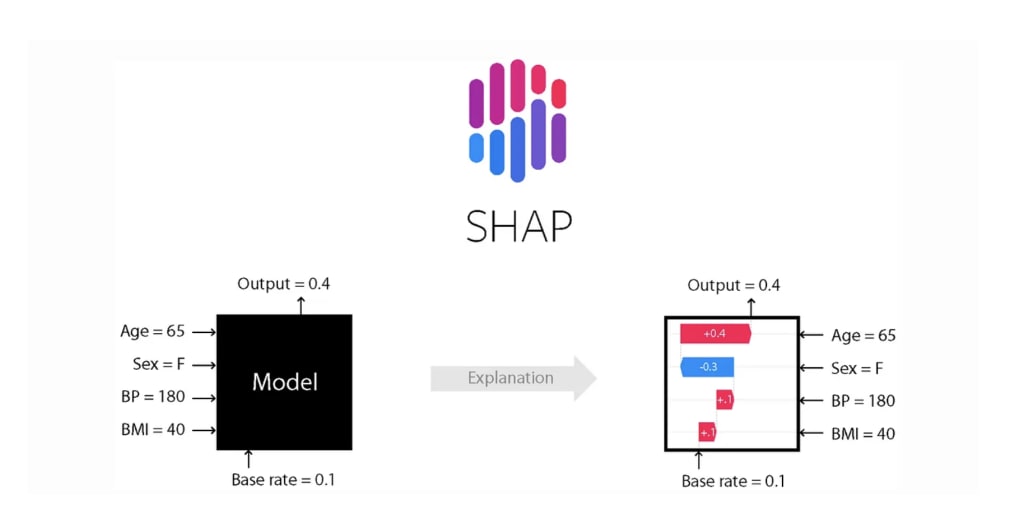
Imagine you’re a detective trying to understand the culprit behind a crime. But instead of fingerprints and alibis, you have a complex machine learning model as your suspect, and its predictions are the crime scene. How do you identify which features were the most influential in making those predictions? Enter SHAP values, your powerful forensic tool in the world of AI.
What are SHAP Values?
SHAP (SHapley Additive exPlanations) values are a game-changing approach to explaining the inner workings of any machine learning model. They leverage concepts from cooperative game theory to assign an importance score to each feature, revealing how much it contributed to the final prediction.
Think of a model’s prediction as a team effort, where each feature is a player. SHAP values determine how much credit each player deserves for the final outcome. Features with positive SHAP values pushed the prediction in a certain direction, while negative values indicate an opposing influence. The magnitude of the value reflects the strength of the effect.
Why are SHAP Values Important?
Black-box models, while often highly accurate, can be opaque in their decision-making process. SHAP values provide much-needed transparency, offering several advantages:
- Debugging and Fairness: By identifying features with high positive or negative SHAP values, you can diagnose potential biases or errors in your model.
- Feature Importance Ranking: SHAP values help prioritize which features matter most for your predictions, allowing you to focus on the most impactful data points.
- Individual Prediction Explanation: You can use SHAP values to explain why a specific prediction was made for a particular instance. This is crucial for building trust and understanding in your models.
Computing SHAP Values in Python
Fortunately, implementing SHAP in Python is a breeze. The SHAP library offers a user-friendly interface for various machine learning models. Here’s a basic example:
Python
import shap
# Load your machine learning model
model = ...
# Explain predictions on your data
explainer = shap.Explainer(model)
shap_values = explainer(X_test)
# Visualize SHAP values with force plots
shap.force_plot(explainer.base_value, X_test[0], shap_values[0])
This code snippet explains the prediction for a single data point in your test set. You can explore various visualization techniques offered by SHAP, like force plots and dependence plots, to gain deeper insights into feature interactions and model behavior.
Interpreting SHAP Values
SHAP values are typically force components, meaning they add up to explain the difference between the model’s prediction and its base value (usually the average prediction). A positive SHAP value for a feature indicates that the feature’s value pushed the model’s prediction higher, while a negative value suggests it pushed the prediction lower. The absolute value of the SHAP value represents the magnitude of the influence.
Conclusion
SHAP values empower you to crack open the black box of machine learning models. By understanding how features contribute to predictions, you can build more interpretable, trustworthy, and effective AI systems. So, the next time you’re looking to demystify your models, remember — SHAP values are your key to unlocking a world of explainable AI.
Further Exploration
This article provides a foundational understanding of SHAP values. To delve deeper, explore the SHAP documentation for various functionalities and explore resources like https://www.researchgate.net/publication/341104768_Interpretation_of_machine_learning_models_using_shapley_values_application_to_compound_potency_and_multi-target_activity_predictions for more advanced explanations and use cases. With SHAP by your side, you’re well on your way to becoming a master of interpretable AI!
About the Creator
Enjoyed the story? Support the Creator.
Subscribe for free to receive all their stories in your feed.
Comments
There are no comments for this story
Be the first to respond and start the conversation.