
20 Detective Puzzle Book Ideas Readers Won't Forget
From cold cases to codebreaking mysteries, these puzzle concepts create a deeper experience than traditional word searches.
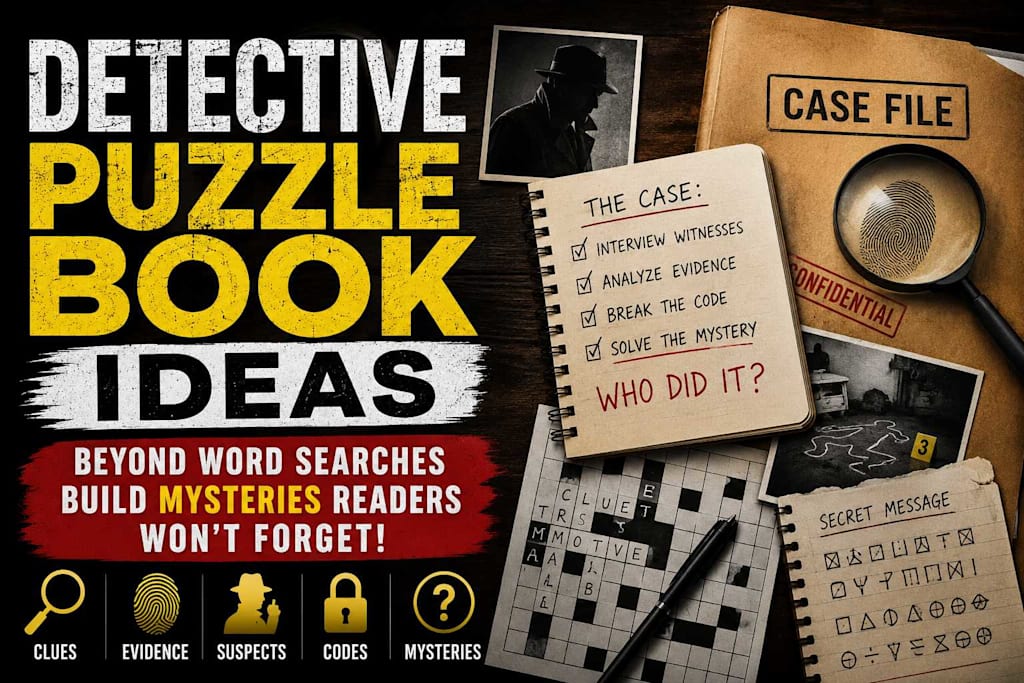
Most puzzle books on the market rely on familiar formats. Word searches, sudoku, fill-ins, crosswords, and mazes dominate the category because they are straightforward to produce and readers understand them immediately. The limitation is that each puzzle stands alone. A reader completes a crossword on page twelve and moves to a word search on page thirteen with no connection between them.
Detective puzzle book ideas operate on a different principle. The reader is not merely completing isolated tasks. They are solving a mystery, following evidence, and experiencing a narrative that unfolds across multiple pages. This creates a different kind of engagement because the outcome depends on how well the reader connects information rather than how quickly they can fill in blanks.
For readers interested in broader mystery publishing concepts beyond detective themes, I previously explored Online Mystery Puzzle Book Ideas for Adults.
Missing Person Case Files
This concept presents a series of missing person reports where the reader acts as a lead investigator. Each case begins with a basic profile, last known location, and a collection of personal effects. Puzzle types include timeline reconstruction, map-based routing exercises, and pattern matching across witness statements.
The clue structure relies on small inconsistencies, such as conflicting times or mismatched descriptions, that only become visible when the reader compares multiple files. The reader journey moves from initial report review through evidence cross-referencing to a final determination of what happened. The target audience includes true crime readers and puzzle enthusiasts who prefer methodical analysis over speed.
Cold Case Detective Challenge
Cold cases work well for puzzle books because the original investigation failed, leaving gaps that the reader must fill. The premise involves a detective reopening old files and discovering new angles. Puzzle types include faded document restoration, fingerprint comparison grids, and photographic detail spotting. Clues are layered across decades, requiring readers to connect a 1987 newspaper clipping with a 2019 property record.
The journey rewards patience and careful re-reading. This format appeals to older readers and those who enjoy complex, multi-step reasoning.
Museum Artifact Theft Mystery
A prestigious museum reports a stolen artifact and the security logs contain anomalies. Readers receive floor plans, guard schedules, and a list of everyone present during the theft window. Puzzle types involve analyzing security camera timestamps, identifying forged access passes, and solving display case mechanism diagrams.
The clue structure centers on opportunity and access. Readers eliminate suspects based on location and timing until only one remains. The journey mirrors real investigative procedure. This idea attracts art history enthusiasts and readers who enjoy spatial reasoning.
Luxury Train Murder Puzzle
A passenger dies en route and the train does not stop until the next station. The reader has the duration of the journey to identify the killer. Puzzle types include compartment layout analysis, dining car seating charts, and luggage inventory matching. Clues appear in ticket stubs, menu orders, and overheard conversations recorded in witness notebooks.
The reader journey creates urgency through limited scope, every suspect is physically present and cannot leave. This format appeals to classic mystery fans and readers who enjoy closed-circle narratives.
Small Town Detective Files
Small towns generate unique investigative dynamics because everyone knows everyone. The premise involves a series of seemingly unrelated incidents that connect to a larger pattern. Puzzle types include local newspaper archive searches, business ledger discrepancies, and family tree mapping.
The clue structure relies on social connections and long-standing grudges that surface through interviews. The reader must track relationships across generations. This idea works well for readers who enjoy community-based mysteries and gradual revelation.
Private Investigator Notebook
This concept adopts the raw format of a working investigator's journal. Entries are dated but fragmented, with coffee stains, torn pages, and margin notes that matter. Puzzle types include decoding shorthand, interpreting surveillance logs, and matching license plates to vehicle descriptions.
The clue structure is intentionally messy because real investigations are not linear. Readers must decide which entries are relevant and which are distractions. The journey feels authentic because it includes dead ends and revised theories. This format appeals to readers who enjoy noir aesthetics and realistic procedure.
Lost Diary Investigation
A diary surfaces years after its owner disappeared, and the entries contain coded references to people and places. The reader must identify the real names behind initials and match described locations to actual addresses. Puzzle types include cipher translation, geographical riddle solving, and calendar-based pattern recognition.
The clue structure builds across entries, with early pages seeming innocent until later context reveals their significance. The reader journey involves re-reading earlier sections with new understanding. This idea attracts readers who enjoy literary puzzles and personal narrative.
Detective Escape Room Book
Escape room mechanics translate effectively to print when the puzzles serve an investigative goal. The premise places the reader in a locked study where a crime was committed. Puzzle types include lock combination derivation from bookshelf arrangements, chemical formula identification from spilled substances, and password reconstruction from desk calendar notes.
The clue structure requires sequential solving, each answer provides a tool or code needed for the next stage. The reader journey builds momentum through visible progress. This format appeals to escape room enthusiasts and readers who prefer tactile, multi-stage challenges.
Spy vs Detective Puzzle Adventure
This concept creates tension between two protagonists. A detective pursues a case while a spy operates in the same environment with opposing goals. The reader receives information from both perspectives and must determine where the cases intersect.
Puzzle types include intercepted message decoding, surveillance photo comparison, and timeline synchronization across two different accounts. The clue structure relies on contradictory reports of the same events. The reader journey involves choosing which narrative to trust. This idea appeals to readers who enjoy espionage and dual-perspective storytelling.
Hidden Evidence Challenge
Not all evidence is obvious. This premise presents crime scene photographs, police reports, and witness transcripts where critical details are embedded in the background. Puzzle types include visual search exercises, audio transcript annotation, and scale measurement from photographs. The clue structure teaches readers to look past the obvious and examine context.
A witness statement about the weather might reveal an alibi contradiction. The journey develops observational skill progressively. This format works for detail-oriented readers and those interested in forensic procedure.
School Mystery Casebook
Academic settings provide natural boundaries and defined populations. The premise involves a series of incidents at a school, theft, vandalism, or worse, with student and faculty suspects. Puzzle types include schedule cross-referencing, handwriting comparison, and grade record analysis for motive identification.
The clue structure uses the institutional environment, attendance records, hall pass timestamps, and club meeting logs. The reader journey feels contained but complex because the setting is familiar. This idea appeals to younger adult readers and educators looking for classroom-appropriate mystery content.
Hotel Mystery Puzzle Files
Hotels operate on registration, room service, and staff rotations. The premise involves a crime during a fully booked weekend where every guest and employee has a story. Puzzle types include key card access log analysis, room service order pattern recognition, and elevator traffic reconstruction.
The clue structure tracks movement through a defined physical space. Readers map who was where and when. The journey requires spatial awareness and logical deduction. This format attracts readers who enjoy hospitality settings and logistical puzzles.
Historic Crime Investigation
Real historical cases or historically inspired fiction provide rich material. The premise places the reader in a specific era with period-appropriate investigative tools. Puzzle types include telegram decoding, vintage map navigation, and newspaper archive searches from the time period.
The clue structure respects historical limitations, no DNA testing in 1923, no cell phone records in 1955. The reader journey includes understanding the constraints of the era. This idea appeals to history enthusiasts and readers who enjoy immersive setting detail.
Secret Witness Puzzle Book
A witness exists but must remain hidden. The reader receives testimony through anonymous letters, coded messages, and dead drops. Puzzle types include postmark analysis, handwriting disguise identification, and message interception reconstruction. The clue structure is unreliable by design because the source is protecting themselves.
Readers must evaluate whether the witness is credible or manipulating the investigation. The journey involves constant reassessment. This format appeals to readers who enjoy psychological complexity and unreliable narration.
Missing Heir Detective Challenge
A wealthy individual dies without a clear heir and multiple claimants emerge. The reader must verify lineage through documents, photographs, and testimony. Puzzle types include genealogical chart construction, signature comparison across decades, and estate record mathematics.
The clue structure involves proving negatives, demonstrating why certain claimants cannot be legitimate. The reader journey is methodical and document-heavy. This idea attracts readers who enjoy legal and familial mystery structures.
Codebreaking Detective Files
Some investigations center entirely on encrypted communication. The premise involves an organization or individual who leaves only coded messages. Puzzle types include substitution cipher solving, frequency analysis, and steganography detection in ordinary documents.
The clue structure teaches cryptographic principles progressively, each solved message provides the key to the next encryption method. The reader journey builds technical skill alongside narrative progress. This format appeals to readers with mathematical or linguistic interests and those who enjoy structured learning through puzzles.
Film Studio Crime Investigation
Film production creates complex logistics with cast, crew, equipment, and locations. The premise involves sabotage or theft during a movie shoot. Puzzle types include call sheet analysis, script revision comparison for planted evidence, and continuity error identification in daily footage logs.
The clue structure uses the production environment, who had access to the prop that became the murder weapon, whose schedule allowed them near the sabotaged equipment. The reader journey involves understanding how film sets operate. This idea appeals to cinema enthusiasts and readers who enjoy industry-specific settings.
Art Gallery Theft Mystery
Distinct from museum theft, galleries feature rotating exhibitions with shorter timeframes and different security protocols. The premise involves a stolen piece from a private showing. Puzzle types include invitation list cross-referencing, wine glass fingerprint analysis from a reception photo, and shipping crate tracking.
The clue structure focuses on the social aspects of gallery culture, who was invited, who brought a guest, who left early. The reader journey feels contemporary and socially nuanced. This format attracts art market followers and readers who enjoy sophisticated settings.
Cruise Ship Detective Mystery
Cruise ships are floating villages with defined passenger manifests and scheduled activities. The premise involves a crime at sea where no one can disembark. Puzzle types include deck plan navigation, excursion group tracking, and onboard account charge analysis for alibi verification. The clue structure uses the ship's rigid schedule against the suspects. Readers know who attended the dinner show and who booked a spa appointment. The journey creates a contained environment with complete information. This idea appeals to travel readers and those who enjoy maritime settings.
Locked Room Puzzle Collection
The locked room mystery is a classic subgenre that translates well to interactive format. The premise presents multiple cases where a crime occurred in a seemingly inaccessible space. Puzzle types include door lock mechanism diagrams, window latch analysis, and timeline reconstruction that accounts for every second. The clue structure focuses on physical possibility rather than motive. Readers must determine how the space was breached or whether it was breached at all. The journey challenges assumptions about what is possible. This format appeals to readers who enjoy engineering logic and pure deduction.
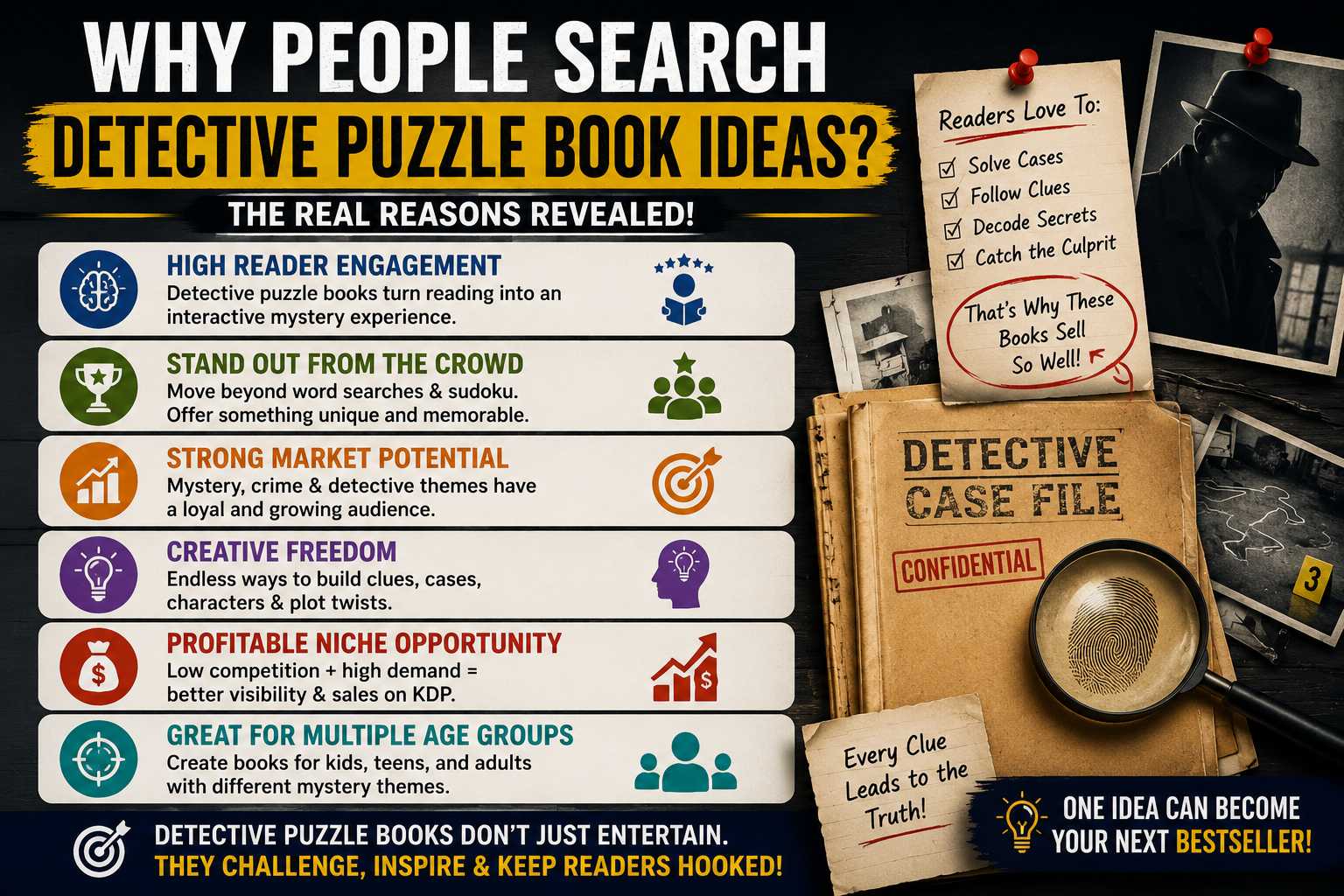
Detective puzzle books differ from traditional puzzle books because they create clue chains. A reader does not solve a sudoku and forget it. They analyze evidence, break codes, interview witnesses, and eliminate suspects in a sequence where each step depends on the previous one. The reader engages more deeply because the puzzles serve a narrative purpose.
Evidence analysis requires comparing multiple sources. Code-breaking reveals hidden messages that change the understanding of the case. Witness interviews contain contradictions that only appear when statements are cross-referenced. Suspect elimination happens through logical deduction rather than guessing. Case progression gives the reader a sense of advancement that isolated puzzles cannot replicate. This structure creates investment because the reader's interpretation directly affects their understanding of the story.
Creating detective puzzle books presents practical challenges that many independent publishers encounter. Connecting clues across multiple pages requires careful planning so that early information remains relevant without confusing the reader. Building evidence trails means deciding what to reveal and when, ensuring that each discovery feels earned.
Creating ciphers that are solvable but not trivial demands balance between difficulty and accessibility. Maintaining story continuity across dozens of puzzles requires tracking details so that no clue contradicts another. Organizing multi-stage investigations means designing paths where readers can recover from incorrect assumptions without breaking the narrative.
While researching how creators build detective and mystery puzzle books with interconnected clues and code-breaking elements, I came across because it focused on mission-based puzzles, ciphers, and mystery-style activity structures rather than traditional standalone puzzle formats.
The publishing landscape for puzzle books continues to expand, but the detective format remains underdeveloped relative to its potential. Readers have demonstrated sustained interest in mystery narratives across every medium. Translating that interest into an interactive format where the reader holds the evidence, studies the clues, and reaches their own conclusion creates a distinct product category. The ideas above represent starting points rather than limitations.
Each concept can be adapted for different age groups, difficulty levels, and cultural settings. The core principle remains consistent: give the reader a mystery worth solving and the tools to solve it. That combination produces a puzzle book that readers remember and recommend.
About the Creator
Brooks Ghost Max
I'm just a running shoe geek with a serious addiction to foam. My current obsession? The Brooks Ghost Max. I spend my days analyzing stack heights and heel drops to help you decide if that $150 price tag is actually worth it.
Enjoyed the story? Support the Creator.
Subscribe for free to receive all their stories in your feed.
Comments
There are no comments for this story
Be the first to respond and start the conversation.