
20 Brain Teaser Mystery Puzzle Ideas for Puzzle Book Creators
Discover detective cases, clue hunts, secret codes, and mystery challenges readers will remember.
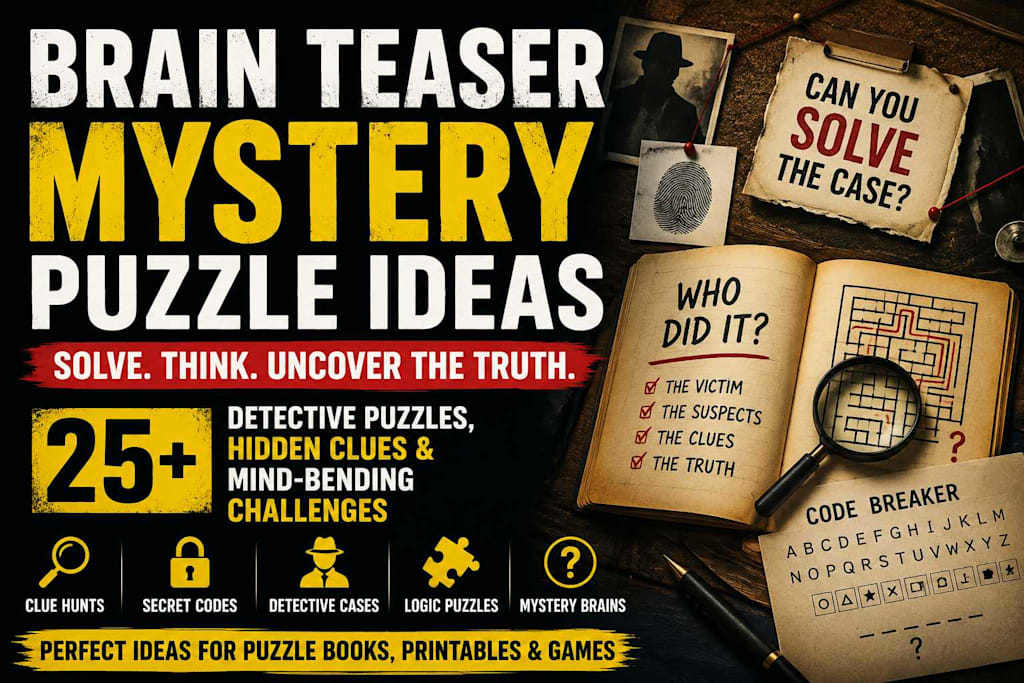
Mystery brain teasers occupy a unique space in puzzle design. They do not simply ask the solver to find a pattern or complete a sequence. They invite the solver into a narrative, present a problem with stakes, and demand deduction rather than raw calculation. A standard crossword or number puzzle offers a closed challenge. A mystery brain teaser offers an open question: what happened, who is responsible, and what detail did everyone else miss?
This matters for creators building puzzle books, printable activity sets, or mystery game products. Readers remember the puzzle that made them feel like a detective. The following collection of Brain Teaser Mystery Puzzle Ideas is designed for immediate use. Each concept includes a premise, a mystery setup, a clue mechanism, a brain teaser element, and a clear reader objective. These ideas work as standalone pages, serialized challenges, or combined into larger detective cases.
The Missing Witness Puzzle
Premise: A key witness to an event has disappeared, leaving behind only a hotel room and a set of personal belongings.
Mystery Setup: The witness was last seen entering the room. The door was locked from the inside. When staff opened it, the witness was gone.
Clue Mechanism: The solver examines an inventory of items left behind. One item contradicts the official timeline.
Brain Teaser Element: The solver must identify which object proves the witness left before the stated time, breaking the alibi of another character.
Reader Objective: Determine the real exit route and identify which suspect lied about their whereabouts.
The Locked Office Mystery
Premise: A confidential document vanishes from an office that remained locked overnight.
Mystery Setup: Three people have keys. Each claims they did not enter. The security log shows no forced entry.
Clue Mechanism: A weather report, a desk calendar, and a coffee cup temperature reading form a logic grid.
Brain Teaser Element: The solver must cross-reference environmental details to prove one key holder is lying about when they were present.
Reader Objective: Identify the true visitor and reconstruct the sequence of entry.
The Vanishing Film Reel Challenge
Premise: A rare film reel disappears from a cinema archive moments before a screening.
Mystery Setup: Four staff members were near the archive. Each has a plausible reason for being there.
Clue Mechanism: A handwritten schedule, a delivery log, and a broken light fixture contain hidden inconsistencies.
Brain Teaser Element: The solver must spot the single physical impossibility in one staff member's account.
Reader Objective: Name the thief and explain how the reel was smuggled out without triggering sensors.
The Misdirected Letter Puzzle
Premise: A crucial letter never reaches its intended recipient, redirecting an inheritance to the wrong party.
Mystery Setup: The letter was posted, tracked to a sorting facility, and then sent to an incorrect address.
Clue Mechanism: The envelope bears a partial postmark, a smudged address, and a faint indentation from a previous letter.
Brain Teaser Element: The solver must decode the indentation to reveal the original intended address and match it to a family tree.
Reader Objective: Prove the letter was intentionally rerouted and identify who benefited from the error.
The Double Alibi Brain Teaser
Premise: Two suspects claim they were together at a public event during the time of an incident.
Mystery Setup: Photographic evidence places them at the event, but a separate witness claims one of them was seen elsewhere.
Clue Mechanism: A photograph timestamp, a transit receipt, and a clothing description create a logic conflict.
Brain Teaser Element: The solver must determine whether the photograph was taken on a different day by analyzing shadows and background details.
Reader Objective: Break the alibi and identify which suspect was actually at the scene.
The Secret Notebook Investigation
Premise: A researcher leaves behind a notebook filled with apparent gibberish after an abrupt departure.
Mystery Setup: The notebook contains lists of numbers, colored symbols, and abbreviated words. Colleagues insist the research was routine.
Clue Mechanism: The first letter of each abbreviated word spells a location when read in reverse.
Brain Teaser Element: The solver must recognize the pattern, decode the color-coded priority system, and map the location.
Reader Objective: Discover where the researcher went and what they were trying to hide.
The Hidden Code Library Mystery
Premise: A library book returned late contains a coded message pressed into its margins.
Mystery Setup: The borrower claims they never wrote in the book. The message references a meeting and a payment.
Clue Mechanism: The code uses page numbers from the same book as a key. Specific words on those pages reveal the plaintext.
Brain Teaser Element: The solver must realize the book itself is the cipher key and extract the hidden message.
Reader Objective: Decode the message and determine whether the borrower is innocent or involved.
The Missing Artifact Logic Puzzle
Premise: A small artifact disappears from a museum display case during a crowded gala.
Mystery Setup: The case was alarmed. The alarm never sounded. Four attendees had access to the room.
Clue Mechanism: Each attendee's statement contains one verifiable fact and one unverified claim. The verifiable facts form a chain.
Brain Teaser Element: The solver must build a truth table to isolate the single person whose unverified claim contradicts the physical evidence.
Reader Objective: Identify the thief and explain how the alarm was bypassed.
The Stolen Blueprint Challenge
Premise: Prototype blueprints vanish from an engineering firm. The theft was discovered during a routine audit.
Mystery Setup: The files were last seen in a locked drawer. Three engineers had access. Each was working on a different floor.
Clue Mechanism: A coffee stain on one blueprint fragment, an elevator log, and a phone call record create a spatial puzzle.
Brain Teaser Element: The solver must calculate movement times and match them to the stain's drying pattern to place one engineer at the scene.
Reader Objective: Name the engineer and reconstruct how the blueprints were copied and removed.
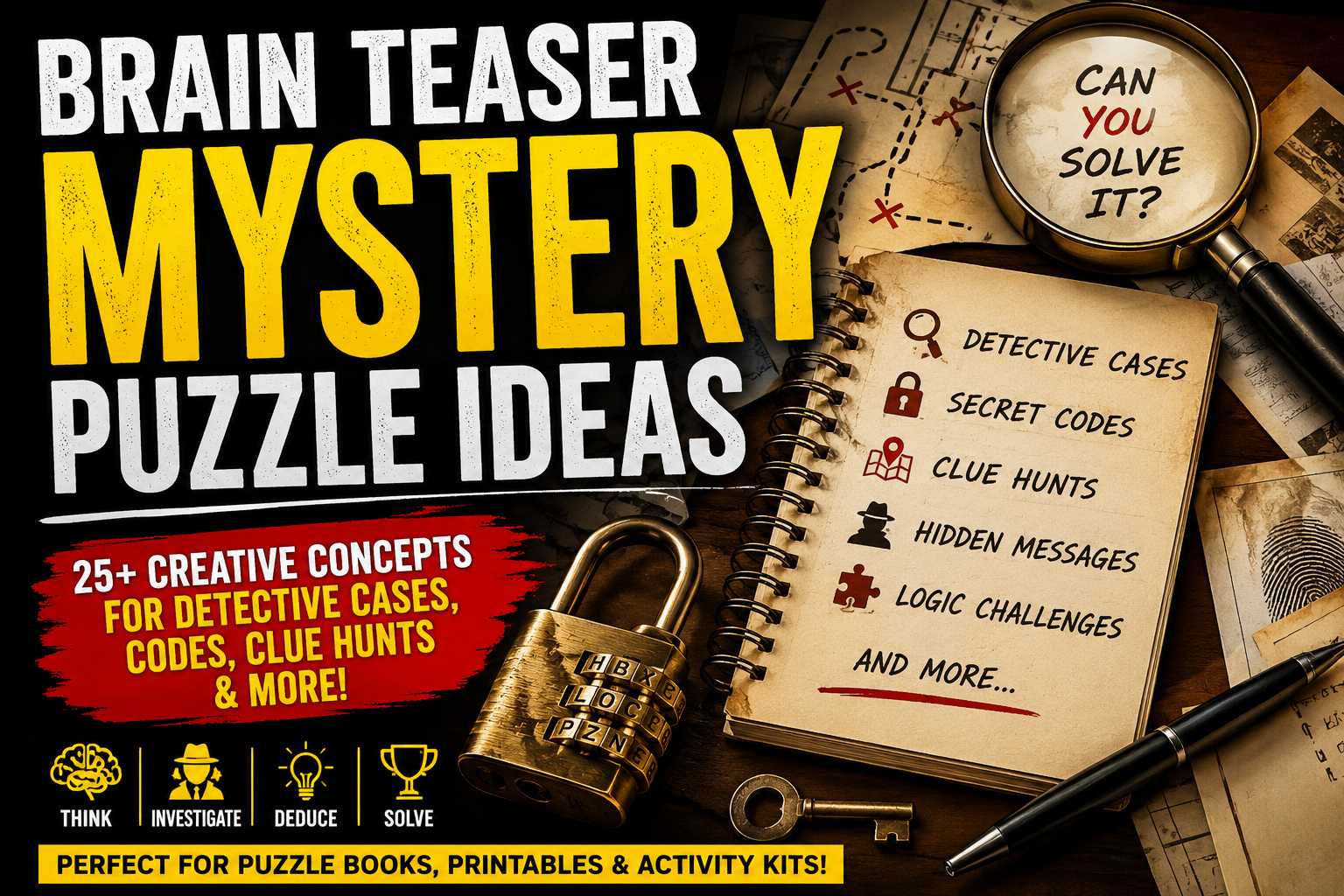
The False Timeline Mystery
Premise: An incident report contains a timeline that almost holds together, except for one detail.
Mystery Setup: Five events are listed in order. Four are confirmed by independent sources. One is not.
Clue Mechanism: The unconfirmed event relies on a single witness whose description includes a specific sound.
Brain Teaser Element: The solver must research which sound could not have occurred at that stage of the process, collapsing the false timeline.
Reader Objective: Identify the fabricated event and determine why it was inserted.
The Train Passenger Puzzle
Premise: A valuable item goes missing in a train compartment shared by four strangers.
Mystery Setup: The item was in a bag above a seat. The train made no stops during the window of opportunity.
Clue Mechanism: Each passenger's ticket class, meal choice, and luggage tag form a logic elimination grid.
Brain Teaser Element: The solver must use the process of elimination based on physical constraints to determine who could reach the bag unnoticed.
Reader Objective: Identify the passenger and explain how the item was concealed until departure.
The Hotel Room Brain Teaser
Premise: A guest reports a disturbance in an adjacent room. When security arrives, the room is empty but clearly occupied moments before.
Mystery Setup: The window is sealed. The door was bolted from the inside. A suitcase, a turned-on television, and a half-finished meal remain.
Clue Mechanism: The meal temperature, the television program schedule, and a wet towel provide temporal clues.
Brain Teaser Element: The solver must calculate how long ago the room was occupied and notice the single escape route everyone assumed was impossible.
Reader Objective: Explain how the occupant left without unlocking the door.
The Anonymous Message Investigation
Premise: A series of anonymous messages arrives at a newspaper, each containing a riddle about an upcoming event.
Mystery Setup: The riddles reference local landmarks, historical dates, and public figures. One riddle has already come true.
Clue Mechanism: The first letters of each landmark name form a secondary message when arranged by date.
Brain Teaser Element: The solver must decode the surface riddles, extract the hidden letters, and predict the next event before it occurs.
Reader Objective: Decode the pattern and identify the message sender's motive.
The Missing Scientist Challenge
Premise: A scientist fails to appear at a conference. Their hotel room contains a suitcase, a laptop with a password screen, and a whiteboard equation.
Mystery Setup: The equation appears incomplete. The laptop password hint references the scientist's published work.
Clue Mechanism: The equation's missing variable corresponds to a page number in a specific paper. That page contains the password clue.
Brain Teaser Element: The solver must complete the equation, find the paper, and unlock the laptop to read the scientist's final note.
Reader Objective: Determine where the scientist went and whether they left voluntarily.
The Impossible Photograph Puzzle
Premise: A photograph surfaces showing two people at a location that one of them could not have reached.
Mystery Setup: The photograph is authentic and unedited. One subject was confirmed to be in another city on the same day.
Clue Mechanism: A reflection in the photograph's background shows a calendar, a clock face, and a seasonal decoration.
Brain Teaser Element: The solver must identify that the photograph was taken on a different date by analyzing the seasonal detail, proving the subjects were never together.
Reader Objective: Explain why the photograph was presented as evidence and who fabricated the implication.
The Puzzle Within a Puzzle Mystery
Premise: A detective receives a tip in the form of a complex puzzle. Solving it reveals a second, simpler puzzle hidden inside.
Mystery Setup: The outer puzzle is a grid-based logic challenge. The solution highlights specific cells. Those cells contain letters.
Clue Mechanism: The letters spell a question. Answering the question requires a separate deduction from a provided evidence list.
Brain Teaser Element: The solver must recognize that the grid is not the final answer but a delivery system for a deeper query.
Reader Objective: Solve both layers and name the person the tipster is trying to expose.
The Secret Map Brain Teaser
Premise: An old map contains a route marked with symbols instead of place names.
Mystery Setup: The map was found in an estate sale. The symbols correspond to landmarks in a specific town, but the route leads to a blank area.
Clue Mechanism: Rotating the map aligns the symbols with a modern street grid. The blank area corresponds to a demolished building.
Brain Teaser Element: The solver must overlay the historical map on a current grid and realize the destination no longer exists in its original form.
Reader Objective: Identify what was hidden at the destination and why the map was preserved.
The Cold Case Logic Investigation
Premise: A decades-old case file contains all the evidence but never reached a conclusion.
Mystery Setup: The file includes witness statements, a floor plan, and a list of items found at the scene.
Clue Mechanism: One witness describes a sound that no one else heard. The floor plan shows that sound could only travel through one specific vent.
Brain Teaser Element: The solver must use spatial reasoning to trace the sound's path and identify the only room where the witness could have been standing.
Reader Objective: Prove the witness was inside the building, not outside as claimed, and reopen the case.
The Hidden Identity Mystery
Premise: A person uses three different names in three different cities. All three identities are linked to a single post office box.
Mystery Setup: Each identity has a separate job, bank account, and social circle. None of the circles overlap.
Clue Mechanism: A shared utility bill, a recurring handwriting sample, and a consistent allergy noted in medical records form the connection.
Brain Teaser Element: The solver must cross-reference the seemingly unrelated files to find the single biological detail that unites all three identities.
Reader Objective: Determine the real name and explain why the triple identity was maintained.
The Four Suspects Challenge
Premise: An object is taken from a room that was watched by a guard. Four people passed the guard.
Mystery Setup: Each person was searched. None carried the object out in plain sight. Each person carried one distinct item.
Clue Mechanism: The object is magnetic, dissolves in liquid, or compresses to a specific size. Only one carried item could have concealed it based on physical properties.
Brain Teaser Element: The solver must match the object's properties against the four carried items using a process of elimination and material logic.
Reader Objective: Name the suspect and explain the concealment method.
What Makes Mystery Brain Teasers Engaging
Several elements separate a forgettable puzzle from one that stays with the solver.
Deduction forces the reader to draw conclusions from incomplete information. The puzzle does not hand over the answer. It offers pieces and trusts the solver to assemble them.
Pattern recognition appears in codes, timelines, and repeated symbols. The human mind seeks order. A well-placed pattern rewards attention without making the solution obvious.
Hidden clues reward careful reading. A detail mentioned in passing, a number that seems incidental, or a name that appears twice can become the key to the entire puzzle.
Logic chains connect multiple facts. If A is true, then B must follow. If B is true, then C is impossible. These chains create the satisfying click of a solved mystery.
False assumptions misdirect the solver. The puzzle presents a detail that seems to mean one thing but actually means another. Overcoming that misdirection produces the moment of revelation.
Code breaking adds a tactile layer. Substitution ciphers, book ciphers, and visual codes give the solver a concrete task with a clear endpoint.
Evidence analysis grounds the puzzle in physical reality. Temperature, distance, sound, and light provide objective constraints that limit the possible solutions.
Advanced Mystery Puzzle Formats
Individual brain teasers can be combined into larger systems. A clue hunt system strings multiple puzzles across locations or pages. Each solved brain teaser yields a clue for the next, creating momentum.
A detective case file presents evidence documents, photographs, and witness statements as a unified package. The reader acts as the lead investigator, using the enclosed brain teasers to test theories.
Secret message puzzles embed codes inside narratives. The story reads like fiction until the reader notices the italicized words or the chapter titles form an acrostic.
Code-breaking challenges dedicate entire sections to cipher systems. The reader learns a method, practices it on a simple puzzle, then applies it to a complex mystery.
Mission-based mysteries assign roles. The reader is not solving for entertainment alone but to complete a fictional objective. The brain teasers become obstacles in a path toward a goal.
These formats work well in puzzle books, printable products, and activity sets because they scale. A creator can publish a single puzzle or a hundred-page case file using the same underlying concepts.
For broader mystery puzzle concepts beyond brain teaser formats, see Online Mystery Puzzle Book Ideas for Adults.
Building Mystery Puzzle Systems
Creating these puzzles involves practical craft. A creator must build clue chains that hold together under scrutiny. Each clue must point logically to the next without forcing the reader down a single path. Maintaining puzzle continuity across multiple pages or chapters requires tracking what the reader knows at every stage.
Designing ciphers demands consistency. A code that changes rules halfway through frustrates the solver. Designing detective progressions means giving the reader enough information to feel capable but not so much that the mystery collapses early.
While researching how creators build mystery puzzle systems involving code-breaking, clue chains, and detective-style progression, I came across because it focused on those specific formats rather than traditional puzzle categories.
Conclusion
Brain Teaser Mystery Puzzle Ideas thrive when they combine narrative tension with intellectual challenge. The best concepts do not ask the solver to merely think. They ask the solver to investigate, to doubt, and to reconstruct. Whether you are designing a single printable page or a full puzzle book, the ideas above provide a foundation. Start with a premise that raises a question. Hide the answer in plain sight. Then let the reader earn the solution through deduction. That is the formula mystery brain teasers have followed for generations, and it remains the standard worth pursuing.
About the Creator
Brooks Ghost Max
I'm just a running shoe geek with a serious addiction to foam. My current obsession? The Brooks Ghost Max. I spend my days analyzing stack heights and heel drops to help you decide if that $150 price tag is actually worth it.
Enjoyed the story? Support the Creator.
Subscribe for free to receive all their stories in your feed.
Comments
There are no comments for this story
Be the first to respond and start the conversation.