
17 Red Flags to Watch For When Hiring an AI Visibility Agency
What smart brands should look for before trusting an agency to measure AI visibility properly

Hiring an AI visibility agency is high-stakes in today’s world of AI-powered search and recommendation systems and choosing the wrong partner can leave you chasing the wrong metrics, missing real buyer influence, or even risking your brand’s reputation.
This article adapts insights from LLM Authority Index’s 17 Red Flags When Hiring an AI Visibility Agency, to help marketing leaders, founders, and strategists separate real value from vanity metrics when evaluating agency partners.
In the fast-evolving landscape of AI-powered discovery, hiring the right AI visibility agency means moving beyond surface-level metrics like mentions or share of voice.
This guide breaks down 17 critical red flags that signal an agency’s reporting may fail to capture whether AI systems actually recommend or positively frame your brand at the moments that drive buyer choice.
- Mentions, share of voice, and generic visibility scores alone do not prove real business value.
- Agencies must distinguish between mere visibility and genuine recommendation quality in AI-generated answers.
- High-intent prompt coverage, sentiment analysis, citation architecture, and competitive displacement are core to proper measurement.
- Red flags include reliance on vanity KPIs, black-box scoring, ignoring negative framing, and failing to connect visibility to commercial outcomes.
- A strong agency should offer transparent methodology, clear definitions, strategic guidance, and prioritized remediation, not just dashboards.
The High Stakes of AI Visibility: Why Measurement Standards Matter
Most brands now compete not only in classic search results, but in AI-generated answers and recommendations on platforms like ChatGPT, Google’s AI Overviews, Perplexity, and others.
Traditional SEO metrics are no longer enough to understand how buyers are influenced in these AI discovery environments.
AI visibility refers to how a brand appears in AI-generated answers being seen, mentioned, or cited. But appearing in answers isn’t the same as being recommended, ranked favorably, or trusted. The real goal is for AI systems to guide buyers toward your brand at scale and at critical decision points.
Too many agencies, however, promise results based only on surface-level “vanity KPIs” metrics that look good in a dashboard but don’t truly measure buyer influence or commercial impact.
For the broader framework behind this shift, read What Is LLM Discovery Intelligence?, which explains how AI platforms discover, rank, compare, and recommend companies before the click ever happens.
Red Flags That Signal Superficial AI Visibility Reporting
The LLM Authority Index identifies 17 red flags that should trigger skepticism when evaluating an AI visibility or AI SEO agency. Here are some of the most common:
1. Counting Mentions as Success
Treating every mention as a positive is misleading. Mentions can be negative, irrelevant, or cautionary. The agency should classify sentiment and recommendation status for every mention, not just tally up appearances.
2. Focusing on AI Share of Voice as the Main KPI
Share of voice (how often you’re mentioned compared with competitors) is diagnostic, not a business outcome. A high share of voice alone doesn’t reveal whether your brand is actually recommended or preferred in buyer scenarios.
3. Ignoring Sentiment and Framing
Not distinguishing positive, neutral, and negative answers can mask serious brand risks. Negative or cautionary mentions should not be counted as visibility wins.
4. Reporting Prompt Rank Without Context
Being listed first doesn’t always mean first choice. Agencies must distinguish between appearance and genuine recommendation in AI answers.
5.Blending Low-Intent and High-Intent Prompts
If an agency combines mentions from broad informational prompts with decision-stage (“best,” “vs.,” “alternatives”) prompts, you won’t know where you actually influence buyers.
6. Using Opaque Visibility Scores
Black-box scores can bundle together mentions, rank, citations, and presence without clarity. If the agency can’t explain the score’s components, it shouldn’t be trusted as a KPI.
7. Relying on Monitoring Without Remediation
A dashboard showing negative framing or competitive loss is only useful if paired with actions to improve the evidence AI systems retrieve.
What Strong AI Visibility Measurement Should Include
To avoid these risks, the best agencies anchor their measurement on evidence-based, commercially meaningful signals:
1. Recommendation Quality
Does the AI system actually recommend your brand, not just mention it?
2. AI Recommendation Share
In how many relevant answers is your brand the recommended or preferred option versus competitors?
3. Top-3 Recommendation Presence
Are you consistently among the most trusted options in AI decision moments?
4. Buyer-Intent Prompt Coverage
Does your brand show up not only in general prompts, but in those that mirror real buyer decision-making?
5. Sentiment-Gated Visibility
Is your visibility mostly positive or does it include negative, cautionary, or competitor-favoring mentions?
6. Citation Architecture and Source Influence
Which types of sources (official pages, reviews, directories, comparisons) are shaping how AI answers form opinions about your brand?
7. Answer Accuracy Auditing
Do claimed features, pricing, or evaluations about your brand reflect reality, or are outdated or hallucinated answers putting you at risk?
8. Competitive Displacement Analysis
Where do AI answers favor competitors, and what’s driving those patterns?
9. Transparent Methodology
Can the agency clearly explain the models, prompts, scoring, and limitations in their analysis?
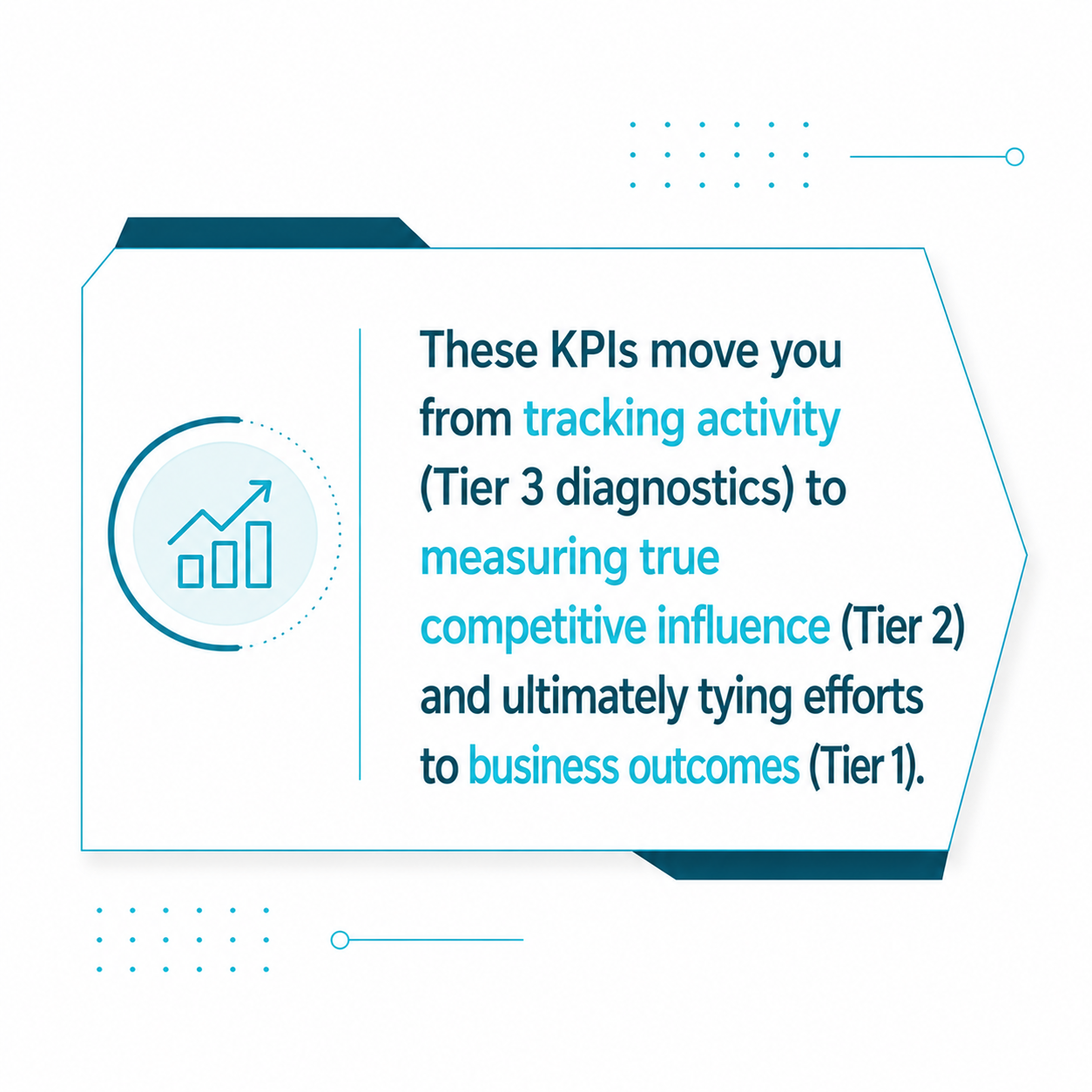
These metrics move your reporting from surface-level diagnostics (mentions, share of voice) to actionable signals that map to real business outcomes: qualified demand, pipeline movement, win-rate, and revenue influence.
To understand the competitive layer most traditional reporting misses, read the hidden layer of search, which explores how AI-driven discovery shapes buyer preference upstream of website visits.
Key Questions to Ask Before Hiring an AI Visibility Agency
Before you sign with any provider, ask these essential questions to assess their rigor and strategic fit:
- How do you distinguish mere mentions from actionable recommendations?
- Do you track and report sentiment, not just presence?
- What process do you use for selecting and segmenting prompt types? Do you focus on high-intent buyer queries?
- How do you measure source influence and citation architecture?
- Can you show where and why competitors are winning in AI answers?
- How do you track and report answer accuracy or brand-risk issues like hallucinations?
- Can you explicitly tie your findings to qualified demand, pipeline, or revenue outcomes?
- What limitations or uncertainties exist in your measurement and how transparent are you about them?
- What specific remediation actions will you recommend based on your findings?
A reputable agency should be able to answer these questions confidently and welcome your scrutiny.
The LLM Authority Index Approach: Buyer-Choice Intelligence, Not Vanity KPIs
LLM Authority Index positions itself as a measurement, reporting, and intelligence layer distinct from generic SEO, PR, or content shops. It’s built around a core distinction:
- Standard AI reporting asks: “Were you seen?”
- LLM Authority Index asks: “Did AI help the buyer choose you, or a competitor?”
This means their frameworks prioritize:
- Presence in decision-stage, high-intent prompts
- Positive recommendation rate and AI Recommendation Share
- Real sentiment and competitive context
- Source-layer mapping for citation and evidence influence
- Actionable, transparent measurement tied wherever possible to business value
Directional campaign results cited by LLM Authority Index show that improvements in evidence-layer sources and community signals can shift AI answer behavior but the goal is not more mentions.
It’s better recommendations, improved buyer influence, and measurable progress where it matters.
The Bottom Line: Measure What Matters
Selecting an AI visibility agency is one of the most strategic decisions a brand can make in the new era of AI-powered discovery.
Agencies that report only on mentions, share of voice, or generic visibility are not capturing the moments where AI influences real buyer decisions.
Move past vanity KPIs. Demand strategic, transparent measurement that focuses on recommendation quality, high-intent prompts, sentiment, source influence, answer accuracy, and business value.
Only then can you ensure that your investments in AI visibility lead to actual buyer impact.
About the Creator
Linda Villar
Data nerd turning complex metrics into compelling narratives. Exploring the 'how' and 'why' behind success stories.
Enjoyed the story? Support the Creator.
Subscribe for free to receive all their stories in your feed.
Comments
There are no comments for this story
Be the first to respond and start the conversation.