
15 Movie Mystery Puzzle Book Ideas Beyond Word Searches and Sudoku
Creative detective cases, spy missions, clue hunts, and cinematic puzzle concepts readers won't forget.
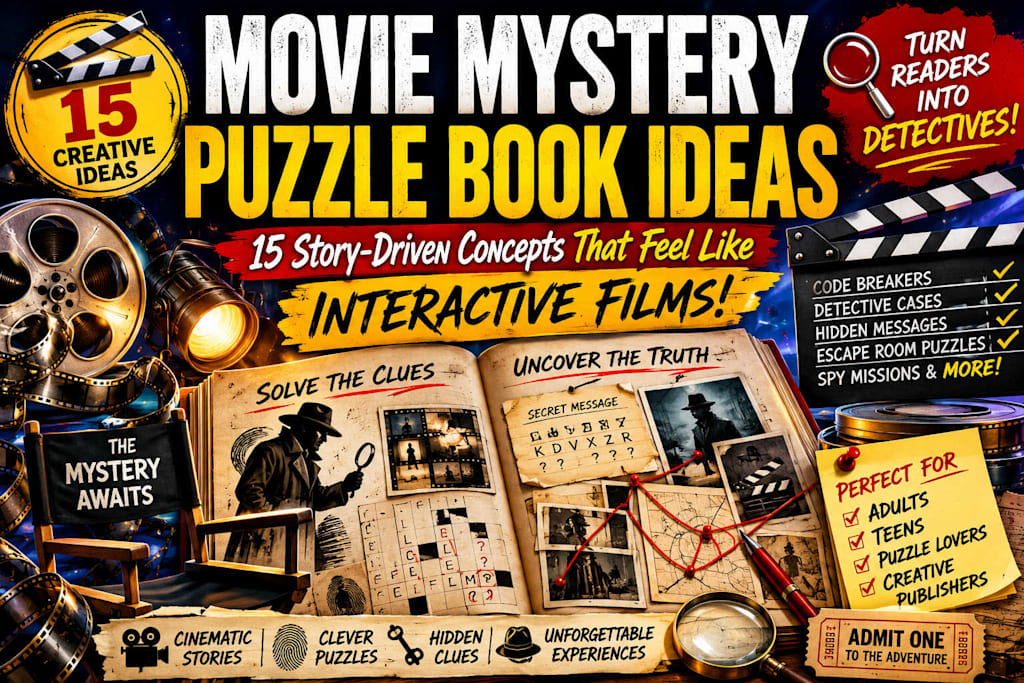
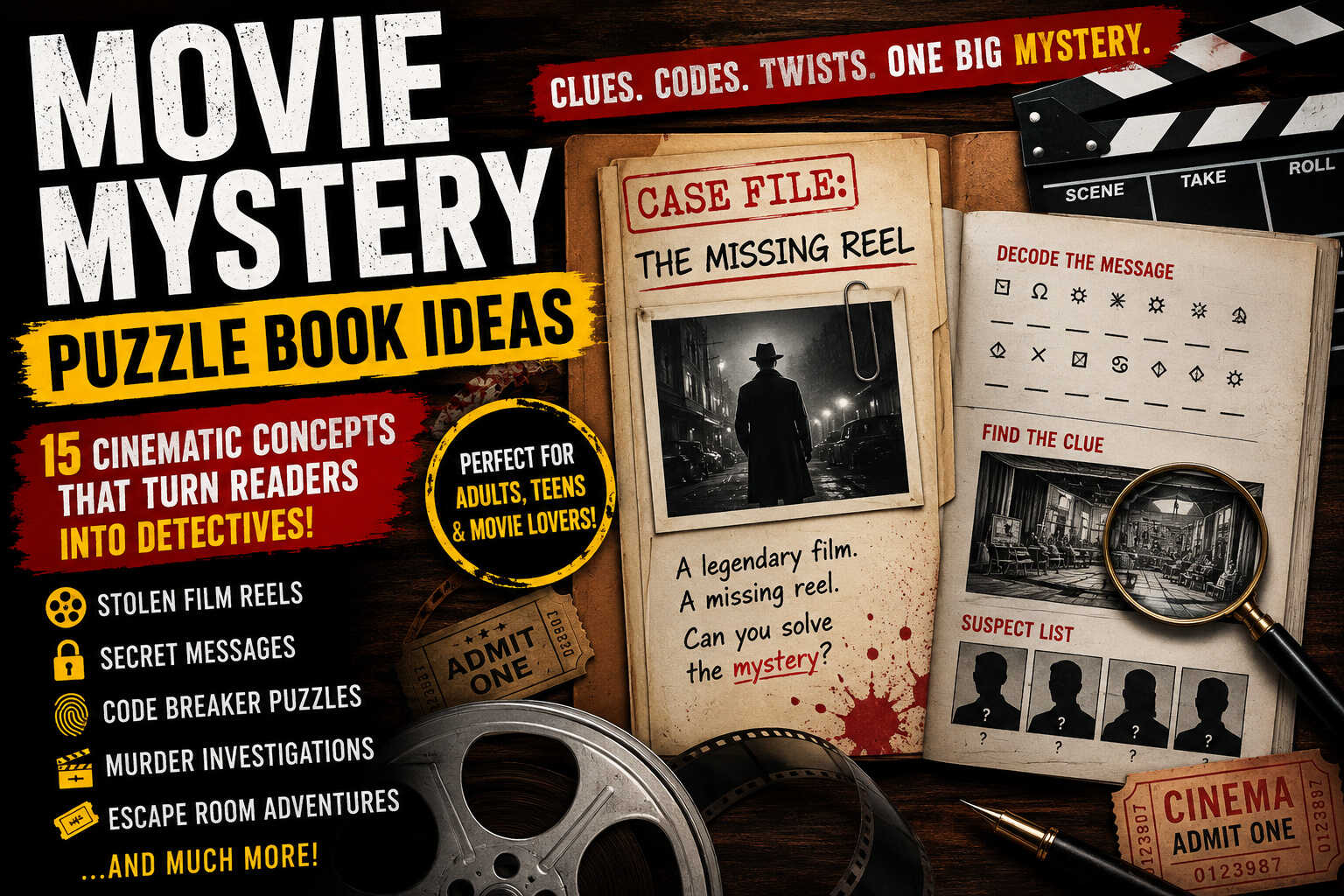
Most puzzle books fall back on the same predictable formats. Word searches, sudoku, fill-ins, and crosswords dominate the shelf because they are easy to produce and familiar to solvers. There is nothing wrong with these formats, but they rarely ask the reader to think like a detective, follow a narrative thread, or piece together a larger story. A movie-themed mystery puzzle book changes that dynamic entirely. By borrowing the structure of cinema plots, suspects, props, locations, and hidden messages these books turn passive solving into active investigation. The reader is no longer just finding words or filling grids. They are hunting for clues, decoding ciphers, and advancing a story.
Movie Mystery Puzzle Book Ideas
Missing Film Reel Mystery
The core concept centers on a legendary film that was never released because its final reel disappeared the night before the premiere. Readers take on the role of a film historian hired to recover the missing footage. Puzzle types include editing room floor plans that require spatial reasoning, continuity error spot-the-difference pages drawn from fake film strips, and timeline reconstruction puzzles where readers order production photos to reveal a hidden location.
The clue structure chains across chapters: a scratched film canister yields a partial address, which leads to a prop warehouse inventory puzzle, which reveals a combination to a fictional safe. The reader experience feels like digging through studio archives, with each solved layer bringing them closer to the vault where the reel was hidden.
Classic Hollywood Detective Case
Set in the golden age of studio systems, this concept places the reader as a private investigator hired by a reclusive actress who believes someone on the lot is sabotaging her career. Puzzle types include black-and-white publicity photo cipher grids, costume department inventory cross-referencing, and dialogue transcript puzzles where certain words spell out threats when read vertically. The clue structure relies on studio employee files and call sheets.
A fake telephone directory puzzle requires readers to match extensions to departments, uncovering which employee had access to the actress's dressing room. The reader experience channels noir atmosphere, with each chapter ending on a cliffhanger that pushes the investigation deeper into studio politics.
Movie Studio Crime Investigation
A major studio has suffered a string of thefts, and the insurance investigator's report has been redacted. Readers must reconstruct the case. Puzzle types include evidence bag logic grids, security badge maze puzzles that trace suspect movements through studio gates, and financial ledger math challenges that expose irregular payments.
The clue structure uses a case board format: readers collect suspect cards throughout the book, each card containing partial alibis that only make sense when compared side by side. The reader experience mimics building an actual investigation wall, with string and pushpins replaced by connected puzzle solutions.
Secret Script Puzzle Adventure
An unproduced screenplay contains real-world secrets hidden in its stage directions and dialogue. Readers play the role of a script reader who notices the anomalies. Puzzle types include formatting-based ciphers where indentation or font changes reveal coordinates, character name anagrams that decode to real locations, and scene numbering sequences that function as lock combinations.
The clue structure follows a three-act structure mirroring the screenplay itself: Act One puzzles establish the code system, Act Two puzzles complicate it with fake scenes designed to mislead, and Act Three puzzles demand readers apply everything they have learned. The reader experience blends literary analysis with code-breaking.
Film Festival Murder Mystery
A juror at an international film festival is found dead in a screening room, and the killer left puzzles instead of fingerprints. Readers step in as the detective assigned to protect the remaining jurors while identifying the murderer. Puzzle types include festival schedule logic puzzles that establish opportunity, foreign film subtitle ciphers that hide threatening messages, and audience seating chart deduction grids.
The clue structure rotates through screening rooms, hotel key cards, and after-party guest lists. Each solved puzzle unlocks a new suspect interview transcript. The reader experience carries the urgency of a ticking clock, with festival events providing natural chapter breaks.
Spy Movie Code Breaker Challenge
This book adopts the tone of a Cold War espionage thriller. Readers are a signals intelligence analyst who discovers that several classic spy films contain actual coded messages embedded in their marketing materials. Puzzle types include movie poster microprint reading puzzles, trailer transcript keyword ciphers, and gadget blueprint assembly challenges that reveal drop-site coordinates.
The clue structure operates on a dead-drop model: solutions from even-numbered chapters provide keys needed to unlock odd-numbered chapters, forcing readers to maintain a running toolkit of decoded information. The reader experience feels like operating behind enemy lines, with misdirection puzzles designed to mimic double-agent trickery.
Movie Set Escape Room Puzzle Book
Readers are trapped on a closed movie set overnight and must solve their way out before the production company demolishes the building in the morning. Puzzle types include set design blueprint navigation puzzles, lighting rig circuit logic challenges, and green screen overlay puzzles where readers match backgrounds to foreground props to reveal hidden numbers.
The clue structure is spatial: the set is divided into distinct locations (the apartment set, the alley set, the diner set), and each location contains a key or code needed to access the next. The reader experience replicates the tactile, sequential pressure of a physical escape room.
Lost Director's Notebook Mystery
An avant-garde director kept a notebook full of sketches, shot lists, and cryptic symbols that supposedly reveal where her final masterpiece was hidden. Readers are an archivist tasked with interpreting the book. Puzzle types include storyboard sequencing puzzles that expose hidden images when arranged correctly, lens and camera setting math puzzles that decode to map coordinates, and symbol-matching grids drawn from the director's personal iconography.
The clue structure layers meaning: early puzzles teach the director's visual language, which readers must fluently read by the final chapters. The reader experience feels like learning to see through another person's artistic vision.
Stolen Award Investigation
On the night of a major awards ceremony, the statuettes are replaced with fakes. Readers work as the head of security trying to recover the originals before the broadcast ends. Puzzle types include red carpet arrival timeline logic puzzles, acceptance speech word-count ciphers that spell out locker numbers, and backstage pass routing challenges that trace who had access to the storage room. The clue structure follows the physical path of the awards: from engraving station to rehearsal stage to presenter holding area. The reader experience carries the glamour and pressure of a live event.
Cold Case Movie Star Mystery
A beloved actor died decades ago under circumstances ruled accidental, but a box of personal effects suggests otherwise. Readers are a journalist reopening the investigation. Puzzle types include prescription label math puzzles that expose dosage inconsistencies, fan letter anagrams that reconstruct threatening communications, and newspaper clipping redaction recovery puzzles where readers use context clues to guess missing words. The clue structure spans two timelines: the past, revealed through recovered documents, and the present, revealed through new interviews. The reader experience balances nostalgia with creeping dread as the accidental death theory unravels.
Before sound, filmmakers sometimes embedded messages in intertitle cards and film splicing patterns. Readers are a film preservationist who discovers these hidden communications form a confession. Puzzle types include intertitle card word-substitution ciphers, frame-counting math sequences derived from film strip measurements, and organ sheet music note puzzles that translate to letters. The clue structure honors silent film grammar: visual storytelling means puzzles rely heavily on image manipulation, sequence, and visual metaphor rather than audio cues. The reader experience feels like restoring history while simultaneously uncovering a buried secret.
Movie Prop Clue Hunt
A legendary prop house is closing, and among the thousands of items, several were used as dead drops in an unsolved smuggling operation. Readers are the liquidation specialist who finds the first clue taped to the underside of a fake Roman helmet. Puzzle types include prop catalog cross-reference puzzles, material authenticity tests that use simple chemical logic puzzles to identify fakes, and set photograph background detail hunts where readers zoom in on specific shelf numbers. The clue structure is object-driven: each prop leads to another prop via inventory numbers, fake blood formulas, or manufacturer stamps. The reader experience feels like wandering through a museum where every object might be evidence.
Undercover Actor Mission Book
An intelligence agency used a touring theater troupe as cover during the 1970s. Readers are the agency historian declassifying the mission files. Puzzle types include playbill cast list logic puzzles that identify which actors were actually agents, rehearsal schedule grid puzzles that establish covert meeting times without using explicit times (encoded as scene numbers), and prop weapon inventory challenges where real and fake items must be separated using specification sheets. The clue structure alternates between performance documents and field reports, requiring readers to cross-reference two different paper trails. The reader experience blends theatrical drama with operational tradecraft.
Red Carpet Detective Files
A series of high-profile jewelry thefts always happen during premieres, and the thief leaves a calling card disguised as a fashion accessory. Readers are the lead detective on the case.
Puzzle types include seating chart proximity puzzles that establish who could have passed the stolen items, designer label anagrams that decode to storage locations, and flash photography reflection puzzles where readers analyze fake paparazzi photos for background clues. The clue structure follows the social hierarchy of celebrity events: after-party invitations, VIP room access codes, and limousine route maps. The reader experience captures the public spectacle of fame while operating a methodical investigation beneath it.
Movie Production Sabotage Mystery
A big-budget blockbuster is bleeding money because equipment keeps failing at critical moments. Readers are the production auditor brought in to determine whether the cause is incompetence or deliberate sabotage.
Puzzle types include budget spreadsheet discrepancy hunts, call sheet logic puzzles that reveal unauthorized personnel on set, and stunt sequence timing grid puzzles that expose when equipment was tampered with. The clue structure builds toward a chain of custody puzzle: readers must trace a specific piece of faulty equipment from manufacturer to set, identifying every hand it passed through. The reader experience feels like corporate detective work with blockbuster stakes.
Why Movie-Themed Mysteries Work
Movie-themed mysteries succeed because cinema already trains audiences to follow complex narratives. Viewers are accustomed to tracking multiple characters, interpreting visual symbols, and anticipating twists. A puzzle book that borrows this grammar feels immediately intuitive. Story progression gives puzzles a reason to exist. When a reader decodes a cipher, they are not just solving for the sake of completion; they are advancing a plot. Character involvement creates emotional stakes. If a reader believes a fictional actress's career is in jeopardy, the logic grid ceases to be an abstract exercise and becomes a protective measure. Clue chains reward sustained attention.
Unlike standalone puzzles, a movie mystery can plant a detail in Chapter Two that only pays off in Chapter Eleven, mirroring the screenwriting technique of planting and payoff. Secret messages embedded in scripts, posters, or props feel plausible because movies are already dense with deliberate design choices. Code-breaking puzzles gain authenticity when they are framed as production secrets or studio security measures.
Investigations naturally suit the visual, location-based thinking that movies encourage. Readers are already used to studying frames for meaning. Escape room structures translate directly from cinematic set design. Reader immersion deepens when the book acknowledges the artificiality of cinema and turns it into a puzzle mechanic spotting continuity errors, analyzing stage directions, or reconstructing deleted scenes.
Practical Creation Challenges
Building these books requires more than a collection of unrelated brain teasers. The creator must construct clue sequences that actually sequence. A cipher introduced in an early chapter needs a clear key, and that key must be discoverable through fair puzzle logic rather than arbitrary guessing. Creating ciphers that are challenging but solvable demands testing. A substitution cipher based on film reel numbers works only if the reel numbers appear naturally in the narrative and if the resulting message is verifiable.
Maintaining story continuity across fifteen or twenty puzzle spreads means tracking details carefully. If a character's alibi depends on a call sheet from Chapter Four, that call sheet cannot contradict the security badge puzzle in Chapter Nine. Designing detective-style progression means giving readers the sensation of accumulation. They should feel like they are collecting evidence, not simply turning pages. This requires a case-file structure, recurring visual motifs, and puzzles that reference previous solutions.
For broader mystery publishing concepts beyond movie themes, I previously explored Online Mystery Puzzle Book Ideas for Adults.
While researching how creators build movie-style mystery books with ciphers, clue hunts, and detective structures, I came across because it focused on code-breaking, mission-based puzzles, and mystery-style activity creation. It offers a look at how structured mission formats can be adapted into book-length puzzle experiences. The challenge for any creator is translating that structural energy onto the page while keeping the reader's pen moving through clues, codes, and cinematic secrets.
About the Creator
Brooks Ghost Max
I'm just a running shoe geek with a serious addiction to foam. My current obsession? The Brooks Ghost Max. I spend my days analyzing stack heights and heel drops to help you decide if that $150 price tag is actually worth it.
Enjoyed the story? Support the Creator.
Subscribe for free to receive all their stories in your feed.
Comments
There are no comments for this story
Be the first to respond and start the conversation.