
Why Some Societies Succeeded While Others Did Not
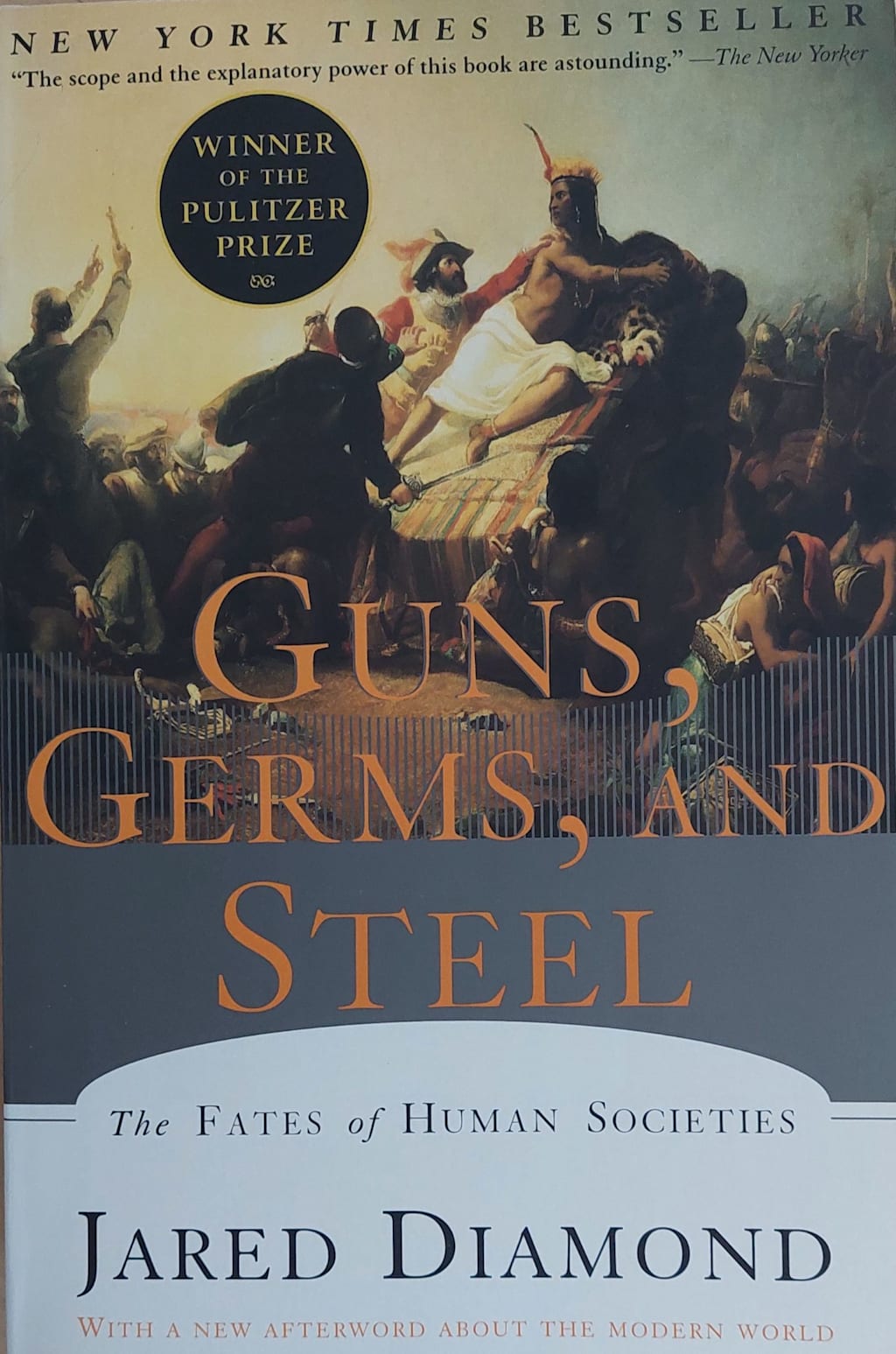
Jared Diamond beautifully developed an idea in his magnum opus, ‘Guns, Germs, and Steel’

There has always been a debate about why some countries are rich while others are poor. Scholars have long sought to answer this profound question.
This seems like a big question, but it was the first time an ordinary person from Papua New Guinea had posed it.
Yes, it was famously posed by Yali, a local leader from Papua New Guinea, to the American ornithologist Jared Diamond.
Jared Diamond beautifully developed this idea in his magnum opus, ‘Guns, Germs, and Steel’, where he links a nation’s prosperity to the long history of human civilisation.
In this Pulitzer Prize-winning book, Jared rejects racial myths and reveals how environmental luck shaped human destiny.
Drawing on evidence from the past 13,000 years, the book is rich with data and careful reasoning.
Why was Eurasia endowed with power and wealth while other continents experienced conquest and displacement?
Jared argues that the answer lies not in biology, but in geography and climate.
Eurasia’s East-West axis enabled the rapid spread of crops, livestock and technologies across similar latitudes, giving its societies a lasting advantage in food production and development.
On the other hand, in the Americas and Africa, vast climatic barriers such as deserts and dense jungles along a North-South axis restricted the expansion of agriculture.
Furthermore, access to domesticable wild plants such as wheat and rice, along with large mammals like cows, horses, and pigs, gave some societies a massive head start.
These resources created reliable food surpluses and provided animal power for labour and transport.
When a society can grow more food than it needs to survive, not everyone needs to be a farmer.
These surpluses allowed inventors, soldiers, bureaucrats, and writers to emerge. These people ultimately developed the Guns and Steel that shaped history.
Eurasians also developed immunity to many diseases, such as smallpox and measles, which originally jumped from animals to humans.
When these germs were carried to other continents, they devastated indigenous populations, in some cases killing up to 90%.
However, the book has received considerable criticism.
Historian James Blaut argues that “Diamond underestimates the role of politics, economics, and ideology in shaping historical outcomes. Geography alone cannot capture the nuances of leadership and cultural adaptation.”
Nevertheless, Diamond’s ideas remain relevant today, especially as we continue to grapple with global inequality, climate change, and the challenges due to globalisation.
In contrast to Diamond’s claim, Daron Acemoglu and James A. Robinson, in their book ‘Why Nations Fail’, have given more importance to institutions that provide broad access to economic opportunities, protect property rights, encourage investment and innovation, and allow citizens to participate meaningfully in political decision-making.
They further argued that societies with such inclusive institutions are better positioned to generate sustained economic growth, whereas extractive institutions tend to concentrate political and economic power in the hands of a narrow elite, ultimately constraining long-term development.
This means that unsuccessful societies failed to develop inclusive institutions, thereby limiting their capacity for sustained economic growth and long-term prosperity.
In conclusion, while the book powerfully explains deep prehistory, it gives superficial attention to colonialism, capitalism, slavery, and imperial exploitation, risking a diminished sense of moral responsibility.
If you are keen to understand the evolutionary history of human societies and have not yet read this book, I highly recommend it.
I am confident that it will offer deep insights into the subject and spark a strong interest in the field.
Jared Diamond is also the author of the following books:
The Third Chimpanzee: The Evolution and Future of the Human Animal (1992)
Why Is Sex Fun? (1997)
Guns, Germs, and Steel: The Fates of Human Societies (1997)
Collapse: How Societies Choose to Fail or Succeed? (2005)
Natural Experiments of History, with James A. Robinson (2010)
The World Until Yesterday: What Can We Learn from Traditional Societies? (2012)
The Third Chimpanzee for Young People: The Evolution and Future of the Human Animal (2015)
Upheaval: How Nations Cope with Crisis and Change (2019)
If you found this worth reading, even a small gesture of support means a lot.
(This story was originally published on Medium.com)
About the Creator
Krishna Babu Shrestha
Ecologist by training, nature lover by instinct. Trying—always—to live with empathy and ethics.
I write about personal growth, happiness, and human potential, as well as the environment and ecology.
Enjoyed the story? Support the Creator.
Subscribe for free to receive all their stories in your feed.
Comments
There are no comments for this story
Be the first to respond and start the conversation.