Sustainability
The Entrepreneurial Landscape in the Face of Climate Change: Challenges and Opportunities
Introduction Climate change has emerged as one of the most pressing global challenges of our time, affecting various aspects of society, including the business world. Entrepreneurs, who are known for their adaptability and innovation, are finding themselves at the forefront of dealing with the impacts of climate change. This article delves into the ways in which climate change affects entrepreneurs, highlighting the challenges they face and the opportunities that arise from this changing landscape.
By kathy rich3 years ago in Earth
From City Life To Off-Grid Homesteading
Hailing from Las Vegas, a place of glitz and glam, I never fathomed that I would become the proprietor of a plot of land and dwell off the grid. Yet, here I sit in my abode in Cambodia, enveloped by the fruitful results of my toil. It has been an arduous voyage to reach this point, replete with ebbs and flows, but every instant has been worth it. Even now, at any given juncture, should I so desire, I can readily board a plane and find myself back in my humble abode in Las Vegas.
By Freddie's Lost Treasures3 years ago in Earth
IonBoost: Unveiling the Power of Negative Ions with the Ultimate Well-Being Sticker
If you believe to have various beneficial effects on human health and well-being. Click here now. In a world dominated by technology and urban lifestyles, it's easy to forget the importance of nature's delicate balance. Our ancestors thrived in environments teeming with fresh air, lush landscapes, and natural energy sources. Among these sources, negative ions stand out as a hidden gem, and IonBoost has harnessed their potential to bring you a groundbreaking innovation for enhanced well-being.
By Haris Shakeel3 years ago in Earth
A Man Who Nearly Drowned in the Sky
Introduction In the vast expanse of our world, there are stories that defy explanation and push the boundaries of human experience. One such tale revolves around a man who found himself in an unimaginable situation—a situation where he nearly drowned in the sky. This gripping account of survival and courage showcases the indomitable human spirit and the will to overcome even the most daunting challenges.
By Divine Dawn3 years ago in Earth
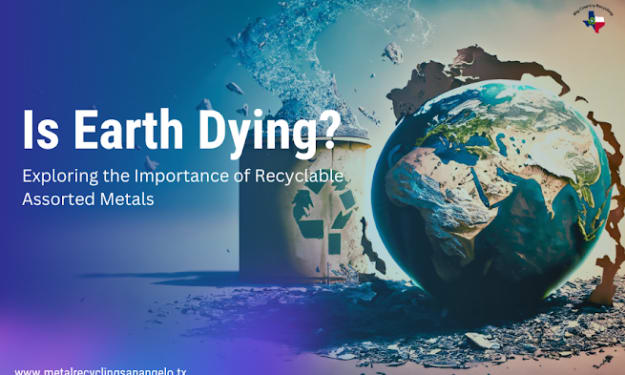
Is Earth Dying?
Introduction The state of our planet has become a topic of increasing concern in recent years. From climate change to pollution, we are witnessing the potential consequences of human activity on Earth. One significant contributor to these issues is the improper disposal and mismanagement of scrap metals. Through this article, we dive into the problems caused by scrap metals and highlight the importance of metal recycling as a solution to mitigate the damage and preserve our planet for future generations.
By Metal Recycling3 years ago in Earth
Water Balancing in Industrial Settings: Enhancing Efficiency and Reducing Environmental Impact
Water is a valuable resource, and responsible water management is crucial in industrial settings. As industries worldwide continue to grow, it becomes increasingly important to optimise water usage, minimise waste, and reduce environmental impact. This blog post explores the significance of water balancing in industrial applications, highlighting strategies for enhancing efficiency and sustainability.
By David Jhon3 years ago in Earth
The Healing Garden
In the heart of the bustling city, where the relentless rhythm of life often left people feeling disconnected and worn, lived a woman named Lily. Lily was a quiet soul, deeply moved by the beauty of nature and the solace it offered amidst the chaos. She had always believed that a touch of greenery could mend even the most weary of hearts.
By Samuel Onudu3 years ago in Earth
Nostalgia and Change
Amelia stood on the rocky cliff overlooking the once-majestic valley. The vibrant hues of green that had once adorned the landscape had faded to muted shades of brown and gray. The once-gushing river now resembled a mere trickle, struggling to meander through the parched earth. It was a sight that tore at Amelia's heart, evoking a powerful mix of nostalgia and sadness.
By Abdulqayyum Bolaji Alao3 years ago in Earth
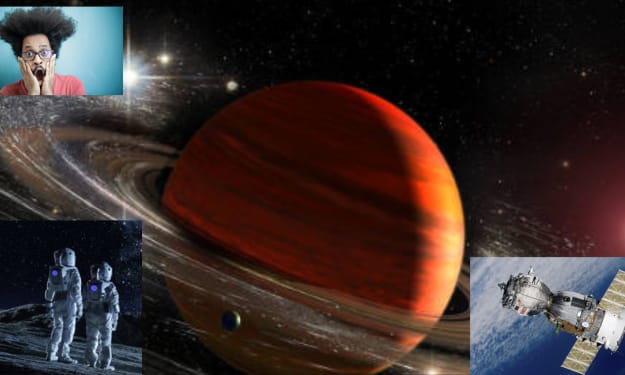
Imagine a scenario in which people attempted to land on Saturn
In 2017, NASA's Cassini probe sent us our closest view of Saturn as it dove into the planet's stormy atmosphere. And the results were stunning. But what would it be like if humans made the journey in person? At its closest, Saturn is 1.2 billion kilometers away from Earth. So with today's spacecraft technology, you'll need about eight years to make the trip. Finally, you arrive and get your first glimpse of Saturn with your own eyes. It's an enormous planet, the second largest in the solar system. In fact, over 760 Earths can fit inside. But hold up. We can't visit Saturn and skip over the best part, its iconic rings. Saturn's rings are almost as wide as the distance between the Earth and the moon, so at first glance, they seem like an easy place to land and explore on foot. Except there's one problem. While they look like giant discs, they're not a solid track at all. Instead, they're made of millions of chunks of ice, some as tiny as dust particles, others as large as buses. But if you were able to hike on one of Saturn's outermost rings, you'll walk about 12 million kilometers to make it around the longest one. That's about 15 round trips from the Earth to the moon. Along the way, you'll come across tiny moons and spokes of dust levitating above the surface. Now, you might notice that streams of tiny ice particles are also flying off the rings, heading towards Saturn. That's ring rain. It turns out, Saturn's magnetic fields are slowly but surely draining away the rings, so we're lucky to visit the rings now, because every 30 minutes, they lose enough water to fill an Olympic-sized swimming pool, and if we arrived 300 million years in the future, we'd miss them entirely. Now, let's climb back aboard and visit the planet itself, 282,000 kilometers away. As we reach the north pole, we'll notice a slight problem with our plan to land on the surface below. There is no surface below. Saturn's made almost entirely of hydrogen and helium gas, which is why it's called a gas giant. 4,000 kilometers above the surface, we hit Saturn's upper atmosphere. As we plummet through the north pole, we'll be treated to the sight of a magnificent aurora, like the ones we see in Alaska. It turns out, Saturn's magnetic field generates huge electrical currents, which heat up the atmosphere at the poles. Unfortunately, the electrical activity within this aurora can disrupt our ship's electronics and navigation system, so best marvel at a distance. Next, we'll hit the troposphere, the part of the atmosphere where weather happens. So watch out, powerful winds may slam into us at nearly 400 meters per second. That's over three times faster than the strongest hurricanes on Earth. All around us, thick yellow clouds give the planet its color. These are filled with ammonia crystals. If you take a sniff, you might be able to smell that distinctive scent, but you should probably keep the window closed. Ammonia is very irritating and could wreak havoc on your respiratory system. Plus, it's freezing out here, reaching as low as minus 250 degrees Celsius, much colder than the East Antarctic Plateau, the coldest place on Earth. So let's head down where it's a bit warmer. Down here, at a depth of 300 kilometers, we reach a layer of water, which is a balmy 0 degrees Celsius. Now, the deeper we plunge, the higher the pressure is around us. And in this next layer, the pressure is so high, it forces those liquid water molecules together, creating solid ice. That ice mixes in with surrounding gasses, so get ready to fight through a flurry of hail. Hopefully, the ice won't shred our ship to pieces, but if we make it through, get ready to go for a swim. Because 1,000 kilometers into the interior, the pressure is so high, it forces hydrogen molecules together into a liquid, which doesn't bode well for us, since even the sturdiest submarine would be crushed in these conditions. And if we somehow survive to reach the next layer, we'll hit yet another obstacle. A layer of liquid metallic hydrogen. The problem here is that this metal can conduct electricity, so even if our navigation equipment and electronics escape the aurora upstairs, it's probably down for the count now. But if we could survive here, our final stop might uncover a mystery in the deepest depths of Saturn. You see, scientists suspect Saturn has a core made of iron and nickel, but they're not sure if it's liquid, like the previous layer, or solid, like Earth's core. So maybe we'll be the lucky ones to find out once and for all. Though, it's over 83,000 degrees Celsius in here, hotter than the surface of the sun and hot enough to dissolve our spacecraft with us inside! Hm. Maybe we should leave the Saturn exploration to unmanned probes after all.
By Mayleen Rosa3 years ago in Earth