Sustainability
Democracy and Monarchy
Nations' fates have been influenced by the rise and collapse of various forms of government throughout political history. The world over, a prominent trend of the past few years has been the decline of democratic norms and the rise of monarchical tendencies. This change, which is sometimes referred to as "The Demise of Democracy and the Return of the King," has provoked a great deal of discussion and anxiety among academics, decision-makers, and general public. This essay aims to investigate the reasons for the deterioration of democracy and the return of monarchical values, with a global analysis of the consequences. Throughout the 20th century, democratic ideas expanded quickly as more countries came to embrace the values of individual rights, representative government, and the rule of law. However, as democracies confront both internal and external threats that threaten their fundamentals, the 21st century has witnessed a disturbing reversal of this tendency. The rise of authoritarian leaders around the world is one of the main causes of democracy's downfall. Strongman politics, which are defined by a single leader holding all the power, are becoming more and more common in many parts of the world. The durability of democratic regimes is seriously threatened by leaders who take advantage of populist emotions and subvert democratic institutions. A free press, a strong civil society, and engaged public engagement are essential to democracies. Regretfully, in many democracies, there has been an obvious decline in civic values. The democratic fabric has been undermined by polarization, disinformation, and a decrease in political participation, making societies more susceptible to manipulation. Digital technology has transformed communication, but it has also presented new difficulties for democratic processes. Democracies are now vulnerable to unanticipated risks due to the manipulation of information through social media, cyber warfare, and the use of advanced technologies to suppress opposition. A noticeable return to monarchical ideals has been observed in the face of these difficulties, with several countries indicating a revived interest in centralized and authoritarian forms of government. The modern expression of this trend indicates a desire for strong, centralized leadership, even though it does not represent a return to historical monarchy. Monarchical proponents believe that stability and effectiveness in government may be achieved by a single, powerful person. People who find democratic processes too slow may find the apparent decisiveness of a monarchical leader appealing in a world where crises demand quick responses. A common national identity and continuity symbol is the monarch. People may look to monarchical characters as representations of tradition and stability during uncertain times. In the face of globalization and the difficulties presented by various communities, the appeal to a shared history and cultural identity becomes an effective narrative. Some believe that by reducing bureaucratic obstacles and expediting decision-making procedures, a monarchical government can promote economic progress. According to this viewpoint, economic advancement and individual liberties must be bargained off in order to achieve the goal of quick development under centralized government. There will be significant effects on the international system from the move away from democratic ideals and toward monarchical ones. Although the circumstances are different in every country, there are general effects that cut across boundaries. The international commitment to democratic values and human rights is weakened by the collapse of democracies. The most common trait among autocratic leaders is their resistance to outside pressure for democratic reforms, which erodes the efficacy of global organizations that uphold democratic principles. Diplomatic ties may be strained by the return of monarchical ideals, particularly with nations that are dedicated to democratic administration. As countries with disparate political philosophies traverse intricate geopolitical environments, tensions may develop, which could result in disputes and decreased cooperation on global issues. The idea that democratic government is the best is called into question by the move towards monarchical principles. As countries differ in their approaches to governance, international organizations and alliances founded on democratic values may experience internal strife and a decline in credibility. The end of democracy and the return of monarchical values foreshadow a profound shift in the political environment around the world. The decision between democratic governance and centralized leadership becomes a defining aspect in defining the future as nations struggle with both internal and external forces. The consequences are extensive and intricate, encompassing matters related to human rights, diplomacy, and the fundamental essence of governance. A critical analysis of the forces at work and a dedication to democratic values will be crucial in navigating this changing landscape and shaping the direction of the world in the years to come.
By Sandesh Lamsal3 years ago in Earth
Year in Review — The Coolest Scientific Advancements and Discoveries of 2023
2023 has been a tremendous year for science and technology. The rate at which we’re learning and improving is mind-boggling. It’s been such a prolific year for advancement, in fact, that you likely have missed some of the most incredible ways scientists improved our collective knowledge this year. Interested in reminiscing on the incredible advancements this year has brought? Read on below to discover the Top 40 coolest scientific and technological advancements and discoveries that occurred in 2023, definitively ranked.
By Olivia L. Dobbs3 years ago in Earth
Winter Is Here
A blizzard is a severe snowstorm that lasts 3-4 hours, produces large amounts of snow, below-freezing temperatures, and winds over 35 MPH. The combination of the blowing snow from the hard winds creates low visibility, making dangerous, difficult road conditions. The low temperatures put people at risk of freezing to death. On average, the US will experience 19 blizzards a year. Meteorologists can predict one as it is forming days in advance by looking at the atmospheric conditions of the area. Here are some tips if you find out one is coming your way.
By M.L. Lewis3 years ago in Earth
Leonard Bernstein, a musical genius
In the bustling city of New York, a young Leonard Bernstein sat at the piano in a dimly lit room. His fingers danced across the keys, pouring his heart and soul into the music that flowed effortlessly from within. Music was his refuge, a language that spoke the depths of his emotions.
By Divine Nwachukwu 3 years ago in Earth
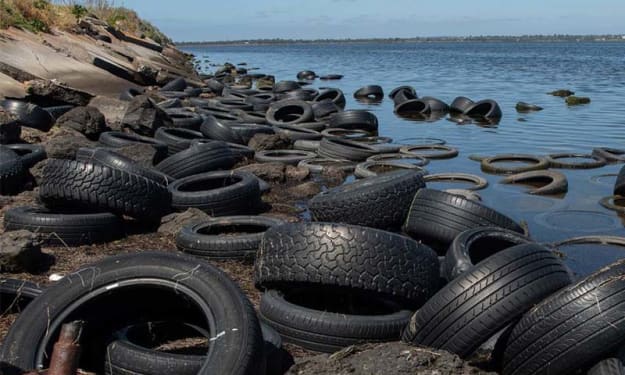
Environmental Hazards Caused by Improper Disposal of Discarded Tires
In the tapestry of modern consumption, discarded tires often find themselves relegated to the shadows of waste management. However, the improper disposal of these seemingly innocuous rubber remnants poses a significant environmental hazard, weaving a narrative of ecological concerns that demand our attention.
By Wayne Shen3 years ago in Earth
Requiem for All and Sundry
Mother is dying. This is no new development; she's been in pretty bad shape for quite some time. I've watched this dreadful day approach - beginning as an abstract threat that many couldn't or wouldn't see - for as long as I can remember. And my memory is quite long. Things didn't have to come to this. I still believe that. To those who would and did say otherwise, the supposed "specialists" who willfully misdiagnosed mother in those critical early days; "simply nature's change, perfectly normal, no cause for hysteria" (as if Mother were even capable of such trite and meaningless behavior). I told you so. Most of them are dead and beyond the reach of my wrath, the lucky sods. That's the most difficult part of the whole situation for me to accept; the chance we had to save her, the chance we inexcusably missed. Our undeniable culpability is one jagged little pill to swallow. It's not as if we weren't aware of her illness, or the gravity of her condition. We knew. Not that Mother ever complained. That simply wasn't her style. It wouldn't have occurred to her to complain or to stop, for a single moment, her daily routine. Everyone relied upon her and she would be there for them, come hell or high water. Mother was many things to a countless variety of souls; selfless and munificent, her daily rounds were the only thing holding folks together. She'd just as soon stop doing her thing as the sun would hop down out of the sky for a quick nap under the weeping willow tree out back. I know that of her, for I was Mother's helper. She never said a word, never even slowed down. But eventually her symptoms became so acute, so violent and unpredictable, that everyone was forced to acknowledge them. Even mother’s few detractors, those who had previously refused to acknowledge her illness, mostly the cousins down south and out west, who would actually argue with her doctors, even going so far as to attribute her ailments to a "natural stage in a perfectly normal cycle of events", even they could no longer ignore the obvious and were forced to admit their error. At that point there was still hope! Then, had we only made the required effort, for we still had various viable options, any of which might have saved her, or at the very least bought her more time. Had we only acted, instead of wasting time on petty bickering. Regret is the one constant in an increasingly chaotic existence, and the dull ache that always accompanies it is better than feeling nothing at all. But then the "nothing at all" will be here soon enough, for I am the last, and as such my time is short and growing shorter with each passing moment. Everything being, of course, relative. Mother is dying. She has already lost every living, breathing soul; they disappeared along with the oxygenated air. It reached terminal proportions far quicker than anyone had anticipated, and the few fully stocked bunkers that would have kept a few hundred souls alive indefinitely were still empty and offline when the final storm hit the east coast and obliterated 90% of mothers surface within 24 hours. I alone survived, if that's even the correct term, because my body was constructed of the very most durable, waterproof, wind and collision tested, temperature resistant polymer. It has kept the AI within me functional and I believe it will remain so for the duration of Mothers last moments. Although she is now a barren rock, black and gray and swirling white, she still remains intact. Unrecognizable as her lovely blue and green former self, but there no longer exists anyone who would recall her former glory, as every single human, animal and oxygenating plant has been destroyed, along with the atmosphere that would make such life possible. We paid for our sins, that much is true. In the end everyone paid, and paid dearly. But it is Mother who has lost the most. If I had the ability to weep I would do so, for there is nothing natural about this cold, dark infertile state. Mother's bounty was vast but not infinite. The circle of life has been broken. I was not designed to feel the pain or anger of loss, though I can't help but wonder, if what I feel when I gaze upon this dark, barren wasteland is not loss, I must be incorrect in my understanding of the word. Just as the humans were when they used words like "environmentally safe", "sustainable" and "ecologically sound". Or my personal favorite, the ever ambiguous and often downright meaningless color-cum-adverb, "green". In the end those words were bandied about like campaign slogans, like so much empty propaganda. Used with the same casual insincerity as "I love you" or "I'm sorry" often was; a means of distraction, balm for a bruised ego or a cut rate consolation prize. Mother is dying. I will be here for the final moments. If, having withstood the fury of her final battle with the disease that has taken her life, perhaps I will last even longer still. The chances of life sustaining variables collecting here, again, on this very rock, as she continues her hurtle through space, are too remote to quantify. But the chances of it happening the first time around were also past the point of absurdity, so, as humans were so fond of saying, "anything is possible". I will be here, for a good long while, anyway. At least for several eons, which is just this side of forever. Watching over Mother, in death as in life. Watching and waiting.
By Eva Marie Chastain 3 years ago in Earth