Sustainability
Google is in more danger than ever of being broken upGoogle will fight to keep its Chrome browser in a search antitrust trial starting Monday, after losing an ad-tech suit.
Google Faces Unprecedented Pressure Amid Antitrust Trials Google, one of the most powerful tech companies in the world, is facing perhaps its greatest legal challenge yet. As the company prepares to defend itself in a major antitrust trial over its Chrome browser and search dominance, it does so under the looming shadow of another recent setback—losing an important case tied to its advertising technology business. These legal battles, taken together, mark a turning point for the tech giant and could alter its business model significantly or even cause it to dissolve. A Legacy of Disputes in Court Antitrust authorities around the world have long targeted Google. In the European Union, the company has already faced billions in fines over its Android operating system, search practices, and online shopping services. However, the current wave of U.S.-based litigation is different—more direct, more aggressive, and potentially more damaging.
By GLOBAL NEWSabout a year ago in Earth
Satellite Captures Mysterious Symbols in Desert Ancient Civilization or Alien Code?
Satellite Captures Mysterious Symbols in Desert Ancient Civilization or Alien Code? High resolution satellite images reveal strange desert markings sparking global debate on ancient cultures secret messages and possible extraterrestrial origins
By Adnan Rasheedabout a year ago in Earth
2025 Solar Storm: A Cosmic Power Surge Headed Our Way!. AI-Generated.
**The Solar Storm of 2025: Understanding the Phenomenon and Its Potential Impact** In 2025, the Earth is expected to experience one of the most significant solar storms in recent history. While solar storms are not new—having been documented for centuries—the intensity and potential consequences of this event are drawing heightened attention from scientists, governments, and industries alike. This article delves into the nature of solar storms, why the 2025 event is particularly concerning, and what the implications might be for modern technology and society.
By Faizan Afrazabout a year ago in Earth
Global Price Increases: Recognizing the Global Cost Increase.
Millions of households and businesses have been impacted by an unprecedented rise in prices across a variety of industries over the past few years. From basic necessities like food and fuel to services and housing, inflation has tightened its grip on global economies, sparking concerns and debates about its causes and long-term consequences.
By Naeem Ahmedabout a year ago in Earth
Did We Break the Planet?
One of the most pressing issues of our time is climate change, with headlines dominated by rising global temperatures, extreme weather, and melting ice caps. However, a crucial question remains: Do humans in fact contribute to climate change? While natural climate variability has existed for millions of years, the overwhelming scientific consensus points to human activities as the primary driver of recent rapid changes.
By Morsalin Russellabout a year ago in Earth
Astronomers say they’ve found strongest ever ‘hints’ of life beyond our solar system
The strongest ever "Hints" of life beyond our solar system are discovered by astronomers. Astronomers have reported the strongest evidence yet suggesting the possibility of life beyond our solar system, in a groundbreaking development that has the potential to reshape our understanding of the cosmos. The discovery, made through the James Webb Space Telescope (JWST), focuses on the atmospheric analysis of a distant exoplanet where signs of potential biological activity have been detected.
By GLOBAL NEWSabout a year ago in Earth
“India’s Hidden Wealth: A Deep Dive into the Net Worth of Its Natural Resources”. AI-Generated.
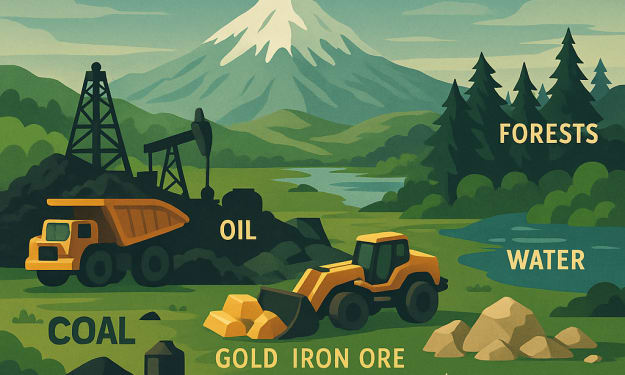
India’s Hidden Wealth: A Deep Dive into the Net Worth of Its Natural Resources India is not only a land of cultural and spiritual richness but also a nation blessed with an extraordinary bounty of natural resources. These natural endowments — including minerals, fuels, forests, water, and renewable energy sources — have powered India's civilization for millennia and continue to serve as the bedrock of its modern industrial and economic development. A Legacy Rooted in Nature From the time of the Indus Valley Civilization, India's terrain has yielded everything from precious gems to vast timber forests. Historical texts, including those from travelers like Marco Polo and Ibn Battuta, speak of India as a land of gold, spices, and mineral treasures. The colonial powers, particularly the British Empire, exploited these resources extensively, laying down the groundwork for modern mining and industrial infrastructure. After independence, India took aggressive steps to regulate and develop its resource-based sectors, creating national organizations such as the Oil and Natural Gas Corporation (ONGC), Coal India Limited, and Indian Bureau of Mines. These institutions have been instrumental in discovering and quantifying the country's natural wealth. Mineral Wealth India’s mineral reserves are among the largest in the world: Coal: India holds the fifth-largest coal reserves globally, estimated at over 319 billion tonnes. These are primarily located in Jharkhand, Odisha, Chhattisgarh, and West Bengal. With energy demands on the rise, coal continues to be India's primary source of electricity. Iron Ore: Rich deposits in states like Odisha and Karnataka make India one of the leading iron ore producers in the world. Annual production exceeds 200 million tonnes. Bauxite and Manganese: India’s reserves of bauxite — the ore for aluminum — are among the top five in the world. These are located in Gujarat, Jharkhand, and Madhya Pradesh. Gold: While not on the scale of Australia or South Africa, India’s Kolar Gold Fields and new discoveries in Uttar Pradesh are noteworthy. Estimated mineral net worth: India’s known mineral wealth is estimated at around $10–12 trillion, with coal, iron, and bauxite forming the core. Oil and Natural Gas India’s oil and gas resources are significant, although still underdeveloped compared to Middle Eastern giants: Oil Reserves: India has approximately 4.5 billion barrels of proven oil reserves, mainly located in the Western Offshore (Mumbai High), Assam, and Gujarat. Natural Gas: The Krishna-Godavari basin is a major hub, along with the Cambay basin. India’s gas reserves are around 1.3 trillion cubic meters. Estimated net worth: As of current global prices, the total value of India’s oil and gas reserves exceeds $1.5 trillion. Forests and Biodiversity India’s forests, covering roughly 24% of its total area, are home to valuable timber species like teak, sal, and sandalwood. Additionally, India is one of the most biodiverse countries in the world, with immense potential in medicinal plants and eco-tourism. Estimated ecological resource value: Including ecosystem services and bio-resource value, the worth of India’s forests and biodiversity is estimated to be over $3 trillion. Water Resources India is endowed with major river systems — the Ganges, Brahmaputra, Godavari, and Krishna, to name a few. Water powers agriculture, which employs over 40% of the population, and is also essential for energy (hydropower) and drinking supplies. Estimated value: In economic terms, India’s water resources contribute nearly $1 trillion to its GDP, factoring in agriculture, hydropower, and ecosystem services. Renewable Energy Potential India has immense potential in solar, wind, and hydroelectric power: Solar Energy: With over 300 sunny days a year, India’s solar capacity is currently at 72 GW and growing rapidly. Wind Power: Coastal states like Tamil Nadu and Gujarat offer high wind speeds ideal for turbine installation. Hydropower: India ranks 5th in the world in hydropower generation. Estimated value: The long-term potential of renewable energy development in India is projected to be $2 trillion by 2040. Putting It All Together: India’s Natural Net Worth Combining coal, oil, gas, minerals, forests, water, and renewables, the estimated total net worth of India’s natural resources surpasses $18–20 trillion. This figure could be higher with the discovery of new reserves and improvements in extraction technologies. Strategic Importance India’s natural resource wealth plays a crucial role in: Energy security: Reducing dependence on oil imports. Industrial growth: Supporting steel, aluminum, cement, and manufacturing sectors. Economic independence: Potential for export-driven growth. Geopolitical power: Ability to influence global markets and trade policies. Conclusion India’s natural resources are not just numbers on a ledger — they are the legacy of millions of years of geological evolution and centuries of civilization. The country’s strategic management of this wealth, combined with sustainable development practices, can elevate India into a global economic powerhouse. With innovation, policy reforms, and conservation, India can ensure that its natural treasures remain a source of prosperity for generations to come.
By Say the truth about a year ago in Earth