Science
Strategies for Effective Energy Resources Management
Energy resources management is the process of optimizing energy use in an organization. It involves identifying and reducing energy waste, as well as implementing measures to improve energy efficiency. Effective energy resource management can lead to significant cost savings, as well as environmental benefits.
By ierminstituteseo3 years ago in Earth
DECADES OF MYSTERIOUS RADIO SIGNALS FROM SPACE
Introduction For decades, humanity has been captivated by the prospect of discovering extraterrestrial intelligence. Among the many approaches to detecting potential alien communication, radio astronomy has been a prominent method. Over the years, scientists have detected puzzling radio signals originating from space, capturing the imaginations of both experts and the public alike. This article delves into the fascinating world of these mysterious radio signals, exploring the scientific quest to decipher their origins, the various natural phenomena that could mimic artificial signals, and the implications of potential extraterrestrial contact. 1. The Discovery of Mysterious Radio Signals The journey into the realm of enigmatic signals began in 1933 when Karl Jansky, an American radio engineer, accidentally detected cosmic radio waves while investigating interference in telephone communications. His discovery laid the foundation for the field of radio astronomy and sparked interest in exploring the cosmos through radio waves. Decades later, in 1967, astronomers detected the first pulsar, a highly magnetized and rapidly rotating neutron star. These pulsars emit regular pulses of radio waves, leading to their nickname "cosmic lighthouses." While pulsars accounted for some mysterious signals, there remained unexplained radio bursts that seemed to defy conventional astrophysical explanations. 2. Fast Radio Bursts (FRBs): A New Enigma In the early 2000s, the discovery of Fast Radio Bursts (FRBs) brought the mystery of unidentified radio signals to the forefront. FRBs are brief but incredibly intense bursts of radio waves originating from deep space. They last only a few milliseconds but release an amount of energy equivalent to the power of hundreds of millions of suns. Initially, FRBs were considered instrumental anomalies, but with advances in radio telescopes and data analysis techniques, astronomers started detecting more of these elusive signals. Despite the increasing observations, the origin of FRBs remained a subject of intense debate. 3. Potential Natural Origins of Mysterious Signals Astronomers proposed several natural sources that could produce signals resembling those of mysterious origins. Among the possibilities were cataclysmic events, such as supernovae or the collision of neutron stars, which could emit powerful bursts of radio waves. Another intriguing candidate was magnetars, extremely dense and highly magnetic neutron stars. The intense magnetic fields of magnetars could potentially generate FRBs when they experience sudden and catastrophic releases of energy. Moreover, some scientists explored the possibility that the signals could be the result of lensing effects caused by cosmic structures, gravitational waves, or other exotic phenomena that bend and focus radio waves from distant sources. 4. SETI: The Search for Extraterrestrial Intelligence The idea of potential communication from intelligent civilizations beyond Earth has fueled the Search for Extraterrestrial Intelligence (SETI) for decades. While the mainstream scientific community remains cautious about the existence of extraterrestrial life, researchers involved in SETI projects continue their vigilant search for any anomalous signals that could indicate contact from intelligent beings. SETI initiatives use radio telescopes to survey the skies for specific patterns that might indicate artificial origin, such as narrowband signals or repetitive patterns that appear out of place compared to natural cosmic sources. 5. Alien Megastructures and Dyson Spheres The mystery surrounding unidentified radio signals has inspired speculation about advanced extraterrestrial civilizations constructing massive structures in space. One of the most intriguing ideas is the Dyson Sphere—a hypothetical megastructure that encircles a star to harness its energy. A Dyson Sphere would emit waste heat in the form of infrared radiation, potentially detectable from Earth. Some astronomers have explored the possibility that certain mysterious signals might be indicative of such a colossal engineering feat. 6. The Challenges of Deciphering Mysterious Signals Identifying the sources of these radio signals is no easy task. Astronomers face various challenges, such as the vast distances involved, the transient nature of the signals, and the potential for natural phenomena to mimic artificial patterns. The rarity of repeat signals from a given source hampers the ability to study them in detail, making it difficult to draw definitive conclusions. Additionally, many of the proposed natural explanations are still theoretical and require further observations and simulations to confirm. 7. The Future of Radio Astronomy and SETI As technology continues to advance, so does our ability to explore the cosmos. Upcoming generations of radio telescopes, such as the Square Kilometre Array (SKA), hold the promise of significantly enhancing our understanding of the enigmatic signals from space. SETI projects are also evolving, incorporating artificial intelligence and machine learning algorithms to process vast amounts of data from radio surveys. These advancements may provide us with the means to recognize patterns that were previously beyond our comprehension. Conclusion The mystery of the radio signals from space continues to captivate astronomers, inspiring ongoing research and scientific exploration. Whether these signals arise from natural astrophysical phenomena or hint at the possibility of contact with extraterrestrial intelligence remains an open question. As we venture further into the cosmos, armed with cutting-edge technology and a spirit of curiosity, the enigma of these mysterious signals may one day be unraveled, providing us with profound insights into the universe and our place within it.
By Daniel Adjei 3 years ago in Earth
Drenched IN THE Magnificence OF THE Selling Slopes: OHIO'S APPALACHIAN Lower regions
Gleaming from the beams of daylight gushing through the encompassing timberland, a meager cover of the strangely named Eccentric Spring sprinkled over the edge almost eight stories over our heads, spilling into a little pool at my feet.
By kalum Dileep Liyanage3 years ago in Earth
Scientists Detected Mysterious 'Morse Code' in Milky Way's Center
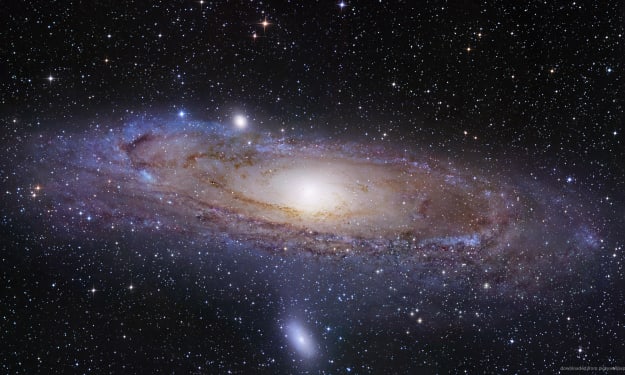
The Milky Way galaxy, where we live, is a spiral galaxy that appeared around 14 billion years ago. It’s filled with stars, nebulae, planets, asteroids, and more. The Milky Way is a barred spiral galaxy that contains our Solar System. It appears as a hazy band of light in the night sky, formed from stars that cannot be individually distinguished by the naked eye. The galaxy has an estimated diameter of 87,400 light-years and is about 1,000 light-years thick at the spiral arms. It is estimated to contain 100-400 billion stars. The Milky Way has several satellite galaxies and is part of the Local Group of galaxies, which form part of the Virgo Supercluster. The Solar System is located at a radius of about 27,000 light-years from the Galactic Center, on the inner edge of the Orion Arm, one of the spiral-shaped concentrations of gas and dust. The stars in the innermost 10,000 light-years form a bulge and one or more bars that radiate from the bulge. It takes our sun 250 million years to make one revolution around the center of our home galaxy.
By Subham Das3 years ago in Earth
Cry of the Earth
In a world teetering on the brink of environmental collapse, the Earth's cries echoed through the hearts of those who bore witness to its plight. This is the emotional story of individuals and communities grappling with the devastating consequences of climate change and striving to heal the wounds inflicted upon their precious home. From despair to determination, this tale weaves together the raw emotions experienced in the face of the ongoing environmental crisis.
By Zeeshan May3 years ago in Earth
The Call to Action On a Significant Impact on the Planet's Health.. Content Warning.
In a remote village nestled deep within the heart of a lush, ancient forest, there lived a young girl named Amara. With eyes that sparkled like emerald leaves and a spirit as wild and free as the wind that danced through the trees, she had always felt a deep connection with the natural world around her. Her days were spent exploring the forest, listening to its whispers, and learning its secrets.
By Rev Dr. Alexander Fenning-Sencherey3 years ago in Earth
Pyramids of Gisa
In the heart of Cairo, a young archaeologist named Dr. Amelia Carter was preparing for the excavation of a lifetime. Her passion for history and archaeology had led her to pursue the study of ancient Egyptian culture, and the Pyramids of Giza had always been her dream destination.
By jane smith3 years ago in Earth
Summit of the World
Once upon a time, amidst the majestic peaks of the Himalayas, stood the towering Mount Everest, the highest mountain on Earth. Its snow-capped summit soared into the heavens, captivating the hearts of adventurers and mountaineers alike. Among them was a young woman named Maya, who had dreamt of conquering the mighty Everest ever since she was a child.
By jane smith3 years ago in Earth
Mysterious 'Morse Code' in Milky Way's Center
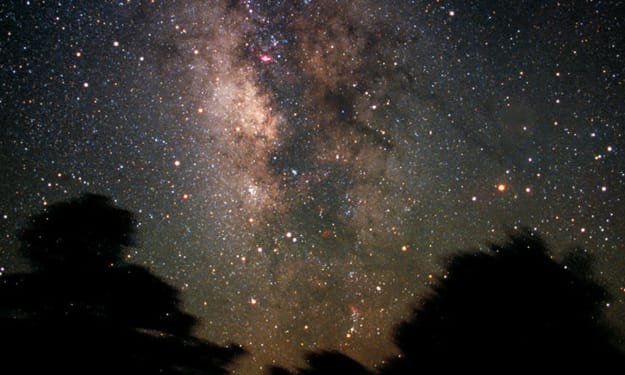
An international team of scientists have discovered something they've never seen before hidden in the center of the Milky Way it resembles Morse code is that our galaxy trying to communicate with us in the early 1980s astronomers discovered giant one-dimensional filaments dangling vertically near Sagittarius. A star as our Galaxy's Central supermassive black hole and recently a new kind of such filament has been found but they're much shorter and lie either horizontally or radially in other words they're spreading out like spokes on a wheel going away from the black hole interestingly even though both types of filaments do have certain similarities, researchers believe they most likely have different origins the vertical filaments stretch through the Galaxy towering up to 150 light years high but the horizontal ones resemble the dashes and dots of morse code scientists were Beyond excited when they made the discovery but they had to do a lot of research to make sure the structures indeed were what they looked like they managed to confirm that the filaments were not random but tied to the outflow of the black hole thanks to them it became possible to study the spin of the black hole and the orientation of its accretion disk a rotating disk of matter formed around the black hole under the influence of its immense gravitational force but let's have a closer look at the filaments we've been talking about there are around 1000 vertical ones they appear in pairs and clusters and are often either equally spaced or side by side like strings on a harp as for their horizontal counterparts they seem to be around 6 million years old now both types of filaments are one-dimensional they can be viewed with radio waves and they seem to be tied to processes happening in the galactic center that's it the similarities end there the vertical filaments are perpendicular to the galactic plane the horizontal ones are parallel but at the same time they Point radially toward the center of the Galaxy and the black hole the vertical filaments are magnetic the horizontal ones seem to emit thermal radiation the vertical filaments contain particles moving at speeds very close to the speed of line the horizontal ones don't do it there are way more vertical filaments and they're much larger than those stretching horizontally 150 light years against 5 to 10 light years at most in any case the new discovery is still filled with tons of unknown things and astronomers are ready to start unraveling them, but the filaments aren't the only unexpected and bizarre phenomenon in the solar system some time ago Australian researchers discovered a weird spinning object in the Milky Way and it was unlike anything they had seen before this object released massive bursts of radio energy three times every hour and even though there are other objects that switch on and off for example pulsars such frequent pulsation has never been observed before some astronomers admitted that this discovery was pretty spooky since no known object in the sky could do it. Research teams started working on the Discovery and found out that the object is likely to be 4000 light years away from Earth it's also super bright and has an incredibly strong magnetic feel and still if you do all the math you'll discover that it isn't supposed to have enough power to produce such radio waves every 20 minutes the theories about the origin of this mysterious object vary some experts claim it could be an ultra long period magnetar whatever that is others think it might be a white dwarf or the remnants of a collapsed star but it also might be something we've never heard about an entirely new type of object but one thing is clear astronomers manage to observe the signal across a wide range of frequencies which means it has a natural origin and isn't something artificial.
By Daniel Theboss3 years ago in Earth
Roof of the earth and why people love it?. Content Warning.
The vast expanse of the sky has captivated human imagination for millennia. From its ever-changing canvas of colors during sunrises and sunsets to the twinkling beauty of stars in the night, the sky offers a mesmerizing spectacle that can have profound therapeutic effects on people. Sky gazing, the act of contemplatively observing the sky, has proven to be of immense importance for people's mental, emotional, and even physical well-being. This essay explores the therapeutic benefits and significance of sky gazing in our modern, fast-paced world.
By Ibaad Ullah Khan3 years ago in Earth