Science
The Use Of Animals In Research
Supporters argue that under strict ethical guidelines and regulations, animal research can be ethically justifiable. They emphasize the potential benefits to both humans and animals that can arise from scientific discoveries made through research involving animals. Animal research has historically played a crucial role in medical advancements, including the development of life-saving medications, vaccines, surgical techniques, and treatments for various diseases.
By Marlene Silvio3 years ago in Earth
Unveiling the Shadows
In the hallowed halls of medicine, where the pursuit of health and healing reigns supreme, a silent and clandestine revolution is unfolding—one that blurs the line between salvation and malevolence. This is the story of Artificial Intelligence (AI) in healthcare, a tale of profound promise and haunting suspense, where technology and humanity clash in a dance that could forever alter the future of medicine.
By Алексей Максимчук3 years ago in Earth
"Whispers of the Forest"
Once upon a time, in a small village nestled deep within a lush green forest, there lived a young girl named Maya. Maya had grown up surrounded by the beauty of nature. She spent her days exploring the woods, listening to the songs of the birds, and feeling the gentle caress of the wind against her skin. Her heart was intimately connected to the environment, and she felt a profound love for the world around her.
By Hamim Hassan3 years ago in Earth
"Unmasking the Truth: The Unrelenting Reality of Global Warming
Global warming is a pressing and multifaceted issue that has garnered worldwide attention and concern. It refers to the long-term increase in Earth's average surface temperature due to the accumulation of greenhouse gases in the atmosphere. While climate change is a natural phenomenon, the alarming rate at which it's occurring today is primarily attributed to human activities. This article explores the causes and consequences of global warming, as well as the urgent need for mitigation and adaptation measures.
By Muhammad Mohib3 years ago in Earth
The Healing Power of Nature
In a world where the relentless grip of a changing climate had left most places desolate and barren, Sarah found herself clinging to a glimmer of hope. She had lost her home, her family, and everything she held dear to the merciless onslaught of hurricanes, wildfires, and droughts. The world had turned into a bleak, unrecognizable landscape, where chaos and despair seemed to reign supreme.
By knowledge about planets3 years ago in Earth
Unknown Depths: Exploring the Ocean's Mysteries
More than 70% of the surface of the Earth is covered by oceans, making them an essential part of the planet's biosphere. We have barely touched the surface of the tremendous mysteries hiding beneath the waters, despite their enormous significance. There is a profound sense of wonder and unrealized potential since a startling 80–95 percent of the world's oceans are still undiscovered and unexplored, according to experts.
By Nor-An Rose Aren3 years ago in Earth
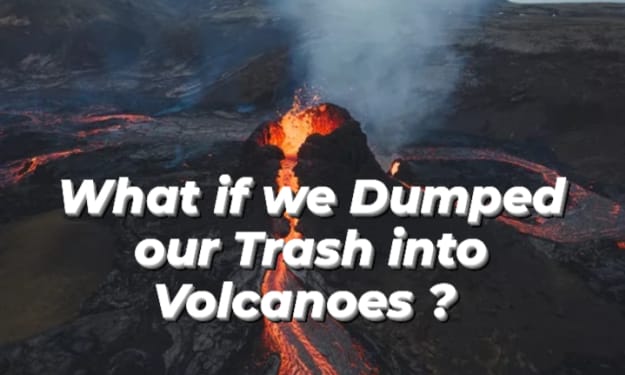
What if we Dumped our Trash into Volcanoes
A volcano is one of the most unforgiving natural phenomenons on Earth. If you were to fall into its magma-filled center, your body would quickly bubble up, and disappear without a trace. So if they're so good at getting rid of things, why aren't we using them to get rid of our garbage? This is WHAT IF, and here's what would happen if we dumped our trash into volcanoes. Americans alone generate about 254 million tons of trash per year, and although dumping it into volcanoes might sound like the perfect way to get rid of it, it wouldn't be that easy. Volcanoes might look like nature's garbage incinerators, but in reality, they're much more dangerous and unstable, not to mention a lot harder to get to. Would overcoming these obstacles be worth it? Or would dumping our trash in volcanoes just cause even more harm to our planet? The first obstacle in our quest for volcanic garbage disposal would be finding an active volcano that can get the job done. There are only about 1,500 potentially active volcanoes worldwide, and most of them aren't located anywhere near humans, for obvious reasons. That means that getting all our trash to an active volcano could turn out to be pretty expensive, and once we get there we may find out it's not even the right kind of active volcano. The kind of volcano we'd be looking for is called a shield volcano, a slow-erupting variety that contains the iconic lava lakes that gradually spew out onto the Earth. Unfortunately, these aren't very common. You're more likely to come across their angry cousins, known as stratovolcanoes. Stratovolcanoes are known for their explosive eruptions, caused by the build-up of pressure from hot gas and magma. In other words, they're probably not the safest location for the town dump. But let's say we're lucky enough to find ourselves a nice active shield volcano; before we worry about the logistics of getting our trash there, let's figure out if it's even a good idea to dump it inside. If you were one of the first waste collectors hired to drive up to the vent of a volcano, you'd quickly start to question your career choices. The vent of a volcano is a treacherous environment full of poisonous gases, lava splatter, and projectile rocks; and things only get worse once you start throwing stuff inside. In 2002, a group of Ethiopian researchers threw a 30 kg (66 lb) bag of trash into a volcano, and the results were explosive. Lava lakes are unstable, so if you pierce their surfaces with something cold, like trash, you'll trigger a chain reaction of explosions involving pressurized and acidic steam. So can you imagine how big these explosions would be if you threw an entire nation's trash in there? Well to put it in perspective, rockfalls into lava lakes in Hawaii have sent lava 85 m (280 feet) into the air, so it'd probably look something like that. Even if you could safely get your trash into the volcano, you'd still have to worry about all the air pollution created by burning our waste without filters. Plus, not all materials will completely break down in lava, which means that the polluting remnants could erupt out and contaminate the surrounding landscape; not ideal if you were hoping to burn nuclear waste, for example. Add these environmental impacts on top of the fact that shipping all our trash to these volcanoes would significantly increase the carbon footprint of the waste disposal, and the whole thing looks like a terrible idea. If we're going to burn our trash, why not at least do it some place where we can use the heat released through incineration to create new sources of energy? Or, instead, maybe we could just shoot our garbage out into space? Surely there can't be any harmful effects there... right?Well that's another question for us to find out.
By Clark Caamiño3 years ago in Earth
10 of the Coolest New Animal and Fungi Species Discovered in 2023
2023 has been a remarkably productive year for science. With COVID restrictions nearly entirely lifted, scientists have finally been able to return to business as mostly usual with field research and exploration. The results are already showing, and all across the world, folks have been finding new animals and fungi hiding in remarkable locations.
By Olivia L. Dobbs3 years ago in Earth
Α scientific true mystery that has puzzled scientists for decades!!
In the boundless expanse of the universe, humanity finds itself immersed in a profound cosmic mystery known as the Fermi Paradox. This paradox stems from a perplexing contradiction: the high probability of extraterrestrial life thriving throughout the cosmos versus the conspicuous absence of tangible evidence or contact with advanced extraterrestrial civilizations. As we delve deeper into this conundrum, we explore the awe-inspiring vastness of the universe and the intricate web of hypotheses that endeavor to decipher this enigma.
By Μarilena Κont3 years ago in Earth
"The Volcanic Enigma: Unmasking the Hazards of Trash Disposal"
In the realm of waste disposal, exploring unconventional methods often seems enticing as we grapple with mounting environmental concerns. Picture this: you find yourself at the precipice of an active shield volcano, contemplating the audacious idea of discarding a truckload of refuse into its fiery abyss. It's a concept that may initially spark intrigue, but beneath the surface lies a complex and perilous narrative that unfolds when waste meets molten lava.
By Μarilena Κont3 years ago in Earth
Understanding Earthquakes
Title: Understanding Earthquakes: Nature's Unpredictable Fury Introduction Earthquakes, one of nature's most formidable and unpredictable phenomena, have fascinated and terrified humans for centuries. These geological events can cause immense destruction, reshape landscapes, and have profound impacts on communities. In this article, we will delve into the science behind earthquakes, their causes, effects, and measures to mitigate their devastating consequences.
By Sharon Chiamaka3 years ago in Earth
The Nature of Happiness: Seeking Lasting Fulfillment. Content Warning.
**The Nature of Happiness: Seeking Lasting Fulfillment** Happiness, that elusive and sought-after state of being, has captivated the human mind for centuries. It's a subject that philosophers, psychologists, and thinkers of all kinds have contemplated, debated, and researched. The pursuit of happiness is ingrained in the human experience, yet it remains a complex and multifaceted concept. What truly brings lasting happiness and fulfillment in life is a question that has intrigued us since time immemorial. Happiness is often depicted as a fleeting emotion, a momentary burst of joy or pleasure. It can be the warmth of a sunny day, the laughter of a child, or the taste of a favorite meal. These moments are undeniably delightful, and they contribute to our overall sense of well-being. However, they are but pieces of a much larger puzzle when it comes to understanding happiness in its entirety. To unravel the essence of happiness, one must delve into its core components and consider its long-term implications. Lasting happiness goes beyond the immediate gratification of desires; it encompasses a deep and enduring sense of contentment and well-being. It is a state of being that withstands the test of time, transcending the ups and downs of daily life. **Materialism and the Pursuit of Happiness** In our modern world, the pursuit of happiness is often intertwined with materialism. The belief that acquiring possessions, wealth, and status will lead to lasting happiness is a common narrative. Advertisements and societal pressures constantly bombard us with the message that more is better and that acquiring more material goods will bring us closer to happiness. Yet, this materialistic pursuit often leads to a paradox. Studies have shown that the initial thrill of acquiring a new possession tends to fade over time. This phenomenon, known as the "hedonic treadmill," suggests that we adapt to new circumstances and material gains relatively quickly. As a result, the happiness derived from material possessions is often short-lived and requires a never-ending cycle of consumption to maintain. **The Role of Relationships and Connection** In contrast to the fleeting nature of materialistic pursuits, lasting happiness is closely tied to the quality of our relationships and connections with others. Human beings are inherently social creatures, and our well-being is deeply intertwined with our ability to form meaningful bonds with family, friends, and the larger community.
By @MelodiaScope3 years ago in Earth