Science
"Seeds of Tomorrow"
Once, the valley flourished with vibrant hues of green, an ode to nature's symphony. However, the melody had been disrupted, as the looming shadow of environmental degradation cast a pall over the land. The air, once pure and invigorating, now carried whispers of despair. In the heart of this dwindling sanctuary, there existed a community determined to rewrite the story.
By Vincent Uche3 years ago in Earth
Don’t Come Closer!
Delving into the vast expanse of the ocean, we encounter a diverse tapestry of marine life, each species contributing to the intricate ecosystem beneath the waves. From the familiar faces of Nemo and Dory to the elegant butterfly fish and the flamboyant guppy, the underwater world unveils a captivating array of aquatic inhabitants.
By Kester Idebaneria3 years ago in Earth
"Unlocking the Mysteries of the Universe: A Guide to Telescopes and Their Wonders"
The universe has consistently dazzled the human creative mind, coaxing us with its divine marvels and significant secrets. From the shimmering stars that enhance our night sky to the confounding dark openings concealed in the profundities of room, the universe has propelled wonderment, interest, and a tenacious quest for understanding. At the core of this mission lies the telescope, an instrument that has gone about as an inestimable key, opening the insider facts of the universe and uncovering it's unbelievable excellence.
By Demont Washington3 years ago in Earth
Environmentalist. Content Warning.
2023 is the year to accomplish a net zero economy to find solutions and policies in the sustainability space ideas that will truly move the goal posts of how we can create a nature positive future. We believe that it is exactly in the high emitting sectors where some of the most important work is being done fabric. Nano is a biotech startup who has found a way to sustainably synthesize bioplastics and fossil fuel-free chemical ingredients at scale and produce those chemicals 100 times faster than normal petroleum-based products. Their breakthroughs could mean that cell-free manufacturing could finally transcend niche to become commonplace after a hugely successful retrofit of the Empire State building in New York city. A program called the Empire Building Challenge is providing 50 million dollars in funding to high-rise building owners to pilot innovative retrofit solutions although new buildings are easy to make green old ones make up 80 to 90 percent of our usage and this is where we need to make sustainability. Sustainability gains the best solutions will be shared widely with other building owners across New York state to create a network of sustainable practice making electricity from human-powered steps is a concept that has been around for a while but without a lot of market uptake but new technology developed by two Swiss labs means that for the first time we can create electricity from wooden flooring. Wood is one of the most sustainable and popular building materials but its electro neutrality has meant that it has been relatively ignored for energy harvesting. These scientists found a way to modify it with silicon and nano crystals relatively environmentally friendly procedures making it triboelectric. What if you could grow wood in a lab. Researchers at MIT have not only discovered how to replicate wood by isolating tunable plant tissues but also to grow it in specific shapes. Thereby reducing waste even though wood can be grown sustainably. This new technology has the capacity to transform our use of biomaterials and combat deforestation. Making affordable fashion sustainable is the goal of this global e-commerce brand. Everything is handmade to order in Spain and Portugal and most importantly they only make what is ordered by totally reducing unsold production waste for every item ordered. They encourage you to resell something you no longer want. They also offset their carbon footprint and donate material scraps to independent fashion brands with an annual average growth rate of one hundred percent. This pioneering stockless fashion brand is on the rise. Buying up carbon credits to satisfy sustainability goals is not going to fully get us to net zero nature positive business solutions require that a price be put on negative externalities and two companies are helping to do just that research project that is a unfunded project that is laying the groundwork for environmental and ecosystem accounting with pilots in Brazil, China, India, Mexico and South Africa. The project is developing the tools language and structure for how we can measure the value of ecosystem services. Similarly, the investor has created a set of modeling tools to evaluate the impact of investments in natural infrastructure in cities. The software models the links between nature and the well-being of populations demonstrating the way investors can become allies to nature but investing in nature can also mean investing in nature. Costa Rica is the first tropical country to have halted and actually reversed deforestation by taxing fossil fuels. The government has financed a 500-million-dollar payout to landowners saving more than 1 million hectares of forest and replanting 7 million trees whilst many good programs exist around the world. Costa Rica has been recognized as one of the most successful countries due to political will and a passion for and recognition of the importance of their environment.
By Saman gill3 years ago in Earth
Plastic waste is spiraling around the world. Content Warning.
Plastic waste is spiraling around the world In recent years, the world has been engulfed in an escalating crisis with dire implications for our environment and ecosystems. The culprit behind it all? The relentless proliferation of plastic waste, With its production skyrocketing to unprecedented levels and disposal mechanisms struggling to keep up, our planet is now grappling with a crisis that has spiraled out of control.
By Engr kawsar Ahmed3 years ago in Earth
11+ Unexplained Phenomena That Won't Let You Sleep Tonight
In the world of unexplained phenomena, where mysteries abound, one can find themselves at the edge of their comfort zone, intrigued and bewildered. Picture this: You're standing at the precipice of nature's fury, gazing upon a live volcano as it erupts. It's a terrifying spectacle by itself, but then, a curious phenomenon takes place. Ominous bright flashes of light pierce the night sky, taking the nightmarish experience to a whole new level.
By Sophia Hayes3 years ago in Earth
A Ray of Hope Amidst the Melting Ice.
In the peaceful, frozen wild of the Icy, the world was evolving. It was a position of crude magnificence, where the perpetual scope of snow and ice extended as should have been obvious. However, underneath the unblemished surface, a fight was being battled, one that would decide the eventual fate of our planet.
By Sheryl Niblock3 years ago in Earth
What if
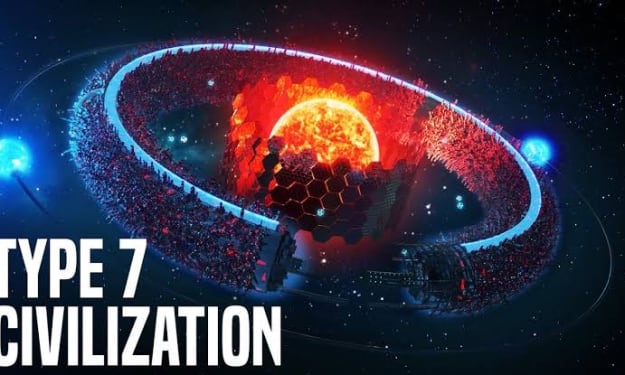
In a world where humanity evolves beyond imagination, progressing from a type one to a speculative type seven civilization, the journey is nothing short of mind-bending. We transition from controlling Earth's power to manipulating entire universes and beyond. Climate change poses challenges, but renewable energy advancements offer hope. A type six civilization takes the reins, granting us control over everything—creating or destroying universes at will, playing with time as a newfound toy. We may encounter diverse civilizations, ruling as gods or observing like caretakers. Our appearance could transcend biology, embracing Robo-human hybrids or limitless forms.
By Osigwe cynthia3 years ago in Earth
Exploring the Abyss: What If You Fell into a Black Hole?
If you're exploring space and stumble upon a black hole, curiosity might lead you to wonder about survival and potential shortcuts to other universes. Despite their name, black holes aren't empty; they're dense concentrations of matter formed when massive stars collapse. Gravity overwhelms all forces, creating a small yet incredibly heavy object. Imagine squeezing four suns into a 15-mile diameter space – that's a black hole.
By Osigwe cynthia3 years ago in Earth
Greenland's ice shelves, play a crucial role preventing sea level
Greenland's ice shelves, play a crucial role preventing sea level Greenland's ice shelves, which play a crucial role in preventing sea level rise by holding back massive amounts of ice, are undergoing significant deterioration, according to recent scientific research published in Nature Communications. Since 1978, the northern Greenland ice shelves have lost approximately 35 percent of their overall volume, equivalent to around 400 billion tons of floating ice. These ice shelves act as barriers, preventing glaciers from flowing into the sea and accelerating the rise in sea levels.
By Engr kawsar Ahmed3 years ago in Earth