Science
Sleeping Giant
Introduction: Yellowstone National Park is renowned for its mesmerizing geysers and hot springs, fueled by the presence of a colossal super volcano beneath its surface. Recent research has shed light on the magnitude of the magma chamber, revealing its immense size and potential implications. While the media often speculates about the likelihood of an eruption, scientists argue that the Yellowstone supervolcano remains stable for now. Though recent seismic activities, though more pronounced, do not indicate an imminent threat.
By Peter Kiruu3 years ago in Earth
Bats: Masters of Flight, Resilient to Viruses, and Potential Medical Marvels
In a world where bats are often associated with deadly diseases, a closer look reveals their extraordinary resilience and unique physiology. Bats, the only mammals capable of flight, have evolved remarkable features in their immune systems and physiology that allow them to tolerate extreme stressors associated with flying.
By Christopher Ezeh3 years ago in Earth
Interesting Facts About Our Universe.
The last decade was undeniably one of the richest periods of scientific discovery ever... researchers across all disciplines tested hypotheses found proofs, and visited places that have made us rethink our understanding of not only our planets but of the entire universe it was the decade when we finally begin to understand one of the greatest challenges humankind has ever faced and we've learned far more than ever before about some of the most destructive objects in existence.
By Peter Kiruu3 years ago in Earth
Unexplained Mystery
At the bottom of our planet lies Antarctica, the coldest and most inhospitable continent in the world, stretching over 5 million square miles! Covered in ice sheets breaching more than a mile deep, with an average daily temperature of negative 49 degrees Fahrenheit and wind speeds reaching over 100 miles per hour! Today, the only inhabitants are scientists working in scattered research stations. Mainstream geologists long believed ancient humans never settled here due to its hostile climate. But incredibly, in 2016, satellite images revealed a curious formation emerging from the ice, potentially a man-made pyramid! Recent reports suggest multiple huge pyramids in Antarctica, dwarfing those in Egypt! Could our ancestors have reached and settled here? A man-made pyramid beneath the Antarctic ice raises questions about its construction, timing, and builders. Despite geologists stating Antarctica has been under ice for millions of years, evidence suggests it may have been free of ice until around 4000 BC. Polynesian stories describe a "strange land" matching Antarctica's description, leading to theories of early human presence. German geologists, in 2017, discovered plant remains suggesting a temperate climate on Antarctica thousands of years ago! This continent's secrets could unveil much about Earth's past. In Cairo, Egypt, the Giza necropolis boasts the iconic Great Pyramids and the enigmatic Sphinx! The Sphinx, a massive statue buried in sand for millennia, holds mysteries archaeologists strive to decipher. While conventionally attributed to Pharaoh Khafre, debates persist on its origin and age. The Sphinx's erosion patterns suggest a much older age, potentially dating back to 10,000 BC! Its discovery in the 1920s marked a turning point in understanding ancient Egypt. Inscriptions on the Inventory Stella hint at a far older structure, challenging conventional timelines. The Sphinx's weathering, possibly from a more temperate era, supports theories of its ancient origins. Its scale and symbolism continue to fascinate researchers, shedding light on ancient civilizations' complexities. In Cincinnati, Ohio, Greg and Dana Newkirk house a collection of cursed objects from around the world, including a terrifying wooden effigy known as the Crone! Visitors experience physical reactions near these objects, underscoring their eerie power. The Crone's malevolent influence led to violent seizures, prompting the Newkirks to return it to its place of origin in a cleansing ritual. This room of cursed artifacts captivates visitors, highlighting humanity's fascination with the supernatural and the responsibility of safeguarding such objects. In the lower Jordan River Valley, the ruins of an ancient city, possibly biblical Sodom, lie buried under layers of dirt and rock. Evidence suggests a meteor explosion over the Dead Sea may have caused its destruction. The biblical narrative of Sodom's fiery destruction aligns with geological findings at the site. Scholars debate whether this event was an act of God or a natural phenomenon, questioning the interplay between faith and science. The story of Lot's wife turning into a pillar of salt further fuels theories of a catastrophic event. The discovery of high salt concentrations supports the biblical account of Sodom's destruction by fire and brimstone. In Pompeii, Italy, the Villa De papyrus, buried by Mount Vesuvius's eruption, preserved a library of ancient texts, offering insights into Roman life! Recent advancements in technology, like virtual unwrapping, provide hope of deciphering these scrolls without damage. The potential discovery of early Christian texts within these scrolls could revolutionize our understanding of early Christianity! The Villa De papyrus stands as a time capsule, offering a glimpse into the past and unlocking secrets hidden for centuries!
By Samuel Temitope 3 years ago in Earth
Who created the circles in the Sahara desert?
In the heart of the vast Sahara, 160 kilometers from any signs of life, a mysterious array of identical circles stretches in near-perfect alignment, capturing the imagination of anyone who comes across them. This enigma unfolds in the largest country in Africa, marking the limits of internet exploration and raising countless questions about their origin and purpose. Over the past 20 weeks, our dedicated team embarked on a thrilling quest to unravel the secrets behind these puzzling circles, delving into diverse perspectives and embarking on an extraordinary journey that would not only shed light on their true nature but also reveal a haunting tale of colonialism and resource exploitation.
By Thiran Perera3 years ago in Earth
The Unseen Symphony - When Climate Emotions Echoed Across the World
Once upon a time, in a world plagued by climate change, the emotional impact of environmental degradation reverberated through the hearts of people from every corner of the globe. The story I am about to tell is one of resilience, hope, and the profound connection between the climate and human emotion.
By Yusuf Taye3 years ago in Earth
The Last Whisper of Green: A Journey of Hope and Redemption
In the world of Eridia, where the sky was perpetually shrouded in thick clouds of pollution and the ground cracked under the weight of industrialization, there lived a young woman named Lyra. She had grown up in a city where the only green she knew was the artificial foliage adorning the windows of skyscrapers, and the only scent of nature was the synthetic fragrance pumped through ventilation systems.
By Joseph Rey Baura3 years ago in Earth
HOW WILL OUR UNIVERSE END. Content Warning.
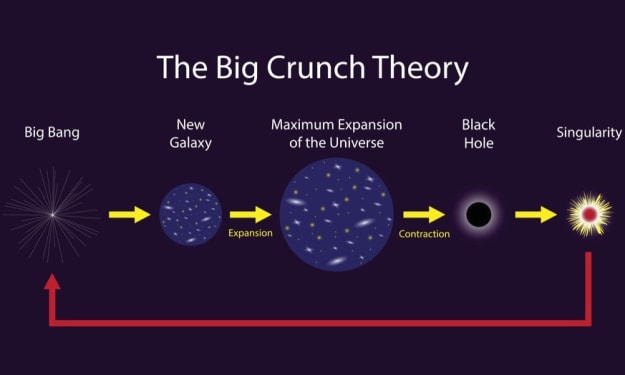
How will our universe end? Big Crunch Theory Of course, I'm referring to the Big Bang, which is what truly started everything again. Most people have heard of it, but what about the Big Crunch? I'm not talking about some weird candy bar here. We've all heard of the Big Bang, and I'm extremely sorry that the series has finished. There is still debate among scientists on how the universe will ultimately end, despite the fact that most of them believe it was created by a tremendous burst of energy. . There are many theories, like the big fries and the big rip, but the big crunch is thought to be the most likely scenario. So what is the Big Crunch? The Big Crunch Theory has its foundations in general relativity theory by Einstein Everything in life is ebb and flow; if the universe expands due to the Big Bang, then eventually the opposite will become true. Once the universe reaches its largest size, depending on the amount of energy present, it will start to collapse in on itself and eventually form a massive black hole that contains all matter because of the conditions that are present in the singularity of the size. Everything will be squashed down to a tiny size, which is why it is called the Big Crunch. This is probably not great news for all those of you who are a class apart and have a tendency to live billions of years. The good news is that although the Big Crunch is likely, there is a dilemma for people who devote their careers to answering questions like these. We still don't fully understand everything in the universe, and there are still certain unanswered questions that could determine our final destiny. First, it seems that two causes are interacting to cause the universe to expand. density and external momentum The more density there is in the universe, the more gravitational forces there are, since density and gravity are directly correlated. This alone would imply that everything will ultimately converge on everything. The problem with this, however, is that observations of the universe have shown that things aren't behaving as simply as we would expect. The outer reaches appear to be expanding at a faster rate than those closer to us, and galaxies are actually moving farther apart from one another. Scientists don't know why this is happening, but they have given this extra element in the expansion of the universe a name: dark energy. Even though there is no friction in space, the Big Crunch is still unavoidable since all matter would essentially return to its original location due to gravity's strong pull against the Big Bang's initial outward motion. However, there are two possible outcomes: either everything will expand indefinitely or objects will be so far apart from one another that everything will freeze and we will still face a big crunch. The amount of dark energy present will determine whether or not everything expands; if there is enough, which some scientists believe may be the case, then everything will continue to expand; if not, then gravity will eventually overcome the effect and bring everything back together. In a 2015 article, it was stated that the current accelerated rates of expansion are the last gasp of the expanding universe, contrary to some who believe the seeming prevalence of dark energy could easily indicate the beginning of the Big Crunch, which is the final gasp of the expanding universe, and that the contraction will start in tens of billions of years. In that case, how would the Big Crunch occur? Assuming that there isn't enough dark energy and that the Big Crunch occurs, it won't be as spectacular as the Big Bang was. The universe will begin to contract evenly because matter is more or less distributed consistently; this would be a slow process that would eventually pick up speed as galaxies get closer to one another and the effects of gravity become more pronounced in roughly 100 billion years. At that point, things would reach a climax temperature, which would cause star explosions, vaporizations, and the disintegration of all objects into their constituent atoms, which would then start to disintegrate in the final stages as all matter from the universe compacted into a small space. This will cause extreme chaos, according to some predictions, to the point where space-time becomes so warped that it breaks into droplets, rendering all concepts of time, distance, and direction meaningless. Of course, no living thing could have survived this far; we would all have been doomed long before this, so given our incomplete understanding of the processes occurring in the universe, it is impossible to predict with certainty how everything will end. One of the scenarios is the Big Crunch, in which all matter returns to its original location, leaving just an enormous black hole. What happens at that moment is totally up in the air, but it's possible that a new universe could be born. It's also possible that all of this has already occurred multiple times and that the period we are living in is only the latest in a long series of cyclical expansions and contractions. In this case, only those of you who hope to live for billions of years will truly need to be concerned.
By Emmanuel Ekow Quainoo3 years ago in Earth
What Happened in 2023!!!. Content Warning.
Introduction: In 2023, the world faced a multitude of viral issues that permeated various aspects of society, posing significant challenges and testing global resilience. From health crises and misinformation epidemics to cybersecurity threats and climate-related challenges, the year presented a complex tapestry of interconnected viral issues. This reflective piece aims to delve into the prominent challenges that dominated headlines, stirred debates, and shaped narratives, requiring concerted efforts to address and overcome.
By A G M Astekur Islam 3 years ago in Earth
Natural Phenomena That Will Give You Chills
Yellowstone National Park, with its breathtaking geysers and rejuvenating hot springs, is more than just a picturesque landscape; it sits atop a colossal super volcano. Beneath the park's surface lies a massive magma chamber, discovered by researchers from the University of Utah in 2015 to be even larger than previously estimated. This cavernous chamber, accompanied by an additional reservoir, boasts enough magma to fill the Grand Canyon not once, but an astonishing 11 times over.
By Marjie Crossman3 years ago in Earth