Science
The Realm of Reverie
In the small, quiet town of Eldoria, nestled between ancient forests and whispering hills, lived a young woman named Elara. Elara was known for her vivid dreams and nightmares, a gift—or curse—passed down through generations. Each night, she would traverse the ethereal landscape of Reverie, a realm where dreams and nightmares intertwined, shaping destinies and uncovering secrets.
By DEBORAH OLUBUNMI2 years ago in Earth
Why is Earth called a miracle planet?
Our Earth is truly miraculous, with perfect conditions for life to flourish. It's in a unique position in our galaxy. Not too close, not too far from the sun, it's just right for us. It's the third planet from the sun and the only one known to support complex life forms.
By Being Inquisitive2 years ago in Earth
What If Earth Had Atmosphere Like Venus?
Welcome to your new Earth, a world where the sky is no longer blue but a thick yellowish haze. A deep breath is no longer refreshing but instead will suffocate you, and the ground beneath your feet is so hot that it's melting your shoes. No, this isn't a nightmare you can snap out of. Earth's atmosphere has transformed into the conditions of our planetary neighbor and so-called evil twin, Venus.
By Dhrubajyoti Kalita2 years ago in Earth
The need for climate change
ChatGPT In the bustling heart of a city where glass towers gleam under the relentless sun, there exists a tale that whispers through the crowded streets and reaches every corner of bustling cafes and quiet parks. It's a story of our time, of a world waking up to the urgent call of climate change.
By DEBORAH OLUBUNMI2 years ago in Earth
YOU WON'T BELIEVE WHAT THIS MAN FOUND IN HIS BACKYARD
You Won't Believe What This Man Found in His Backyard. It Changed His Life Forever! It All Started With a Simple Garden Project . Richard Blake, an average guy from Springfield, embarked on what seemed like a routine garden project. His plan was simple: to plant some tomatoes in his backyard. Little did he know, this mundane activity would soon lead him to uncover a secret that had been buried for centuries, leaving experts and locals utterly speechless.
By Onuorah Uchenna2 years ago in Earth
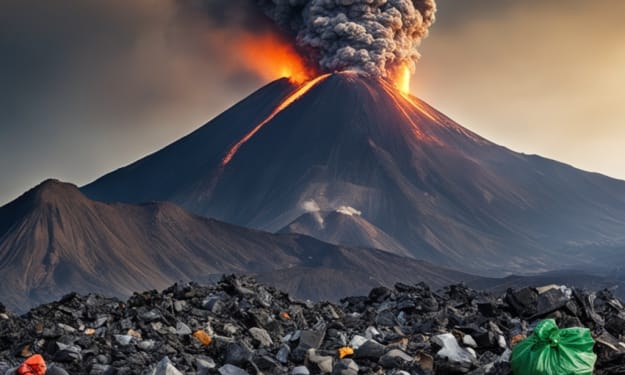
What If We Dumped Our Trash into Volcanoes?
A volcano is one of the most unforgiving natural phenomenons on Earth. If you were to fall into its magma-filled center, your body would quickly bubble up and disappear without a trace. So, if they’re so good at getting rid of things, has anyone tried it before? How would we transport all our trash to them, and what dangers would be in this? This is ‘What If,’ and here’s what would happen if we dumped our trash into volcanos.
By Dhrubajyoti Kalita2 years ago in Earth
From Octopuses to Bees: Unveiling Nature's Astonishing Secrets". AI-Generated.
Introduction: Octopuses: Are They Alien Visitors? Imagine a world where octopuses are not just fascinating sea creatures but potential extraterrestrial beings, visitors from outer space. This intriguing concept stems from the ancient Greek theory of panspermia, proposing that life exists throughout the universe, not limited to planets alone. According to this hypothesis, celestial bodies like ice-encased octopus eggs could have collided with Earth, blending their genetic material with the existing life forms here, giving rise to these intelligent cephalopods. While this notion might seem far-fetched, exploring the mysteries of octopuses unveils a realm of astonishing biological wonders that expand our understanding of life on Earth. The Ancient Origins and Remarkable Capabilities of Octopuses Octopuses, with their enigmatic intelligence, trace back millions of years, predating even dinosaurs. Fossil evidence indicates their existence nearly 300 million years ago, highlighting their enduring lineage in Earth's evolutionary history. What sets octopuses apart is not just their ancient origins but also their incredible adaptability and problem-solving abilities. Unlike most animals where the majority of neurons reside in the brain, octopuses allocate two-thirds of their neurons to their arms, granting them remarkable dexterity and autonomy. This allows them to multitask effectively, showcasing a level of intelligence akin to ninja-like prowess in the animal kingdom. Expanding Perspectives on Animal Intelligence: Pigs, Pigeons, and Kangaroos While humans often claim the title of the most intelligent species, recent studies have shed light on the cognitive abilities of other creatures. Pigs, for instance, surprised researchers by excelling in joystick-based video games, showcasing their cognitive agility and adaptability. Similarly, pigeons demonstrated an aptitude for art recognition, challenging traditional notions of animal perception and learning. Even kangaroos, particularly the red kangaroo, defy conventional locomotion norms by utilizing their tail as a fifth limb, showcasing nature's ingenuity in adapting to diverse environments. Australia's Wildlife Marvels and Hazards Australia, known for its unique wildlife, houses both marvels and hazards of the natural world. From the mesmerizingly venomous inland taipan snake to the dangerously potent funnel web spider, the continent harbors species that command both awe and caution. Yet, amidst these perils, Australia's fauna also offers insights into evolutionary adaptations, such as the red kangaroo's specialized locomotion techniques, showcasing nature's diverse strategies for survival. The Enigmatic Lives of Deep-Sea Dwellers: Angler Fish and Brittle Stars Venturing into the depths of the ocean unveils a world of peculiar yet ingenious creatures. Angler fish, with their bioluminescent lures and unique upside-down living habits, epitomize the adaptive marvels of deep-sea life. Likewise, brittle stars, despite lacking a conventional brain, exhibit remarkable learning capabilities, challenging our understanding of intelligence across different life forms. These enigmatic beings not only survive but thrive in extreme environments, pushing the boundaries of what we perceive as possible in the natural world. Color, Vision, and Behavior: Insights from Mantis Shrimps and Orange Cats The world of color perception and behavior reveals intriguing facets of animal cognition. Mantis shrimps, with their psychedelic vision owing to multiple photo receptors, pose questions about how they perceive their colorful surroundings. Conversely, the "orange cat behavior" phenomenon hints at potential links between coat color and feline behavior, although conclusive studies are yet to validate these connections fully. These nuances highlight the complexities of sensory perception and behavior in diverse animal species. Nature's Collaborative Wonders: Sloths, Fennec Foxes, and Red Pandas Collaboration and symbiosis are recurrent themes in nature's playbook. Sloths, adorned with algae in their fur coats, showcase a symbiotic relationship that aids both the animal and the algae's survival. Similarly, the fenic fox's adaptations to desert life and the red panda's gentle demeanor underscore nature's diverse strategies for thriving in varied ecosystems. These examples underscore the interconnectedness and interdependence prevalent in the natural world. The Ingenious Societies of Bees: Decentralized Intelligence and Cooperation Bees, with their minuscule brains, exemplify the power of decentralized intelligence and cooperative behavior. Their ability to share resources directly among hive members, such as transferring honey for energy, underscores a sophisticated social structure built on collaboration and communication. These insights into bee societies offer valuable lessons on collective intelligence and resource management, reflecting nature's mastery in fostering resilient communities. Conclusion: Revelations from Nature's Tapestry Exploring the diverse realms of animal intelligence, adaptation, and cooperation unveils a tapestry of wonders within the natural world. From the potential origins of octopuses to the collaborative societies of bees, each revelation deepens our appreciation for the intricacies of life on Earth. As we continue to unravel nature's mysteries, let us embrace the curiosity that fuels exploration and understanding, paving the way for new discoveries and insights into the fascinating world we share with countless remarkable species.
By Mbeha maliwa 2 years ago in Earth
Secrets Etched in the Landscape: Exploring Mysterious Symbols, Phenomena, and Legends from Above. AI-Generated.
If you take a bird’s-eye view of the United States, you might notice some peculiar barcode-like symbols etched into the pavement. Don’t worry—they’re not surveillance QR codes or ancient artifacts. These symbols have a fascinating history dating back to the 20th century when they were used to calibrate aerial and satellite cameras. Let’s explore these and other intriguing phenomena that can be seen from the sky, delve into eerie stories, and uncover legends that continue to captivate our imagination. ### Calibration Targets: Ey Charts for Cameras Back in the 20th century, the United States utilized peculiar symbols to fine-tune the imaging equipment of planes and satellites. Known as calibration targets, these symbols, made using black or white paint on concrete or asphalt, were essential for determining the optical resolution limits of aerial and satellite cameras. Smaller than a basketball court, these bar-shaped lines played a crucial role in ensuring accurate imagery from above. Today, advanced technology has rendered these targets obsolete. However, you can still find remnants of these calibration targets scattered across the U.S., including at the Nevada Test Site, Fort Huachuca in Arizona, and Travis Air Force Base in California. These relics serve as a testament to the evolution of imaging technology and its impact on scientific advancements. ### Phytoplankton Blooms: Nature's Watercolor Masterpieces Size does not always matter when it comes to observing remarkable phenomena from the sky. Take phytoplankton, for example—these teeny tiny bacteria, when viewed up close, seem insignificant. However, when they team up, they create breathtaking watercolor masterpieces visible from space. Thanks to NASA’s satellite images, we can witness the massive blooms they form, painting the ocean with vibrant hues. Phytoplankton blooms are explosive growth spurts of these tiny plants, happening rapidly. Satellites monitor their expansion to ensure they do not disrupt the marine ecosystem. These blooms are not just visually stunning; they play a crucial role in the ocean’s carbon cycle and provide a primary food source for marine life. ### Marfa Lights: Ghostly Glows in the Texas Desert You don’t need to venture into the sky to encounter eerie phenomena. The Marfa Lights in West Texas, near the quaint art town of Marfa, are a prime example. These ghostly lights appear at night near Highway 67 in the desert, manifesting as distant glowing spots of various colors that pulse and flicker. They move above desert plants, seemingly on a mission. While some attribute the lights to car headlights, ranch lights, or atmospheric reflections, those who have witnessed them insist these lights are unlike anything they’ve seen before. The Marfa Lights have been a source of intrigue since the late 1800s, when early settlers chased after them in the dark, only to come up empty-handed. ### The Roswell Incident: UFOs and Government Secrets No discussion of mysterious phenomena would be complete without mentioning Roswell, New Mexico. In 1947, a rancher and his son stumbled upon strange metallic debris on their property. The lightweight material was taken to the Roswell Sheriff, who then contacted Colonel Blanchard at the Roswell Army Airfield. An intelligence officer announced that the Army had recovered a flying saucer. Decades later, the U.S. Air Force released a report stating that the wreckage was merely a test balloon. However, the Roswell incident has continued to fuel UFO conspiracy theories and remains a cornerstone of paranormal lore. ### Mel’s Hole: A Bottomless Pit in Washington In the Manastash Ridge of Washington, a man named Mel Waters claimed to have discovered a mysterious hole on his property. This was no ordinary hole—it was believed to be a gateway to another dimension. For years, Mel and his neighbors used the hole as a personal trash can, yet it never filled up, no matter how much junk was tossed in. The hole exhibited other strange phenomena: radios picked up weird signals, and even dogs avoided it. Waters claimed that a mysterious black beam would sometimes shoot out of the hole, and portable radios would start playing tunes from the past. Attempts to measure the hole’s depth suggested it was deeper than 80,000 feet, but the bottom was never reached. The hole eventually disappeared, adding to its mystique. ### Skinwalker Ranch: A Hotbed of Paranormal Activity Skinwalker Ranch in Uintah County, Utah, spans 512 acres and has witnessed over 100 incidents of bizarre activity. Reports include animals disappearing, magnetic fields fluctuating, mysterious lights, and creatures with glowing red eyes. Despite numerous investigations, the strange occurrences remain unexplained. Some skeptics believe the current owners fabricate stories for attention, but the ranch has become the subject of movies, TV shows, and documentaries, keeping the legend alive. ### Mount Shasta: Myths and Legends in the Cascade Range Mount Shasta in California’s Cascade Range is shrouded in myths and legends. Indigenous tribes hold the mountain in high regard, believing a secret city lies within, filled with tunnels and treasures. In 1904, a British prospector claimed to have found an underground village with gold and ancient artifacts. However, he vanished before leading an exploration team back to the site. Speculations about Mount Shasta range from ancient civilizations to extraterrestrial beings. The mountain remains a focal point for mystical beliefs and adventurous explorations. ### The Nazca Lines: Ancient Geoglyphs in Peru For a truly eerie aerial experience, look no further than the Nazca Lines in the Peruvian desert. These massive geoglyphs, depicting shapes like spiders, spirals, and birds, are best seen from above. Created by the ancient Nazca culture, their purpose remains a mystery. Some theories suggest they were used for astronomical purposes or religious rituals. Despite being centuries old, the Nazca Lines have endured the test of time, captivating researchers and tourists alike. ### The Ghost Town of Rhyolite: Echoes of the Past In Nevada, the ghost town of Rhyolite stands on the edge of Death Valley, offering a glimpse into the past. Founded during a gold rush in 1904, Rhyolite boomed with essential establishments, including banks and schools. However, the financial panic of 1907 led to its rapid decline, and by 1920, only 14 residents remained. Today, Rhyolite’s crumbling structures and eerie bottle house, made of over 50,000 bottles, attract visitors. Paramount Pictures restored the bottle house in 1924, recognizing Rhyolite as an ideal filming location. ### Vatican Secret Archives: A Repository of Mysteries For a historical and slightly paranormal adventure, consider the Vatican Secret Archives. Although off-limits to the public, you can explore these archives virtually through Google Maps. Rumors suggest the archives hold secrets that could unravel mysteries and possibly even paranormal phenomena. ### Conclusion From the skies above the United States to the depths of mysterious holes and ancient geoglyphs, our world is filled with intriguing phenomena and legends. These stories, whether rooted in history or the realm of the paranormal, continue to captivate our imagination. As technology advances and we explore new frontiers, who knows what other mysteries we might uncover? Whether you’re a skeptic or a believer, there’s no denying the allure of these enigmatic tales etched into the landscape of our planet.
By Mbeha maliwa 2 years ago in Earth
The Sun vs. a Black Hole: Cosmic Clash of Titans**. AI-Generated.
*Introduction* Imagine a colossal giant like the Sun clashing with a seemingly tiny yet immensely powerful opponent: a small black hole. This cosmic collision could have drastic consequences for our solar system. Will the Sun withstand the intense gravitational pull of the black hole, or will it be swallowed whole? Let's explore the fascinating dynamics and potential outcomes of such a mind-blowing cosmic event by breaking down the forces at play. **Understanding Black Holes** A black hole is a region of space with such strong gravity that nothing, not even light, can escape from it. Acting like a cosmic vacuum cleaner, it sucks up anything that gets too close, warping the fabric of space-time around it. Black holes are among the most mysterious and powerful objects in the universe, challenging our understanding of physics. Black holes come in various sizes, from small ones a few miles wide to supermassive ones billions of times the mass of the Sun. Most black holes form from the collapse of massive stars. After their formation, black holes can grow by consuming everything in their path, and when two or more black holes collide, they can merge into one enormous cosmic entity. **Types of Black Holes** The smallest known black holes are called stellar black holes, weighing between 3 to 10 times the mass of our Sun. Despite being relatively small, they are incredibly dense, compressing vast amounts of matter into a tiny space. For comparison, intermediate-mass black holes weigh between 100 to 1,000 solar masses, while supermassive black holes can weigh millions or billions of solar masses and span unimaginably vast distances. **Formation of Stellar Black Holes** Stellar black holes are born from the remnants of massive stars. When a star exhausts its nuclear fuel, gravity takes over, causing the star to collapse. As it collapses, the core heats up to billions of degrees, eventually leading to a supernova explosion. The remaining core becomes a singularity, a point of infinite density and gravity, surrounded by an event horizon beyond which nothing can escape. **The Sun vs. a Black Hole: Potential Scenarios** Given the distances involved, the likelihood of our Sun colliding with a black hole is incredibly small. However, it's fascinating to explore the potential outcomes. The closest known black hole to our solar system, Gaia BH1, is about 1,600 light-years away, making such an encounter extremely unlikely. Yet, understanding how such a scenario could unfold helps us appreciate the forces at play in our universe. **Rogue Black Holes** One hypothetical scenario involves a rogue black hole passing through our solar system, much like a comet or asteroid. Unlike these visible objects, black holes are invisible and detectable only by their gravitational effects. If a rogue black hole approached the Sun, its immense gravity would start pulling material from the Sun's surface, leading to a process called spaghettification, where the Sun would get stretched and distorted. **The Accretion Disc** As the black hole pulled in material from the Sun, it would form a swirling disc around itself called an accretion disc. This disc would heat up, emitting intense radiation. The Sun, now significantly brighter and hotter, would release massive amounts of energy in the form of light and heat. The outer layers of the Sun would vaporize, creating a massive cloud of gas and dust that would expand outward. **Impact on Earth and the Solar System** Such an event would have catastrophic consequences for Earth. The intense radiation and solar material would cause wildfires and vaporize oceans. High-energy particles would bombard the planet, ionizing the atmosphere and making survival impossible. The entire solar system would be affected, with planets destroyed by the immense heat and radiation. **Tidal Disruption Event** In the unlikely scenario of a direct collision, the black hole's gravity would cause the Sun's outer layers to be pulled away, creating a tidal disruption event. This event would result in a massive explosion, and the black hole would grow in size, forming a new accretion disc around it. The Sun, being larger than a typical star, wouldn't be completely devoured but would be significantly disrupted. **Historical Perspective on Supervolcanoes** Volcanic activity, both in Antarctica and elsewhere, holds the potential to reshape our planet. Understanding past eruptions helps scientists predict future behavior. For example, the Central Atlantic Magmatic Province (CAMP) event over 200 million years ago involved a series of massive volcanic eruptions lasting 600,000 years. This activity released immense amounts of carbon dioxide, altering the planet's climate and contributing to the growth of dinosaurs. **The Yellowstone Supervolcano** The supervolcano beneath Yellowstone National Park is another significant point of concern. With a history of epic eruptions, Yellowstone's last major eruption occurred about 640,000 years ago. This eruption was a thousand times greater than the 1980 eruption of Mount St. Helens and reshaped much of North America. Despite its dormancy, recent underground activity at Yellowstone keeps scientists vigilant. **Monitoring Volcanic Activity** Advances in technology have significantly improved our ability to monitor volcanic activity. Satellites can detect thermal anomalies and gas emissions, while drones collect samples from inaccessible areas. These tools are crucial for understanding volcanic behavior and improving early warning systems. **Preparing for the Unpredictable** While predicting volcanic eruptions with absolute certainty is challenging, preparation and education are key to mitigating their impact. Communities near active volcanoes should be informed about evacuation routes, emergency shelters, and safety protocols. Governments must invest in research and monitoring to stay ahead of potential threats. **Conclusion** From the icy reaches of Antarctica to the fiery depths of black holes, the forces of nature hold immense power to shape our universe. By studying these phenomena and leveraging modern technology, scientists aim to unlock the secrets of these hidden giants. Understanding the dynamics of black holes and their potential impact helps us appreciate the delicate balance of our cosmic environment. As we continue to explore and understand the universe, we move closer to a future where we can coexist with these powerful forces. By staying informed and prepared, we can face the challenges posed by volcanic activity and cosmic events with greater confidence and resilience. Let’s keep researching, exploring, and observing the depths of space, ready for whatever the universe might throw our way.
By Mbeha maliwa 2 years ago in Earth
Volcanic Vents and Antarctic Mysteries: A Scientific Exploration of Dormant Threats. AI-Generated.
**Volcanic Vents and Antarctic Mysteries: A Scientific Exploration of Dormant Threats** *Introduction* Antarctica, the frozen continent at the southernmost part of the Earth, is not just a land of ice and snow. Beneath its thick ice sheets lie volcanic vents that release gases and vapors into the air. Under the right conditions, these vents can spew out enough material to build ice towers up to 10 feet tall. Despite the challenging conditions of this polar region, scientists have found ways to monitor these volcanic activities. However, predicting eruptions remains a daunting task. By analyzing past volcanic events, we can get a glimpse of what might happen if Antarctica's sleeping volcanoes awaken. Let's delve into the mysteries of these Antarctic volcanoes and explore their potential impact on our world. **Monitoring Antarctic Volcanoes** Scientists keep an eye on Antarctic volcanoes using seismometers, which detect tremors caused by volcanic activity. Sometimes, they also employ more sophisticated technology, but the remoteness and harsh conditions of Antarctica make this task incredibly challenging. This is why predicting eruptions is difficult. By studying past events, scientists can make educated guesses about future volcanic activities. **Mount Takahe: A Case Study** Nearly 20,000 years ago, Mount Takahe, one of Antarctica's dormant volcanoes, experienced a series of eruptions. These eruptions released a significant amount of halogen-rich gases into the atmosphere. Some scientists believe these events contributed to the warming of the Southern Hemisphere, leading to the melting of glaciers and the end of the last ice age. For similar events to happen today, we would need a series of eruptions from volcanoes now exposed above the ice, releasing substances rich in halogens. While this scenario is unlikely, it is not entirely impossible, given that it has occurred in the past. **Volcanoes Beneath the Ice** Volcanoes hidden under Antarctica's thick ice layers pose a different kind of threat. Their gases might not reach the atmosphere, but their heat could melt vast caverns at the base of the ice, producing significant amounts of meltwater. The West Antarctic Ice Sheet is already wet and not frozen to its bed, meaning this meltwater could act as a lubricant, setting the overlying ice into motion. Although a single eruption might not make a noticeable difference, multiple eruptions could accelerate ice movement, leading to increased ice flow into the ocean and rising sea levels. **Runaway Effect: A Chain Reaction** Scientists call this potential scenario a "runaway effect." If several volcanoes in West Antarctica erupt close to or beneath major ice streams, the resulting meltwater could increase ice flow into the ocean. These ice streams are essentially rivers of ice that carry most of Antarctica's frozen water to the ocean. A change in their speed and flow could lead to unusual amounts of water entering the ocean, raising sea levels and thinning the ice. This, in turn, could trigger more eruptions, creating a chain reaction similar to what happened in Iceland when glaciers began receding at the end of the last ice age. **Global Implications of Melting Ice** Antarctica holds about 80% of the world's fresh water. If all this ice melted, global sea levels would rise by nearly 200 feet, drastically altering our planet. Although this extreme scenario is unlikely, the melting of Antarctic ice due to volcanic activity could still have significant effects. Even without a catastrophic eruption, the lubrication of ice streams and the addition of meltwater to the ocean could contribute to sea-level rise, affecting coastal communities worldwide. **Supervolcanoes: A Historical Perspective** The concept of supervolcanoes adds another layer of complexity to the volcanic threat. Over 200 million years ago, the world experienced a series of massive volcanic eruptions known as the Central Atlantic Magmatic Province (CAMP) event. This supervolcano activity, which lasted for about 600,000 years, released immense amounts of carbon dioxide into the atmosphere, drastically altering the planet's climate. These eruptions are believed to have contributed to the growth of dinosaurs from small creatures to the giants we know from Jurassic Park. **Yellowstone: A Supervolcano in Waiting** In the present day, the supervolcano beneath Yellowstone National Park is a significant point of concern. Yellowstone has experienced some of the largest volcanic eruptions in Earth's history. The last major eruption, about 640,000 years ago, was a thousand times greater than the 1980 eruption of Mount St. Helens. This eruption reshaped the landscape, spreading ash and debris across much of North America. Despite its long dormancy, recent underground activity at Yellowstone keeps scientists vigilant. **Understanding Yellowstone's Activity** The ground above Yellowstone sits on a hot spot made of molten and semi-molten rock called magma. This magma flows into a chamber beneath the park, causing the ground to rise and fall. Volcano watchers have observed the ground lift about 10 inches over 20 years, but it has been subsiding since 2010. Experts believe that a massive eruption is not imminent, though smaller steam and hot water eruptions are possible. The timing and magnitude of future eruptions remain uncertain, making Yellowstone a subject of ongoing study. **Conclusion** Volcanic activity, both in Antarctica and around the world, holds the potential to significantly impact our planet. Understanding and monitoring these natural phenomena are crucial for predicting and mitigating their effects. While the scenarios described, from Antarctic meltwater to supervolcano eruptions, may seem like something out of a science fiction novel, they are rooted in scientific research and historical precedent. By staying informed and prepared, we can better navigate the challenges posed by these powerful forces of nature. Through continued exploration and study, scientists aim to uncover more about these hidden giants and their potential impact on our world. As we piece together the past and present activities of volcanoes, we move closer to understanding their future behavior. This knowledge not only satisfies our curiosity but also equips us to protect our planet and ourselves from the formidable power of volcanic eruptions.
By Mbeha maliwa 2 years ago in Earth