Science
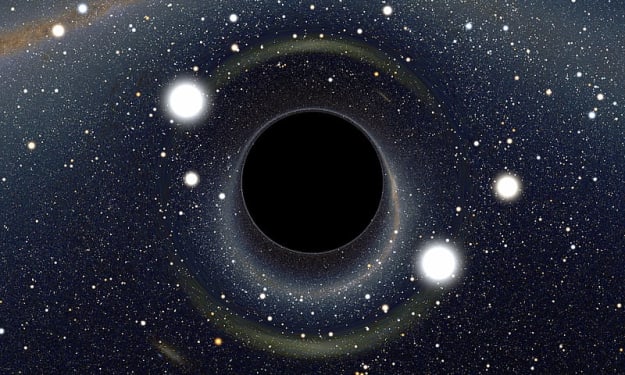
What if White and Black hole meet?
Black holes are giant space vacuums that pull everything inside. Have you heard of white holes, a space phenomenon? What would happen if these two met and collided? Let's explore them together. We can't see black holes directly, even with advanced telescopes. However, we can observe their effects on surrounding objects in space. When a black hole passes through a cloud of space matter, it pulls everything towards itself in a process called accretion. This causes the matter to become hot and emit detectable x-rays. Sometimes, a regular star may come too close to a black hole and get torn apart. A black hole is a super dense object with an incredibly strong gravitational pull that can stretch a star into a long and thin shape like spaghetti, a process we call spaghettification. The pieces of the star are pulled in, become hot, and emit x-rays. Alternatively, a black hole can squish a star, making it flat like a pancake. In contrast, white holes are less well known, and our knowledge of them is limited. White holes are theorized based on the same equations as black holes, and they are believed to have a mass and spin.They may have an Event Horizon that separates them from the rest of the universe. While black holes cannot release matter and energy, white holes can. They are like the most exclusive club in space, with no entry allowed. Overall, both black holes and white holes have similarities, but the key difference is that white holes can release matter and energy.
By Pallabi Saikia2 years ago in Earth
''The Incredible Mantis Shrimp: Exploring the Vibrant Colors and Powerful Claws of the Marine Marvel''
Description: Discover the fascinating world of the mantis shrimp, known for its vibrant colors and powerful claws. Learn about its unique abilities, habitat, and significance in marine ecosystems
By KingFree MaN2 years ago in Earth
'Saiga Antelope: The Plight of Central Asia's Critically Endangered Species'
Description: Discover the critically endangered Saiga antelope (Saiga tatarica) of Central Asia, known for its distinctive oversized nose. Learn about their habitat, behavior, threats, and conservation efforts.
By KingFree MaN2 years ago in Earth
''Tardigrade: Surviving Extreme Conditions and Beyond''
Description: Discover the fascinating world of Tardigrades (Phylum Tardigrada), also known as water bears or moss piglets. Learn how these microscopic creatures survive extreme conditions, including the vacuum of space.
By KingFree MaN2 years ago in Earth
Narwhal (Monodon monoceros): The Mythical Unicorn of the Sea
Introduction Narwhals (Monodon monoceros), often referred to as the "unicorns of the sea," are mysterious and enchanting creatures of the Arctic waters. These remarkable whales are renowned for their long, spiral tusks, which have intrigued scientists and fascinated humans for centuries. This comprehensive guide delves into the intricate details of narwhal life, exploring their habitat, behavior, and the critical conservation efforts to protect these unique marine mammals.
By KingFree MaN2 years ago in Earth
''Discover the Astonishing Star-Nosed Mole''
Introduction The star-nosed mole, scientifically known as Condylura cristata, is one of nature's most intriguing creatures. This small, burrowing mammal is easily identifiable by the 22 pink, fleshy appendages that surround its nose, giving it a distinctive star-like appearance. These appendages are not just for show; they are highly sensitive and play a crucial role in the mole's ability to detect prey through touch. Found primarily in the wet lowland areas of North America, the star-nosed mole is a marvel of evolutionary adaptation.
By KingFree MaN2 years ago in Earth
The Astonishing World of the Axolotl (Ambystoma mexicanum)
Introduction The axolotl, often referred to as the "Mexican walking fish," is a unique species of salamander renowned for its incredible regenerative abilities and perpetual larval state. This remarkable creature, native to the lake complex of Xochimilco near Mexico City, offers a captivating glimpse into the wonders of nature and the intricacies of evolutionary biology. In this comprehensive article, we will explore the axolotl's biology, habitat, conservation status, and its significance in scientific research.
By KingFree MaN2 years ago in Earth
The World's Busiest Airport
Hartsfield-Jackson Atlanta International Airport is the busiest airport in the world. It manages 250 flights per hour and processes 95,000 bags daily. The airport accommodates 2 million passengers weekly and employs 63,000 staff. The airport's operation is often likened to 'the underground Disney'. Delta Airlines Ramp Tower oversees aircraft operations, while Ground Control manages aircraft movements. Gate controllers are responsible for gate operations and ensuring timely turnarounds. Pilots and flight attendants have dedicated lounges for downtime and preparation, providing relaxation and privacy. Pilots rely on pre-departure paperwork for essential flight information and readiness. The ramp controller coordinates with air traffic control and provides instructions to pilots for on-time departure. The subterranean network handles 2700 flights per day, efficiently moving passengers and baggage. Properly closing train doors is crucial for air traffic safety, as trains cannot move without closed doors, potentially leading to air traffic delays. Atlanta's advanced technology aims to reduce lost or damaged bags through rigorous TSA screening, including bag inspection and security processes. Bags are inspected for explosive devices or trace materials, utilizing swabs on laptops and advanced technology for bag tracking. Jacksonville Airport also ensures efficient luggage handling and tight connection assistance, handling up to 108,000 bags daily and ensuring timely delivery to the correct flights.
By Isaac Ekow Anyidoho2 years ago in Earth
How 'Dark Oxygen' Could Redefine Our Understanding of Marine Life". AI-Generated.
The Unexpected Find Challenging Scientists' Knowledge of the Ocean" The ocean depths are one of the least explored and understood regions of our planet. Discoveries like ‘dark oxygen’ found 13,000 feet under the sea underscore the need for advanced technology and innovative research methods. Current technology allows us to reach these depths, but the harsh conditions and the vast expanse of the ocean mean much remains undiscovered. Future technological advancements will enhance our ability to map, explore, and understand these extreme environments. Uncovering the secrets of the deep sea is crucial, as it holds answers to fundamental questions about Earth’s biology, chemistry, and geology Future Research Directions Given the intriguing nature of ‘dark oxygen’, found 13,000 feet under the sea, future research will likely focus on several key areas: Characterization: Scientists will aim to characterize the chemical and physical properties of dark oxygen in more detail, such as its molecular structure, stability under different conditions, and reactivity. Interactions: Research will explore how dark oxygen interacts with other marine compounds, which could reveal new biochemical pathways and processes unique to deep-sea environments. Ecosystem Role: Understanding the role of dark oxygen in the broader deep-sea ecosystem will be essential. This includes studying its impact on deep-sea organisms, microbial communities, and overall biodiversity. Applications in Other Fields: The potential applications of this discovery in other scientific fields, such as astrobiology, will be an exciting avenue of exploration. Dark oxygen might offer clues about the potential for life on other planets with similar extreme conditions. 2Challenges in Studying Dark Oxygen Studying ‘dark oxygen’, found 13,000 feet under the sea, presents several challenges: Extreme Conditions: The high pressure, low temperatures, and complete darkness at these depths make sample collection and analysis complex and costly. Specialized submersibles and remotely operated vehicles (ROVs) are required for deep-sea expeditions. Technical Hurdles: Researchers must overcome technical hurdles related to pressure-resistant equipment, temperature regulation, and the preservation of samples during their retrieval and transport to the surface. Cost: Deep-sea research is expensive due to the need for advanced technology and logistics involved in conducting expeditions. Funding and resource allocation are critical issues for ongoing research. Despite these challenges, the potential rewards of understanding this phenomenon drive continued research and innovation in the field. The Broader Impact of the Discovery The discovery of ‘dark oxygen’, found 13,000 feet under the sea, has broader implications for our understanding of the ocean and its ecosystems: Complexity and Diversity: It serves as a reminder of the complexity and diversity of life on Earth, particularly in the most remote and extreme environments. Each discovery adds to our knowledge of the intricate web of life that exists in the deep sea.Scientific Advancement: Such discoveries not only advance scientific knowledge but also provide insights into evolutionary processes, biochemical adaptations, and the potential for life in similar extreme conditions elsewhere in the universe. Conservation Importance: Highlighting these unique habitats emphasizes the importance of preserving them for future generations. Conservation efforts can be informed by understanding the roles and interactions of different species and chemicals in these environments. Public Interest and Awareness The discovery of ‘dark oxygen’, found 13,000 feet under the sea, has sparked significant public interest. Media coverage and educational outreach are crucial for several reasons: Raising Awareness: Highlighting the importance of deep-sea research and ocean conservation helps the public understand why these areas are worth exploring and protecting. Engaging the Public: By engaging the public and fostering a sense of wonder about the natural world, scientists can garner support for continued exploration and preservation efforts. Educational Value: Educational outreach can inspire the next generation of scientists and researchers, encouraging them to pursue careers in marine science and related fields. Conclusion In summary, the discovery of ‘dark oxygen’, found 13,000 feet under the sea, represents a fascinating and complex phenomenon that challenges our current understanding of marine chemistry and biology. This discovery opens up new avenues for research and highlights the remarkable adaptability of life in extreme environments. As we continue to explore the depths of the ocean, we can expect to uncover even more secrets that enhance our knowledge of the natural world and our place within it. Continued research into dark oxygen will deepen our understanding of the ocean’s mysteries, improve our technological capabilities, and potentially reveal new biological and chemical principles applicable beyond
By Mohamed sha2 years ago in Earth