Science
NASA Image Reveals Earth's Tallest Lightning.
NASA Image Reveals Earth's Tallest Lightning. The recent capture of a rare atmospheric phenomenon known as a gigantic jet by the International Space Station (ISS) has once again sparked interest in the mysteries of Earth's upper atmosphere. This extraordinary form of lightning often called Earth's tallest lightning is a massive electrical discharge that occurs between powerful thunderstorms and the ionosphere reaching nearly 50 miles into the sky. Unlike conventional lightning that travels between clouds or from clouds to the ground gigantic jets extend upward piercing the atmosphere in a dramatic display of raw energy. These electrical events are rarely observed and even less frequently captured in photographs making this latest image a significant contribution to scientific understanding. Gigantic jets belong to a category of atmospheric discharges known as transient luminous events (TLEs). These phenomena include other unusual forms of lightning such as sprites blue jets and elves each with unique characteristics and behaviors. Gigantic jets however are particularly notable due to their immense scale and power. They have been described as electrical tendrils stretching toward space a stark contrast to the downward bolts of traditional thunderstorms. Though first documented in 2002 they remain an enigmatic aspect of atmospheric science with researchers still trying to determine the exact mechanisms behind their formation.
By Adnan Rasheed2 years ago in Earth
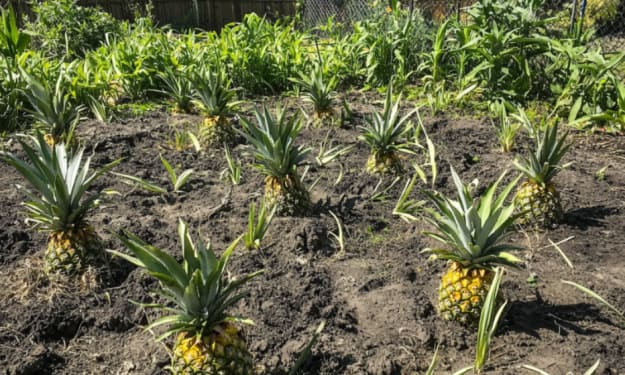
Plant Pineapples ALL Over Your Garden, See What Happens a Week Later.
When you hear the word pineapple, it probably elicits thoughts of a refreshing summer fruit sweet, tangy, tropical. Whether blended into smoothies, savored alongside savory meals, or consumed fresh by themselves, pineapples are one of the most loved fruits on the planet. But often overlooked is the simple fact that fruit can be grown even in some of the coldest climates. Fruits you should plant.
By Rohitha Lanka2 years ago in Earth
NASA’s Europa Clipper Uses Mars to Go the Distance.
NASA’s Europa Clipper Uses Mars to Go the Distance. NASA’s Europa Clipper is set to embark on a historic journey to explore Jupiter’s moon Europa one of the most intriguing celestial bodies in the solar system. This mission designed to determine whether Europa has conditions suitable for life relies on a strategic interplanetary route that includes multiple gravity assists. On March 1, 2025 the spacecraft will execute a critical maneuver by using Mars’ gravity to adjust its trajectory and fine tune its path toward the outer solar system. This technique a staple in NASA’s space exploration playbook allows the spacecraft to conserve fuel and optimize its travel time. Europa Clipper’s encounter with Mars is a planned gravity assist a maneuver where the spacecraft flies close to a planet to alter its trajectory using the planet’s gravitational pull. The upcoming flyby will bring the probe just 550 miles 884 kilometers above the Martian surface taking advantage of the Red Planet’s gravitational force to reshape its solar orbit. This interaction will slow down the spacecraft slightly refining its path in preparation for the next major assist a slingshot around Earth in December 2026. As Europa Clipper approaches Mars it will be moving at an impressive velocity of 15.2 miles per second 24.5 kilometers per second relative to the Sun. The planet’s gravity will act as a cosmic steering wheel bending the spacecraft’s path and adjusting its speed. After the flyby Europa Clipper will continue its voyage at a slightly reduced speed of 14 miles per second 22.5 kilometers per second positioning it for the next leg of its interplanetary journey.
By Adnan Rasheed2 years ago in Earth
NASA installs 'bulletproof' sunshade on powerful Nancy Grace Roman Space Telescope.
NASA installs bulletproof sunshade on powerful Nancy Grace Roman Space Telescope. NASA's Nancy Grace Roman Space Telescope has achieved a significant milestone with the successful installation of its deployable sunshade a critical component designed to enhance the observatory's ability to capture faint infrared signals from the cosmos. This advancement brings the mission closer to its anticipated launch in 2027 promising to expand our understanding of the universe. The sunshade officially known as the Deployable Aperture Cover functions akin to a pair of blackout curtains effectively blocking unwanted light that could compromise the telescope's sensitive observations. Constructed from two layers of reinforced thermal blankets the design ensures that stray light is minimized thereby increasing the telescope's sensitivity to distant celestial objects. One of these layers is fortified with Kevlar the same material used in bulletproof vests providing robust protection against potential micrometeoroid impacts. This meticulous engineering ensures that even if one layer is perforated the staggered design reduces the likelihood of light penetrating both layers simultaneously maintaining the integrity of observations.
By Adnan Rasheed2 years ago in Earth
The Global Sneeze: How Pandemics Spread
Picture a world where every continent is just a hop, skip, and a jump away—a dazzling global network where modern jet travel can whisk you (and any unwelcome microscopic hitchhiker) from one side of the globe to the other in the blink of an eye. Today, a single sneeze in a crowded subway station can ignite a chain reaction that transforms local germs into a worldwide spectacle. Welcome to the age of instant connectivity, where every handshake and every boarding pass carries the hidden potential to spark a health crisis.
By Eyo Otoabasi2 years ago in Earth
What Will Happen if War Comes?
What Will Happen if War Comes? Sitting by the window, I watch the clouds in the sky, heavy and dark. It's hard to shake the knot of fear in my stomach. If there is a war, what will become of us? Will any of us survive, or will this world we know be lost forever? It chills me to the bone. People say Donald Trump will start the next war. Please god no save us. The world seems set out to cause wars.
By ♿ V+ Marie381Uk 2 years ago in Earth
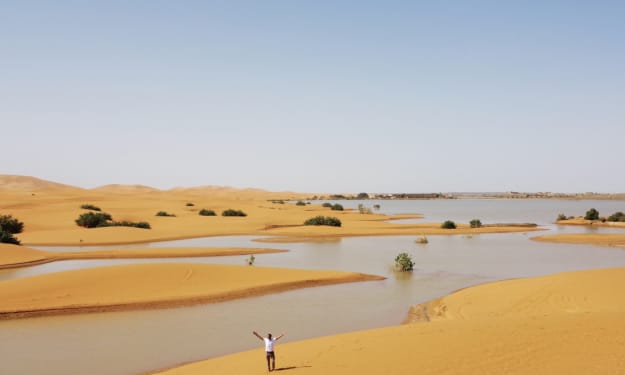
HOW SAHARA IS CHANGING
The Sahara is often seen as a barren wasteland. However, recent satellite images reveal surprising sights—lakes and rivers in Morocco and Algeria. This change followed heavy rains in early September 2024. These are not oases; they mark the Sahara returning to a wetter state. Long ago, the Sahara was a lush paradise with rich vegetation.
By Rafsan monir Kousol2 years ago in Earth
What Should Businesses Expect From A Staffing Agency?
Businesses often need reliable employees to keep operations running smoothly. A staffing agency in Philadelphia helps bridge the gap by providing skilled professionals suited for various roles. Whether a company needs temporary workers or long-term hires, these agencies streamline the hiring process and reduce the workload for business owners.
By United Development Staffing LLC2 years ago in Earth