Science
Invisible Wings: The Secret Beauty of the Glasswing Butterfly
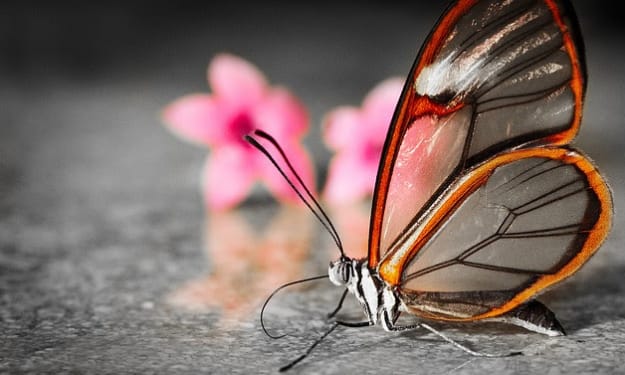
Introduction Some of nature’s most astonishing wonders aren’t always bold and colorful — sometimes, they’re nearly invisible. Among these hidden gems is the Glasswing Butterfly (Greta oto), a delicate insect whose wings are so transparent, they almost disappear into the air. With its ghostlike flight and crystal-clear wings, this butterfly isn’t just beautiful — it’s a quiet marvel that challenges how we define visibility, beauty, and survival. --- Appearance and Features At first glance, the Glasswing Butterfly may seem like a trick of the light. Its wings, which span about 5.5 to 6 centimeters, are almost completely transparent. The edges of the wings carry soft tints of brown or orange, but the rest is see-through — like polished glass. The secret lies in the structure of its wings. Unlike most butterflies, whose wings reflect light to produce color, the surface of the glasswing’s wings is covered in microscopic structures that scatter light and reduce reflection. This makes them nearly invisible against their surroundings. --- Habitat and Distribution Glasswing Butterflies are native to Central and parts of South America. You can find them fluttering through the rainforests of countries like Mexico, Panama, Costa Rica, Ecuador, and Colombia. They prefer warm, humid environments with abundant flowering plants — especially in shaded forest areas where they can hide and feed safely. --- Feeding and Behavior Glasswings feed on the nectar of a wide variety of flowers, but they are particularly attracted to plants that are toxic to other creatures. By feeding on certain poisonous plants, they become distasteful — even mildly toxic — to predators like birds and lizards. This combination of invisibility and toxicity gives them an impressive survival advantage. It’s nature’s version of an invisibility cloak backed by a hidden warning sign: "You can't see me — and even if you eat me, you'll regret it." --- Defense Mechanisms In addition to their see-through camouflage, these butterflies have another form of protection — chemical defense. The toxins they absorb from host plants linger in their system, making them unappetizing or even harmful to would-be predators. Predators quickly learn to avoid them. And since their wings don’t offer a bold warning like many other butterflies, their transparency becomes the ultimate disguise. --- Reproduction and Life Cycle Males release special pheromones to attract females, and courtship is usually subtle and slow. Once mating occurs, females lay their eggs on specific toxic host plants. The emerging caterpillars feed on these plants to absorb the same protective chemicals that will help them survive later in life. The caterpillars go through the usual butterfly transformation — egg to larva to pupa to adult — emerging finally as the ghostlike adult butterflies that drift silently through the forest. --- Scientific and Artistic Inspiration Scientists have studied the wing structure of Glasswing Butterflies in detail, as their anti-reflective properties offer insights for technology. Engineers and designers are mimicking this natural nanotechnology in everything from glare-free glass to advanced optical lenses. Meanwhile, artists and poets continue to be inspired by the butterfly’s elegant, ghostlike beauty — a living contradiction of strength through softness, of presence through absence. --- Symbolism and Cultural Meaning In various cultures, the Glasswing Butterfly symbolizes transparency, purity, and quiet transformation. Its nearly invisible wings speak to the unseen beauty in the world — the kind that doesn’t shout but whispers its presence. For many, it serves as a reminder that sometimes, the most powerful and resilient things are those we barely notice. --- Conclusion The Glasswing Butterfly is more than a scientific curiosity — it's a living poem. Its wings may be transparent, but its presence is unforgettable. It teaches us that beauty isn’t always about bold colors or loud displays. Sometimes, it’s about grace, mystery, and the elegance of blending in. In a world that often rewards noise and show, the Glasswing Butterfly thrives in silence and subtlety — proving that even the quietest creatures can leave the loudest impression.
By Insect Legendsabout a year ago in Earth
The Peacock Spider – Nature’s Tiny Dancer of Color
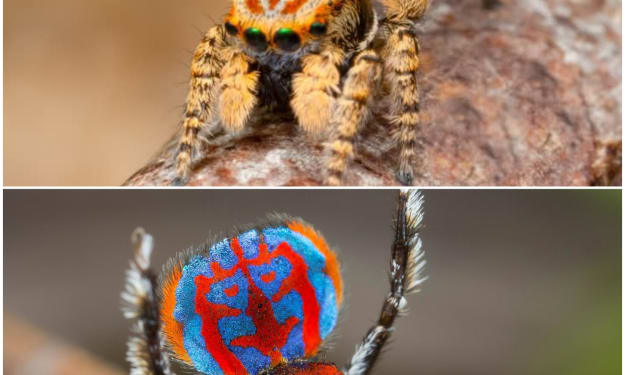
Introduction Among the many hidden wonders of nature, the Peacock Spider stands out as a tiny masterpiece of design and behavior. Found only in Australia, this spider belongs to the Maratus genus and has captured global attention through its dazzling colors and mesmerizing mating dances. Though small in size, it’s a true spectacle in the world of arachnids — a creature that merges beauty, biology, and rhythm in the most unexpected way. --- Appearance and Colors The Peacock Spider is incredibly small — adult males usually measure between 4 to 6 millimeters in length. But despite their tiny size, they boast some of the most vivid and brilliant coloration in the insect world. Male peacock spiders are adorned with bright blue, red, orange, yellow, and green markings that shimmer in the light like a living gemstone. Their most famous feature is the flap-like, colorful “abdomen fan” that males lift and display during courtship. This colorful plate resembles the fan of a peacock’s tail feathers — hence the name — and plays a key role in attracting females. --- The Dance – A Performance of Survival What truly sets the Peacock Spider apart is its unique and elaborate courtship ritual. When a male spots a female, he begins an intricate and rhythmic dance to impress her. He raises his colorful abdominal fan, extends his third pair of legs (which are also brightly colored), and begins to shake, vibrate, wave, and sway — all in perfect coordination. This dance isn’t random. It’s highly choreographed and varies between different Maratus species. Some even make clicking or vibrating sounds using body movements, adding an acoustic layer to their performance. The dance can last several minutes, and its success determines whether the male will mate — or be rejected, or worse, eaten by the female. --- Habitat and Lifestyle Peacock Spiders are endemic to Australia and are primarily found in dry, open environments like sandy areas, scrublands, and bushland regions in Western Australia, New South Wales, and Tasmania. They prefer habitats with plenty of leaf litter or shrubs under which they can hide and hunt. Unlike many other spiders, peacock spiders do not build webs to trap prey. Instead, they are active hunters, stalking and pouncing on small insects with cat-like precision during daylight hours. Their excellent vision and agility make them skilled predators despite their small size. --- Are They Dangerous? Not at all. Despite being spiders, Peacock Spiders pose no threat to humans. They are not venomous in a way that would harm people, and their tiny fangs are not even capable of piercing human skin. They are harmless, shy, and more interested in their tiny insect prey and dance routines than anything else. In fact, they are considered one of the most harmless and visually appealing species of spiders on the planet. --- Why Are They So Popular? Peacock Spiders have become internet celebrities thanks to high-definition macro photography and viral videos that showcase their colorful dances. Scientists, nature photographers, and YouTubers alike have documented their behaviors in stunning detail, leading to a surge of interest among people who might otherwise fear or dislike spiders. Their charm has helped change the perception of spiders for many people — turning fear into fascination. --- Scientific Discovery and New Species Over the past few decades, dozens of new Peacock Spider species have been discovered. Each has its own unique color pattern and dance style. Scientists like Dr. Jurgen Otto, an entomologist who has dedicated years to studying and filming these spiders, have brought these tiny wonders into the spotlight, showing that even the smallest creatures can be extraordinary. The discovery of new Maratus species continues as researchers explore more regions of Australia. Each new find adds to the colorful puzzle of nature's artistry. --- Conclusion The Peacock Spider may be tiny, but it represents a grand performance in the world of nature. Through its brilliant colors, elegant movements, and harmless charm, it captures the imagination and challenges our view of spiders and insects as a whole. It reminds us that beauty is not only found in large or majestic creatures, but sometimes in the smallest of beings. The Peacock Spider, with its dance of life, is a celebration of nature’s creativity — and a reminder that there is always more wonder waiting to be discovered, even beneath a leaf.
By Insect Legendsabout a year ago in Earth
The Great Black Wasp: Nature's Unsung Hero
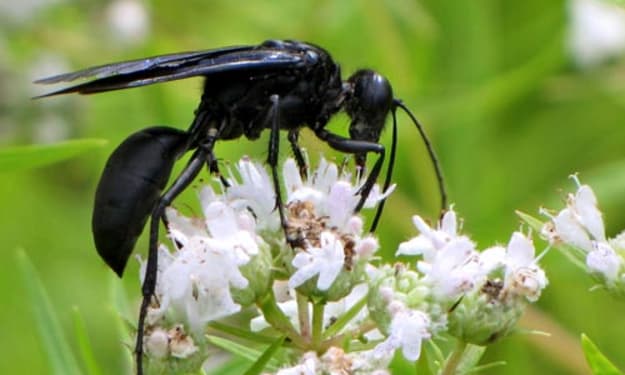
Introduction Amidst the myriad of insects that inhabit North America, the Great Black Wasp (Sphex pensylvanicus) stands out not only for its imposing appearance but also for its pivotal role in maintaining ecological balance. Despite its intimidating size and coloration, this solitary wasp is a benign presence, contributing significantly to pollination and natural pest control. This article delves into the physical characteristics, habitat, behavior, life cycle, and ecological importance of the Great Black Wasp, shedding light on this remarkable yet often overlooked insect. --- Physical Characteristics The Great Black Wasp is a member of the digger wasp family, characterized by its substantial size and distinctive coloration. Females typically measure between 1.3 to 1.5 inches in length, while males are slightly smaller. The wasp's body is entirely black, exhibiting a glossy, almost metallic sheen. Its wings possess a subtle blue iridescence, adding to its striking appearance. Notable features include long, segmented antennae, large compound eyes, and robust mandibles. The female's stinger is a modified ovipositor used primarily for subduing prey rather than defense. --- Habitat and Distribution The Great Black Wasp is widely distributed across North America, thriving in diverse habitats ranging from open fields and meadows to suburban gardens. Its adaptability allows it to inhabit areas with varying climates, though it shows a preference for warmer regions. Unlike social wasps that build communal nests, the Great Black Wasp is solitary, constructing individual nests underground. Females excavate burrows in loose, sandy soil, often in sunny locations, to create a suitable environment for their offspring. --- Behavior and Diet As a solitary predator, the female Great Black Wasp exhibits fascinating hunting behaviors. She preys primarily on insects from the Orthoptera order, such as katydids, grasshoppers, and crickets. Using her powerful mandibles and stinger, she captures and paralyzes her prey, transporting it back to her burrow. There, she places the immobilized insect into a nest chamber and lays a single egg upon it, providing a live food source for the emerging larva. This method ensures the larva has fresh nourishment during its development. Adult Great Black Wasps primarily feed on nectar and pollen from various flowering plants. This dietary preference makes them effective pollinators, as they inadvertently transfer pollen from one flower to another while foraging. Their preference for plants like milkweed and Queen Anne's lace highlights their role in supporting the reproduction of these species. --- Nesting and Reproduction The nesting behavior of the Great Black Wasp is a testament to its industrious nature. Females meticulously dig burrows that can extend up to a foot into the ground, creating multiple chambers for their offspring. Each chamber is provisioned with a paralyzed insect, upon which a single egg is laid. After sealing the chamber, the female may continue to hunt and prepare additional nests. The larva hatches within a few days, feeding on the provided prey until it pupates and eventually emerges as an adult wasp. This life cycle ensures that the young have a secure environment and ample nourishment during their development. --- Interaction with Humans Despite their formidable appearance, Great Black Wasps are generally non-aggressive toward humans. Females can sting but typically only do so when directly threatened. Males, lacking stingers, pose no threat. Their solitary nature means they do not defend communal nests, reducing the likelihood of human-wasp conflicts. For individuals without specific allergies to wasp venom, encounters with this species are usually harmless. --- Ecological Importance The Great Black Wasp plays a dual role in its ecosystem as both a pollinator and a natural pest controller. By feeding on nectar and pollen, it facilitates the pollination of various plants, contributing to biodiversity and the health of plant communities. Simultaneously, its predation on herbivorous insects like grasshoppers and katydids helps regulate populations that might otherwise damage vegetation. This balance underscores the wasp's contribution to the stability and health of its habitat. --- Conclusion The Great Black Wasp exemplifies the intricate interconnections within natural ecosystems. Its solitary yet industrious lifestyle, combined with its roles as a pollinator and predator, highlights the importance of even the most unassuming creatures in maintaining ecological balance. By understanding and appreciating the life and contributions of the Great Black Wasp, we gain insight into the complex web of life that sustains our environment.
By Insect Legendsabout a year ago in Earth
Alien or Ancient Human? The Truth Behind Peru’s Mysterious Three-Fingered Mummy
In southern Peru near the Nazca Lines they found a very mysterious mummy in a tomb. The discovery was made in early 2017 and it took the internet by storm. Everyone was curious about this mummy and what made it different from others.
By Tabraiz Bukhariabout a year ago in Earth
Not India, This Is the USA”: Viral Clothesline Video Sparks Unexpected Culture Clash
‘Not India, this is USA’: Viral Video of Clothes Drying in Backyard Triggers Heated Discussion, Backlash In the age of social media, even the most mundane aspects of daily life can spark viral debates — and the latest example is a video that has divided the internet over something as simple as drying clothes in the backyard.
By Sultan Khanabout a year ago in Earth
Hybrid Power Systems Market will grow at highest pace owing to increasing focus on renewable energy adoption
The hybrid power system market comprises systems consisting of two or more electricity generators that operate simultaneously to provide power. Hybrid power systems make use of both renewable energy sources such as solar and wind power along with backup generators that run on diesel, natural gas or other fuels. These systems enable continuous power supply by leveraging complementary power sources and storage capabilities. Hybrid Power Systems cater to off-grid and weak-grid consumers in remote areas and are also widely deployed as decentralized power solutions in developing nations where conventional power infrastructure is underdeveloped. They help avoid dependency on a single source of energy and minimize carbon footprints by optimizing the use of renewable resources. The key components of these systems include photovoltaic panels, wind turbines, battery banks and backup generators.
By carollakraabout a year ago in Earth
The Big Bang Theory: The Explosive Birth of Our Universe
Introduction Imagine everything—every star, planet, galaxy, and even the space between them—compressed into an infinitely dense point. Then, in a split second, an unimaginable explosion takes place, resulting in the birth of time, space, and matter itself. This is the Big Bang Theory, the most widely accepted explanation for the origin of our universe.
By Akib Ashrafabout a year ago in Earth
The Hidden World of the Centipede: Nature's Swift and Secretive Predator
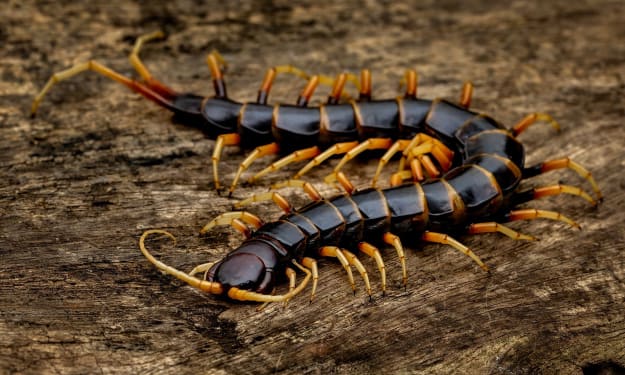
In the damp corners of our homes, beneath rocks in the forest, or buried deep in the soil, a long, segmented creature moves with astonishing speed. The centipede, whose name means "hundred feet," is one of the most misunderstood yet fascinating predators in the insect world. Despite their unsettling appearance, these creatures have a unique and important role in ecosystems. Anatomy of a Night Hunter Centipedes belong to the class Chilopoda and can be found on every continent except Antarctica. Ranging in size from a few millimeters to over a foot long, these invertebrates have between 15 and 177 pairs of legs, depending on the species. Contrary to their name, no centipede actually has exactly 100 legs. Their bodies are flat and flexible, allowing them to slip into narrow cracks and crevices. The first pair of legs has evolved into venomous fangs known as forcipules, used to paralyze their prey. Their antennae are highly sensitive, helping them navigate and hunt in complete darkness. The Perfect Predator Centipedes are carnivorous and feed on insects, spiders, and even small vertebrates such as lizards or mice, depending on their size. They are fast, agile, and lethal. A single bite from a large centipede can kill prey quickly, thanks to their venom. Their hunting style is silent and efficient. They rely on speed and stealth to ambush their prey, wrapping around them and injecting venom before devouring them. This role helps control insect populations, making centipedes beneficial to the balance of natural habitats. Living in the Shadows These creatures are nocturnal and prefer moist environments. During the day, they hide under rocks, logs, leaves, or inside walls and basements. At night, they emerge to hunt. Their preference for darkness and hidden places has earned them a fearful reputation among humans. Many people encounter them in their homes and panic. But while their appearance may be intimidating, most centipedes are harmless to humans. Bites are rare and usually not medically serious, though they can be painful. A Survivor Through Time Fossil records show that centipedes have existed for over 400 million years, evolving and adapting through countless environmental changes. Their resilience makes them one of the oldest surviving land arthropods. Some ancient centipedes, such as the extinct Arthropleura, could grow over two meters long, making them among the largest invertebrates to ever crawl the Earth. Today’s centipedes are much smaller, but their adaptability remains impressive. Cultural Fascination and Fear Throughout history, centipedes have appeared in folklore, mythology, and art — often symbolizing fear, mystery, or protection. In some Asian cultures, large centipedes are used in traditional medicine and believed to possess spiritual power. In horror literature and films, their image is often used to evoke discomfort or fear. Their alien-like body and rapid movement make them an ideal creature for spooky tales. But in truth, they are more helpful than harmful. Conservation and Curiosity Though not endangered, centipedes are sensitive to environmental changes, particularly pesticide use and habitat destruction. As we expand cities and alter natural landscapes, their populations may decline in some areas. Learning about these creatures can help reduce irrational fear and encourage respect for their role in nature. Observing centipedes in their natural environment reveals a creature finely tuned for survival — fast, quiet, and effective. Final Thoughts The centipede is a creature of darkness, not evil — a predator, not a pest. Its presence reminds us that nature’s design includes all shapes and strategies. Every creature, even those that crawl in shadow, has its place and purpose. So the next time you see a centipede, pause your fear. Instead, marvel at its ancient design, its quick movements, and its secret life. For in the quiet corners of the world, the centipede reigns as a silent and swift guardian of the balance of nature.
By Insect Legendsabout a year ago in Earth
The Butterfly’s Secret: A Journey Through Change, Color, and Courage
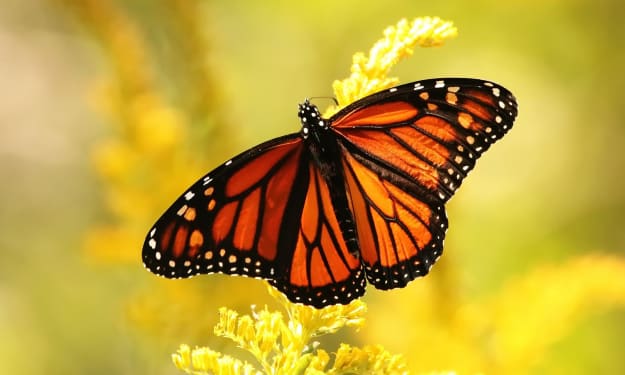
In the quiet corners of gardens, forests, and meadows, a tiny creature begins a journey that is nothing short of miraculous. The butterfly, with its delicate wings and graceful flight, wasn’t always a symbol of beauty and transformation. Its life begins humbly, as a caterpillar inching along leaves, focused solely on eating and growing. But hidden within this crawling creature is a blueprint for greatness. It teaches us that beginnings do not define the end, and that within the ordinary lies the potential for the extraordinary. The Metamorphosis Miracle The butterfly's life is divided into four main stages: egg, larva (caterpillar), pupa (chrysalis), and adult. Each stage carries its own challenges and beauty, but the transformation from pupa to butterfly — called metamorphosis — is perhaps one of the most astonishing in the animal kingdom. Inside the chrysalis, the caterpillar’s body dissolves into a kind of biological soup. From this fluid, a new form is built — wings, antennae, new legs. It is like watching a story of destruction and rebirth happen in silence, inside a fragile shell. The process is so profound that scientists still study the genetic and cellular mysteries that guide this transformation. This incredible metamorphosis shows us that true change often happens in quiet, unseen places. Just as the caterpillar must endure the stillness and vulnerability of the chrysalis, we too must sometimes retreat to grow, to heal, and to re-emerge stronger. Nature's Masterpiece Butterflies come in over 20,000 species around the world. Their wings display every color imaginable, often with patterns that serve as camouflage, warnings, or courtship signals. Some butterflies mimic leaves to hide from predators, while others display bright colors to warn that they are toxic. Their beauty is not just skin-deep. Butterflies play vital roles in ecosystems: they pollinate flowers, serve as food for other animals, and act as indicators of a healthy environment. When butterflies thrive, nature is usually in balance. Some butterflies migrate thousands of miles, such as the Monarch, which travels from North America to Mexico. This epic journey, driven by instinct and perseverance, adds yet another layer of awe to their story. Cultural and Emotional Symbolism Across cultures, butterflies symbolize change, hope, and the soul. In many traditions, seeing a butterfly is believed to be a message from a loved one or a sign of good fortune. Their short but vibrant lives remind us to live fully and embrace our own transformations. In literature and poetry, the butterfly often represents personal growth and emotional healing. It whispers the truth that pain and darkness can lead to flight and light. Artists have painted them, writers have praised them, and spiritual leaders have reflected on their journey as a metaphor for enlightenment. Threats and Conservation Despite their beauty, butterflies are facing serious threats: habitat loss, climate change, and pesticides are reducing their numbers rapidly. Species like the Monarch butterfly have become symbols of the environmental crisis. But the story isn’t over. Conservation efforts, like planting native flowers, avoiding chemical sprays, and creating butterfly gardens, can help protect these winged wonders. Every garden can become a sanctuary. Communities, schools, and individuals can all contribute to building environments where butterflies can thrive. Organizations across the globe are now tracking butterfly populations, engaging in habitat restoration, and raising awareness about pollinator protection. Supporting these efforts means supporting biodiversity and the health of our planet. What the Butterfly Teaches Us The butterfly teaches us to be patient with change. That growth can be uncomfortable, even painful — but it leads to something beautiful. It reminds us that we all have a hidden potential waiting to take flight. It teaches resilience, grace, and the power of quiet evolution. Just as the butterfly spreads its wings after transformation, we too can emerge from our trials with renewed strength and color. Their journey encourages us to trust the process, no matter how uncertain it seems. So next time you see a butterfly, pause for a moment. In that fleeting dance of color, a quiet wisdom glows. Let it remind you that beauty often rises from the most unexpected places.
By Insect Legendsabout a year ago in Earth