Science
Islands of the Ocean in World
Islands of the Ocean in World The vast blue oceans of our planet hold countless islands each with its own unique story. These landmasses rising from the watery depths are like nature’s experiments in isolation and adaptation. From towering volcanic peaks to flat coral atolls islands come in many forms and sizes. They are home to strange creatures rare plants and cultures found nowhere else on Earth.
By Arsalan Khanabout a year ago in Earth
James Webb Telescope Uncovers Planetary Catastrophe
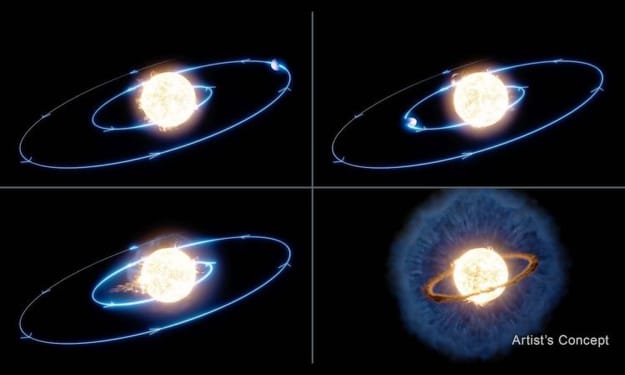
The James Webb Telescope Reveals the Truth About a Planet That Crashed Into Its Own Star The James Webb Space Telescope (JWST) of NASA has revealed for the first time compelling evidence of a planet that literally crashed into its own star, making a ground-breaking discovery about a distant planetary system. The cosmic event not only challenges current theories about planetary stability but also opens a new window into the life cycle of planetary systems. The Brutal Decline of a Planet A distant star with the designation WD 0145+234, which is approximately 570 light-years away, was the source of unusual light signatures and infrared emissions that were observed by the JWST. What initially appeared to be a typical white dwarf—a stellar remnant of a sun-like star—soon revealed an intense infrared glow inconsistent with its usual profile. Upon deeper analysis, the Webb Telescope’s highly sensitive instruments detected traces of vaporized rock and heavy metals like iron and magnesium swirling in the star’s atmosphere. These elements are hallmarks of terrestrial planets, indicating that a rocky planet had been violently torn apart and consumed by the dying star. How did it occur? According to scientists, the catastrophic event likely began after the star exhausted its nuclear fuel and collapsed into a white dwarf. The star's planetary system's gravitational landscape would have changed dramatically during this transformation. The resulting chaos could have destabilized nearby planets, pushing them into decaying orbits. In this instance, one unfortunate planet was pulled inward until it was torn apart by gravitational forces. The Webb Telescope was able to observe the thermal and spectral signatures left by the metallic debris, vaporized rock, and planetary dust that were left behind as they spiraled into the star. A Glimpse Into Our Future? This discovery is not just an isolated celestial drama—it could also serve as a preview of what might happen in our own solar system billions of years from now. When our Sun eventually becomes a white dwarf, it too could disturb the orbits of the remaining planets. The gravitational pull of the dying star could engulf or shatter Earth, resulting in a similar fate. Redefining Our Knowledge Our understanding of the evolution of planetary systems is being transformed by the James Webb Space Telescope's ability to observe these minute details at such great distances. Not only has it provided a direct glimpse into the destructive end of a planet’s life, but it has also offered critical insights into how stars and their planets interact over cosmic timescales. Dr. says, "This is a smoking gun." Elena Morales, one of the project's lead researchers. “We’ve long suspected that stars could consume their planets, but this is the first time we’ve seen clear, unambiguous evidence.” What’s Next? Researchers plan to continue using JWST to observe other white dwarf systems for similar signs of planetary disruption. The hope is to gather enough data to create a broader theory of how common these planetary collisions are and what they mean for planetary system formation, evolution, and destruction. The Webb Telescope's revelation is a powerful reminder of the dynamic—and sometimes violent—nature of our universe. We are also learning more about our own cosmic destiny as we look further into space.
By Shanto adhikary about a year ago in Earth
What will the world be like in 2050?
The World in 2050: A Glimpse into the Future As we look ahead to 2050, the world stands on the cusp of profound transformation. Driven by rapid technological advancements, evolving geopolitical dynamics, and the pressing challenges of climate change, the planet in 2050 will be a radically different place—both more connected and more complex.
By Salauddin Manik about a year ago in Earth
NASA. AI-Generated.
NASA: Exploring the Final Frontier The National Aeronautics and Space Administration (NASA) stands as a symbol of human curiosity, scientific ambition, and technological innovation. Established on July 29, 1958, NASA emerged during the height of the Cold War in response to the Soviet Union’s launch of Sputnik, the world’s first artificial satellite. Over the decades, NASA has evolved from a space race participant to a leader in global space exploration, scientific discovery, and aeronautical research.
By MD SUMON HOSSAINabout a year ago in Earth
A Mysterious Jawbone Found Near Taiwan Sheds Light on Ancient Human Cousins. AI-Generated.
A remarkable fossil discovery near the coast of Taiwan is offering fresh clues about a mysterious group of ancient humans called Denisovans. This group, related to both Neanderthals and modern humans, once roamed vast areas of Eurasia. What makes this discovery even more exciting is that it shows just how far Denisovans may have traveled and how adaptable they were to different environments.
By Waqar Ahmadabout a year ago in Earth
Most Carbon-Rich Asteroids Never Make It to Earth—and Now We Know Why
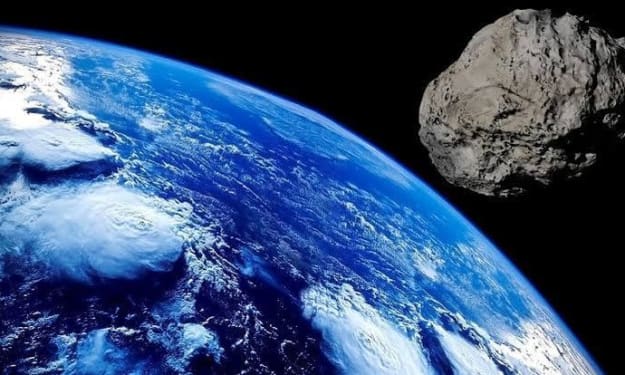
A cosmic mystery has baffled scientists for decades: why are carbon-rich asteroids so uncommon on Earth in comparison to other types of space rocks? Carbonaceous chondrites, or asteroids with organic compounds, water, and other essential elements for life, are among the most primitive materials in the solar system. Yet, despite their abundance in the asteroid belt, they make up only a small fraction of meteorites found on Earth.
By Tasbir Kabirabout a year ago in Earth
Jupiter, Earth, and the Cosmic Love Triangle: A Tale of Gravity, Auspice, and Cosmic Jealousy. AI-Generated.
In the astronomical theater of space, where celestial bodies perform their perpetual waltz, a tale as old as time—yet ever unfolding—grips the solar system: the peculiar, invisible pull of a cosmic love triangle between Earth, Jupiter, and the illimitable space that circumvents them. This isn’t just a story of planetary dynamics. It's a mythic tale of gravity, destiny, and the mute envy indited into the stars.
By Sadman Arefin about a year ago in Earth