Nature
Resolute Measures Against a Coup. Content Warning.
In a resolute stand against the recent coup in Niger, the Economic Community of West African States (ECOWAS) and the African Union (AU) have issued stern warnings to the coup plotters, demanding an immediate reversal of their illegal takeover of power. The ultimatums underscore the urgency of preventing a dangerous trend of coups in West Africa.
By Michael Rama3 years ago in Earth
Torn Asunder. Content Warning.
In the heart of a once-thriving nation, a darkness began to creep, like a relentless storm cloud threatening to engulf everything in its path. The shadows of economic warfare descended upon the land, leaving its mark on every street, in every home, and in every soul. Hope seemed elusive, and the spirit of the people hung in delicate balance, teetering between resilience and despair.
By Michael Rama3 years ago in Earth
Utilize the Force of Inquiries to Incite Composing Subjects
Voyaging, visiting tourist spots and eating food of new locales lights my faculties. Nonetheless, getting to the objective tests my understanding. During the long periods of driving, my advantage winds down expecting me to get inventive to remain conscious. First up is the letters in order game. When each letter has been spotted on street signs, I start to find a tag from each state in the association. Then, at that point, I torture my significant other by shouting, "I spy!" and portraying some dark thing. He cooperates until we both lose interest and move onto other animating games like posting creatures whose names start with each letter of the letter set.
By Prashant Kumar 3 years ago in Earth
What About the Real Motive Behind Our Lack of Ocean Exploration?
Ever wonder why, despite our scientific and technological progress, there is so much of our world that we still know so little about? Over 80% of our seas are still unexplored. Why is this enormous body of water that covers most of our Planet also one of the most vulnerable and misunderstood areas in the universe? Pressure has a lot to do with it. Did you know that only about seven per cent of the world's oceans have a special tag called marine conservation areas or maps? We have this enormous aquatic playground in our backyard, but we've barely scratched the surface. Our deep ocean is a terrifying region with zero vision, subfreezing temperatures, and pressure so high that, in some places, you'd think you weighed fifty pounds. jumbo It makes sense that sending humans into space is easier than sending them to the ocean's bottom if you have jets on your body. the deeper you go into the waters the more stress piles up but let's not forget we have Tech on our side right researchers now use these cool satellite technologies that monitor the color of the ocean to examine how much phytoplankton is there for instance why is this important you might ask since these little plant-like Critters are genuinely pretty major players in our big blue oceans in the grand system of things in the Aquatic World phytoplankton is such as the Bedrock of the ocean food chain it provides Life to almost everything from the tiny zooplankton that are animal-like microorganisms to those colossal amazing whales when these Technologies first came within satellites could get clear images of the ocean faster compared to a ship could take the same number of measurements in 10 years but it's not all regarding looking at the ocean from space at times you gotta dive in there and see it for yourself gratefully we've come a long way in Ocean investigation Tech too we've got things like floats and Drifters that ride the ocean winds while collecting data and a whole Fleet of underwater Vehicles a few of which are manned some remote controlled and some even autonomous recall James Cameron the guy who made the movie Titanic he's super into examining the ocean and in 2012 he established a record by going down to the Mariana Trench in a vertical torpedo sub he believes there's nothing like being in the ocean and experiencing it firsthand Other companies use a variety of technologies for their ocean explorations, which has allowed them to find amazing things like the only deep sea coral reef in the Mediterranean Sea near Morocco. They have also discovered new species and documented ones thought to only exist in the Atlantic. These efforts have persuaded the local authorities to designate some locations as Marine Parks, but the road is challenging. We can't always rely on bathymetric information, which refers to the study of the ocean floor, because it's frequently unavailable, and that's the tricky part because it's not always available. We need to explore more to learn more, but raising money for these kinds of projects can be difficult when there are so many unknowable variables. The explorations of one particular company have so far assisted in protecting nearly 4 million square miles of ocean. The data they gather during their expeditions is invaluable; it is used to locate vulnerable habitats, identify new species, and even highlight areas where threatened species are being disregarded. Their work helps disprove justifications from local authorities who assert they lack the knowledge necessary to establish more marine protected areas. The same organisation supports the 30 by 30 initiative, which aims to safeguard 30% of our oceans by 2030. We must set aside areas for protection and research regardless of whether we don't have all the information just yet. On that note, some cool scientists have recently discovered a massive and Mysterious World beneath the Pacific Northwest Coast's ocean floor. The best part is that this massive realm of Life is essentially cut off from the rest of the Planet. Scientists call this type of Life chemosynthetic, which sounds complicated but simply means chemical reactions sustain Life. This type of Life has been found deep within the Earth and around seafloor hydrothermal vents. These tiny creatures aren't like you or me; they don't depend on sunlight or the organic products of aquatic and terrestrial ecosystems for sustenance instead. The team that discovered this finding included a geomicrobiologist from Denmark. The size at which these creatures are located beneath the oceanic crust is unparalleled; it may even be the most comprehensive ecosystem on Earth. He asserted that the oceanic crust, an average of four miles deep and makes up over 50% of our Planet's surface, is enormous; consider the magnitude of the chemosynthetic party taking place there. Since the 1990s, scientists have noticed strange, tiny holes in the basalt rocks that comprise a large portion of the Earth's outer crust. These holes appear to have been made by bacteria, but hey, there was supposed to be no life there; after all, imagine trying to survive in a place that's hot, dark, dense, and largely devoid of the organic compounds we require to sustain Life, yet here they are. Over the years, more puzzle pieces came together, and scientists made this discovery. Basalt After then, researchers wondered how long this Life would last. Drilling far below the ocean's surface, geologists obtained crust samples from a plate 120 miles off the coast of Washington. What they discovered down there was amazing. the Life down there runs on a distinctive fuel hydrogen yep in the lack of sunlight hydrogen offers the energy for all their biological processes these microbes use hydrogen to change carbon dioxide into organic have significance this matter and other byproducts like methane then fuel other organisms producing a network of light of obviously the Life down there isn't as complex as the one we understand up here scientists uncertainty there will be any multicellular life under the ocean since it's too hot and energy poor but hey who understands this universe under our oceans nevertheless has a lot to reveal this whole thing is important for many reasons first it indicates that Life can exist in places without oxygen which shifts our perspective on where we can find Life this makes us speculate if Life could exist under identical conditions on other planets where surface circumstances might be too harsh the implications on Earth are also significant if a large portion of Life exists in the oceanic crust then our comprehending of Life on our own Planet could be completely changed This fascinating Discovery pushes the boundaries of what we know about Life and encourages us to continue penetrating the enigmatic depths of our oceans. NASA is involved in the deep sea investigation project as well, so why shouldn't they be focused on space because they want to learn more about the possible characteristics of the oceans on other planets? NASA experts are highly optimistic that through uncovering undersea secrets, we will find answers to some of the key space-related mysteries, and they are also testing some cool technology for future trips across the solar system.
By Ian Sankan3 years ago in Earth
Consider the Reality That Crocodiles Haven't Changed in Millions of Years
If you ever got an an opportunity to travel back in time you know way back you would probably not be able to understand many animals but certainly you'd know the crocodilians caimans alligators crocodiles cereals and other associated species have barely transformed since the time of dinosaurs so why did they stop developing and did they really crocodilians have endured around for about 85 million years and they had diverse ancestors that developed to be even earlier over 205 million years ago all these ancestors are jointly known as crocodilemores many of them created their first appearance in the late Mesozoic as well as early Cretaceous periods and actually evolved pretty quickly there were all kinds of Crocs back then from earthly to water dwelling and even vegetarian ones yeah one kind looked a lot like its modern relatives with the only variance being that it was two times as long as a giraffe is tall there there were also some smaller kinds with mammal-like teeth and Crocs with tusks as well as super armor so where did all that diversity go and how did Crocs we know right now manage to stay alive well it all has to do with the way crocodilians have evolved we normally see Evolution as a the amount of gradual changes that take place over a long period of time but scientists suggested a theory that says Evolution doesn't always work like that they call this Theory the punctuated equilibrium sounds to me like a ruptured eardrum, but according to it there were long stretches of time where no changes occurred at all; there may have been some mutations, but they didn't live on; then all of a sudden something made the species evolve quickly; this something was probably a rapid change in the environment. For example, certain crocodiles lived in deep water rivers for a very long time; they were perfectly comfortable in that environment, and Since they evolved into aquatic animals, they had to find a way to avoid breathing water. That's how they developed a second pallet in the roof of the mouth that helps them keep air and water apart, and that's how the ancestor of modern-day crocodiles developed elongated snouts full of conical tea, a long and flexible tail, a membrane to protect their eyes, and a body armoured with spines. platypus stems from an ancestor that went its own way from other mammals within 150 million years ago a British paleontologist observes that the Platypus has a number of primitive features you can see them both in fossilised remains and their modern Anatomy the Platypus still lays leathery eggs and their milk oozes out of mammary gland ducts and gathering grooves on their skin this isn't a thing usual for mammals that evolved after this being only Platypus and two species of Echidna can boast this superpower between present-day mammals scientists were able to determine platypus fossils by their duck-like bills and unique Jaws the oldest ones that look like the Platypus we know right now stay to around two and a half million years ago there are further than 60 species of a possum snail and they live in the Americas Australia New Zealand Tasmania as well as New Guinea they're a compassionate of marsupial those animals who carry their offspring in a pouch they've hardly transformed in their external body form contrasted to their ancestors from over 65 million years ago mammals came to be around the same time as dinosaurs They came to the conclusion that the first marsupials resembled members of the contemporary opossum family. These adorable creatures have so many characteristics in common with their millions of years-old forebears that they are frequently called living fossils. Opossums exist in various settings and can adapt to a continuously changing environment because they are not fussy eaters; of all sharks, the cow shark is the evolution champion. This may be one reason why they have managed to survive so well. They will eat bugs, trash, and rotting fruit without batting an eye. Regarding cow sharks, four species have six or seven gills, a holdover from their extinct ancestors from millions of years ago. Scientists typically study the sharks of the distant past using their teeth since sharks do not possess bones but cartilage; that's mainly what is left of them based on their findings. However, most living shark species, including the famous great white, can boast five gills on the side. paleontologists have developed that cow sharks have existed for at least 175 million years it looks like they utilised to have their rough bladed teeth to feed on whatever they could find in the ocean and acted as the deep sea cleanup crew the way horseshoe crabs appear screens prehistoric survivors they're shield-like carapaces and long spine tails are the ideal proof that these creatures as we know them nowadays have been around for millions of years around 150 million based to scientists they changed contrasted to their ancestors and lost the nest of double branched legs utilised both for breathing and moving within modern horseshoe crabs use their segmented legs at the front for walking and consuming their rear legs are accountable for breathing as they form flattened gills this was not the solely change over millions of years of course but the shifts are really insignificant in the big evolution game this being has survived several mass extinctions the development and fall of the non-avian dinosaurs and the changing of continents which had literally altered the world but not these seabed crawlers and it appears like they're ready to carry on for another 100 million years or so and perhaps their attitudes will evolve after all this time they're nevertheless crabby meanwhile these guys might not have the most impressive appears and aren't exactly popular among individuals but lies can tell their own Survival Story and it might be one of the longest on Earth finding their fossils is uncommon so the scientists were pretty lucky to reveal a 44 million year old feather Laos that appear incredibly similar to lies that still live on water Birds plumes, however, are likely much older than that. Based on genetic analysis of fossils and living organisms, it appears that feathered life separated from its relatives between 115 and 130 million years ago, when feathered dinosaurs still ruled the planet. Because lice had evolved to live on early birds and feather-covered dinosaurs, they had to adapt to their new hosts after their previous landlords ended the lease. Horsetails are among the most impressive plants. You will discover them growing in patches along stream banks and other moist habitats, where a dino would blend in just fine. Horsetails still reproduce by sports, unlike all other plants, which abandoned this method in favour of seeds millions of years ago. Because of this reproduction method, horsetails are nearly impossible to remove from areas where they shouldn't be growing. Another fascinating fact about horsetails is that they are one of the few plants that can tolerate drought.
By Ian Sankan3 years ago in Earth
The Biggest Underwater Eruption Ever, perhaps?
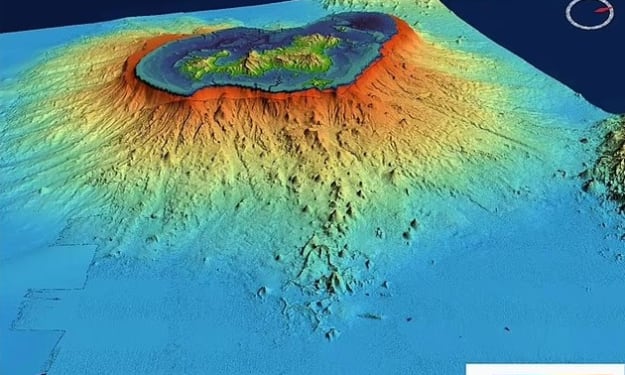
The most powerful underwater earthquake occurred in 2018 between East Africa and Madagascar. There was a deep rift between the Earth's crust and the mantle, and thousands of tonnes of magma emerged onto the ocean floor. Subsequently, a massive underwater volcano with a height of 2,700 feet was formed close to Madagascar's coast. This is virtually twice the height of the Empire State Building, and it is all submerged beneath the water. French scientists research this place since it had regular seismic behaviour when the geologist went on a trips to the coast of Madagascar they noticed this giant underwater Rock which was not here until most recently with the assist of geological equipment they discovered the earthquake occurred deeper than usual beneath the Earth's crust geologists created a special Observatory to monitor the circumstance at this site in real time among February and may 2019 they recorded about 17 thousand seismic operations below the ocean floor scientists had rarely recorded such deep earthquakes this suggests that there are reservoirs as well as drainage systems inside our planet via which magma floods it's like the veins as well as vessels of a living organism volume of lava the volcano spews at this place may be compared with the volcanic eruptions in the hottest spots of Earth possibly this is one of the the majority catastrophic but at the same time appealing events in nature over the past few years to comprehend what can be beautiful regarding this let's first figure out what an underwater volcano is as well as how it works in our planet there are incandescent liquid metals and molten rocks with almost all the chemical elements from the periodic table all this hot material is called magma which constantly flows in the planet's bowels nevertheless magma is lighter than the surrounding Earth's crust so it constantly tries to break out upwards don't lay the exterior of our planet is powerful enough and doesn't allow magma to Splash out but occasionally it happens and here's why the Earth's crust comprises of many solid parts Imagine a large image of puzzles where each piece represents a tectonic plate and how they are all continually moving to trigger collisions with one another. Sometimes a puzzle piece falls out of place, creating a gap where flowing magma rushes out, creating what are known as volcanoes. When a volcano erupts, a new geology is initiated, and a splash of magma shocks the ocean floor. When lava and ash erupt from our planet's interior, a tremendous amount of destructive force is released, but because of the water, such a calamity can go unnoticed. There is a complete mess inside the ocean, but more than 70% of the seismic activity linked to volcanoes occurs underwater, and nearly no one perceives it. The ocean in this region boils, and gigantic air bubbles rise, but the enormous pressure of hundreds of millions of gallons of water inhibits the volcano's destructive force. Lava heats the water and destroys the seafloor. molten rocks of the Earth's crust are pressed against the seabed, which blocks the effects of the disaster. Still, occasionally the eruption reaches the surface as it did in 2012 when enormous pieces of pumice the size of a van started to float up in the Southeastern Pacific Ocean. There were hundreds of thousands of them, looking more like a group of unidentified Islands and volcanic rocks scattered in the ocean over an area twice the size of New Zealand. Scientists used deep-sea technology to study the phenomenon. There is a lot of vegetation, flowers, and trees around volcanoes because the volcanic ash, lava, and soil around the volcano are rich in minerals that nourish the soil and encourage the development of microorganisms on land and water. Underwater volcanoes can eventually form natural islands, but this long process causes a sizable piece of land to emerge from the water when magma goes out of the water. Over millions of years, layer by layer, the volcano has been growing. It has been slowly rising due to constant eruptions. Some volcanoes may go out forever, and some continue to erupt, and then eventually, the level of volcanic Rock gets to the surface in the form of a huge island after many more years. The release of magma raises the level of the seabed. After another hundred, maybe a thousand years. There are several creatures, trees, flowers, and plants in the region of the wrecked seabed. These volcanic islands evolved independently of all continents, giving them distinctive ecosystems. Numerous islands worldwide have formed due to underwater volcano eruptions; you may locate them in Hawaii. Observing such Islands aids scientists in understanding how life on Earth first began. Iceland and Indonesia. Many are populated, and people have built villages and small towns there. These locations may appear like paradise, with fruit and vegetable farms, fish-filled waters, and lush soil, but living there is risky due to the volcano. People built a beautiful city right in the crater of an active volcano on the island of Ogashima, south of Tokyo. In May 1785, the eruption started without anyone expecting it to. At some point, thousands of birds rose and flew away from the island, and then the ground started to shake with a heavy, low sound. originated from below the underworld dead. Thick smoke, enormous rocks, and red-hot bits of lava shot into the sky from the summit of the green volcano during the tragedy, which lasted for several weeks. People could flee, although it took a while for them to recover. Nearly 250 years have passed since then, and during that time, the volcano has remained dormant despite the threat of a new eruption. People have continued to live there, and the population is expanding because no one wants to leave this paradise-like location. After all, it has thermal Springs. Deep woods with many fish and fertile soil Movements and tectonic plate ruptures cause another natural calamity, which meteorological and seismological services continuously monitor. When seismic activity causes the crust to shift vertically up or down, destructive tsunamis are created, unlike volcanoes. When the ocean floor's water pressure changes, energy is released. This energy pushes the water and causes a tsunami using the same principle that causes a small wave to form when you throw a stone into the water. At first, the tsunami is small and moving towards the coast at 500 miles per hour, nearly twice as fast as a Formula One race car. Millions of gallons of water are involved. Nothing can withstand the catastrophic power of nature; on the Japanese coast, for example, tsunamis are a common occurrence. People have constructed enormous shields nearby to stop the waves from reaching the shore, but despite all preparation, nature always manages to win out.
By Ian Sankan3 years ago in Earth
The Last Refuge: A tale of a group of endangered animals seeking sanctuary in a shrinking fores
In the heart of a vast forest, hidden away from human encroachment, existed a tranquil haven known as "The Last Refuge." This sanctuary was home to a diverse group of endangered animals who sought solace amidst the towering trees and lush foliage. For generations, they had coexisted in harmony, forming a tight-knit community bonded by love and resilience.
By Desert Weapon3 years ago in Earth
Farming the Unfarmable
Crop circles located in the midst of the Saudi Arabian desert are discernible even from outer space. Additionally, wind turbines have been implemented to induce precipitation in regions where it is scarcely observed. These innovations have the potential to significantly mitigate the expansion of deserts, which pose a grave threat to the sustenance of over a billion individuals. The human-induced conversion of arid lands into barren wastelands has rendered them inhospitable to life. The prospect of rejuvenating and rehabilitating these areas is undoubtedly feasible and viable.
By Hanif Salahudin3 years ago in Earth
The Essence of Human Emotions:
Title: The Essence of Human Emotions: Exploring the Depths of Love Human emotions are a complex and fascinating aspect of our existence. Among these emotions, love stands out as one of the most profound and universal experiences that shape our lives. Love transcends boundaries, cultures, and languages, and it is a force that binds us together as human beings. In this essay, we will delve into the depth of human emotions, particularly love, and explore its significance in our lives.
By Mohamed Sathir3 years ago in Earth
Explored the AMAZON RAINFOREST
Deep within the Amazon rainforest in Ecuador resides the indigenous Sapporo community, a group of fewer than 700 people. Their isolated existence in the heart of the jungle has allowed them to maintain their unique culture, traditions, and territorial identity despite the encroaching pressures of an ever-advancing capitalist world. In this piece, we embark on a journey to experience a day in the life of the Sapporo people, immersing ourselves in their captivating customs and the daily challenges they face.
By Lahiru Dilanka3 years ago in Earth