Nature
From Greenhouse to Green Future: Confronting the Realities of Climate Change
Understanding the Global Climate Crisis In recent decades, our planet has experienced a remarkable transformation. The Earth's climate, a complex system governed by a delicate balance of atmospheric components, has been significantly altered by human activities. This phenomenon, commonly known as climate change, poses unprecedented challenges to the environment, ecosystems, and the future of humanity.
By Tayyab Ali3 years ago in Earth
Echoes of Existence
In a world where humanity's footprint grows ever larger, the delicate tapestry of life weaves itself into a haunting melody of survival. Among the threads that are fraying, those of endangered wildlife stand out as the most heartrending. Their stories are whispers of existence, fading into the shadows of history. One such story, a tale of a lone Amur leopard, speaks to the urgency of conservation efforts and the emotional toll of impending extinction.
By Ramsey Idiata3 years ago in Earth
Whispered Wonders: Rediscovering the Ozone Layer
"The 1980s were an era of big hair, neon colors, and the rise of MTV. Amidst all the cultural trends and pop phenomena, a less visible but crucial issue began to emerge: the thinning of the ozone layer. In a puzzling revelation, every October witnessed the appearance of a hole in the ozone layer over the South Pole, an alarming occurrence that raised questions about the environment's fragility. Picture this: the hole was as vast as the entire continental United States. The ozone layer, a protective belt of gaseous molecules encircling Earth, had come under an unprecedented threat. By 1980, scientists were raising red flags about the looming catastrophe. The possibility of completely annihilating the ozone layer, a shield safeguarding all living organisms from harmful ultraviolet radiation, was predicted to become a harsh reality by 2050. Such a scenario would bring about ecosystem collapses, an epidemic surge in skin cancer cases, and the demise of life as we knew it. It was a dire warning that humanity could not afford to ignore. So, what led to this impending ecological disaster, and how did we manage to steer away from the brink? To unravel this narrative, we must first delve into the science behind the ozone layer. Imagine it as a protective belt, a guardian of sorts, comprised of gaseous molecules enveloping our planet. This vital shield absorbs harmful ultraviolet radiation emanating from the Sun, serving as a shield for every living being on Earth. But despite its potent defense mechanism, the ozone layer is surprisingly delicate. In 1985, a startling revelation emerged: a massive depletion of the ozone layer was detected over Antarctica. An astonishing 40% of the layer had vanished, resulting in the formation of a daunting "hole." This discovery sent shockwaves through the scientific community. What's more, this hole expanded every spring, becoming progressively worse with each passing year. The gravity of the situation was undeniable; it was a wake-up call that could no longer be ignored. Dr. Susan Solomon, an atmospheric chemist hailing from Boulder, Colorado, emerged as a key figure in this unfolding narrative. In 1986, she led a team of scientists on an expedition to Antarctica, determined to decipher the cause behind the ominous ozone hole. Dr. Solomon vividly recalls the challenges of working in such an extreme environment, where the primary goal was to avoid frostbite while meticulously collecting data. The mission aimed to not only measure ozone levels but also analyze various chemicals contributing to its depletion. Scientific tools like balloons and ground-based measurements were deployed, all leading to a unanimous revelation: the primary culprit was chlorine, a byproduct of man-made compounds known as Chlorofluorocarbons (CFCs). CFCs, once harmless on the ground, underwent a sinister transformation in the stratosphere. Under the Sun's influence, they broke down into chlorine, which then interacted with ozone molecules to create oxygen and chlorine monoxide. Subsequent interactions led to a devastating chain reaction, causing further ozone depletion. What compounded the problem was the exceptionally long lifespan of CFCs in the atmosphere, persisting for up to 150 years. Consequently, the accumulation of CFCs year after year had led to an exponential increase in their concentration. In the late 1980s, the urgency of the situation became even more pronounced, with a staggering 50% drop in ozone levels. This looming catastrophe triggered one of the most remarkable displays of global collaboration and action on climate issues. The success of this endeavor could be attributed to the "three P's": personal impact, perceptible consequences, and practical solutions. Skin cancer, a direct consequence of ozone depletion, made the threat personally relatable to everyone. Satellite measurements vividly depicted the destruction of ozone, making the issue perceptible to the masses. Moreover, finding alternatives to CFCs, like substitutes for aerosol cans, proved to be a practical and feasible solution. The public played a pivotal role in driving change. Scientists like Dr. Solomon communicated their findings through press conferences, highlighting the urgency of the situation. The ozone hole even found its way into popular culture, with TV shows and movies incorporating references that resonated with the public. This collective awareness exerted pressure on global leaders, compelling them to take action. This culminated in the Montreal Protocol, a groundbreaking international agreement that acknowledged the peril of ozone depletion and outlined measures to combat it. The Montreal Protocol, the first and only universally ratified treaty, marked a turning point in environmental cooperation. By encouraging the reduction of ozone-depleting substances and supporting developing nations in adopting alternative technologies, the protocol laid the foundation for a global shift away from CFCs. As the protocol came into effect in 1989, the consumption of ozone-depleting substances, including CFCs, plummeted. Over three decades later, the ozone hole ceased its expansion and is now slowly contracting. Experts predict a full recovery by 2065. But the journey doesn't end here. As CFCs were phased out, Hydrofluorocarbons (HFCs) emerged as replacements. While not harmful to the ozone layer, HFCs are potent greenhouse gases that contribute to climate change. This realization prompted an amendment to the Montreal Protocol in 2016, extending its scope to include the phase-out of HFCs. However, this represents just one facet of the broader challenge of climate change. Climate change remains a pressing global concern, demanding collective action on an unprecedented scale. While progress has been made, the looming threat of climate catastrophe by 2030 underscores the need for sustained efforts. The personal impact of climate change, perceptible consequences, and practical solutions continue to guide us on a path towards a sustainable future. As the world unites once again to tackle climate change, the lessons learned from the successful healing of the ozone layer serve as a beacon of hope, reminding us of our capacity to overcome seemingly insurmountable challenges when we act together."
By Shubham Bajaj3 years ago in Earth
Top 10 Amazing and Interesting Facts of The World!
The world is teeming with surprises and undiscovered information that remains largely unknown to us. With approximately 200 countries, billions of individuals, a diverse range of plant and animal species, and the hidden wonders of nature, there are countless captivating and enjoyable facts to explore. For those who have a penchant for discovering intriguing tidbits about the world, we present a compilation of the top ten astonishing facts.
By Paulla Kantasak3 years ago in Earth
Global Warming . Content Warning.
Title: Global Warming: A Comprehensive Analysis and Call to Action Introduction: Global warming, a phenomenon commonly referred to as climate change, has become a critical issue in today's world. It is characterized by the long-term increase in Earth's average surface temperature, primarily caused by human activities. This essay aims to provide an in-depth analysis of the causes, impacts, and potential solutions to global warming, highlighting the urgency for collective action and sustainable practices.
By Hayley Benge3 years ago in Earth
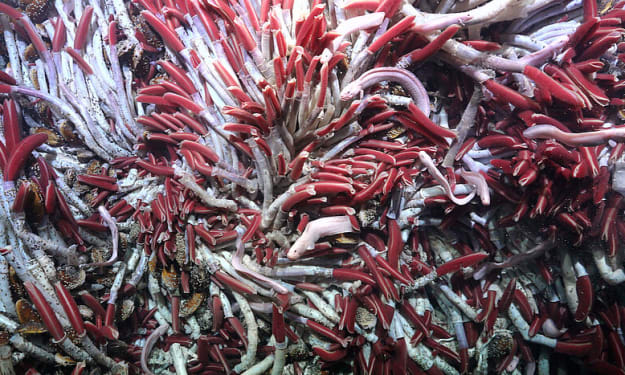
HYDROTHERMAL VENTS REVEAL UNIQUE, UNEXPECTED MARINE ECOSYSTEM
I started snorkelling at a very young age, and I always found underwater swimming in lakes and ponds more enjoyable than doing laps in a concrete pool. There’s something compelling about the underwater world and its inhabitants.
By David Morton Rintoul3 years ago in Earth
The Impact of Deforestation on Biodiversity and Ecological Balance
In the heart of the lush, untouched forest of Eldoria, a symphony of life played out every day. Birds of vibrant hues sang melodiously, their calls interweaving with the rustling leaves and the distant gurgling of a pristine river. An intricate dance of predator and prey painted the landscape, while majestic trees stood tall, guardians of an intricate web of life. However, the harmony of this ecosystem was about to be disrupted by a force that had already scarred many other parts of the world: deforestation.
By Pius Junior 3 years ago in Earth
Weaving the Threads
Introduction In the grand tapestry of global concerns, climate change stands as an intricate and pressing challenge that engages scientists, policymakers, and environmental advocates alike. While our conversations predominantly center around its ecological and economic implications, there's a lesser-explored narrative that deserves our attention - the intersection of climate change and cultural heritage. This uncharted terrain unravels a story of profound interdependence, where safeguarding our history becomes intrinsically linked to forging a sustainable future.
By Md. Hasin Arman Khan3 years ago in Earth
The Silent Suffering of Our Ecosystems
In the heart of the sprawling city, where skyscrapers reached for the heavens and the bustling streets hummed with life, there existed a silent suffering that went unnoticed by many. It was a suffering that transcended the boundaries of human perception, a distress that the ecosystems bore in silence, yearning for a voice to carry their pain to the world.
By Pius Junior 3 years ago in Earth
Why Earth Is Round and not Other shapes
In reality, the formation and evolution of planets are complex processes influenced by various factors, including initial conditions, the dynamics of material in protoplanetary disks, and the collisional and gravitational interactions that lead to the gradual accretion of material into planetesimals and eventually planets. These factors, along with the influence of gravity, lead to the predominantly spherical shapes we observe in planets.
By Felix Afele3 years ago in Earth