Nature
Climate Anxiety
The Weight of the World Sophie's anxiety wasn't limited to just her own life; it extended to the planet as a whole. She would lie awake at night, her mind racing with thoughts of melting ice caps, rising sea levels, and catastrophic weather events. She felt a profound sadness for the generations that would inherit a world ravaged by climate change.
By Queen John3 years ago in Earth
Escape to nature
In a world gripped by the chaos of climate change and environmental destruction, two souls sought solace and healing in the embrace of the natural world. Sarah, a weary climate scientist, and David, a war-weary veteran, found themselves drawn to a remote cabin nestled deep within a vast, untouched wilderness. Act 1: Searching for Sanctuary Sarah had spent years studying the devastating effects of climate change. The relentless onslaught of news about wildfires, hurricanes, and rising sea levels had left her emotionally drained. David, on the other hand, carried the scars of war, both seen and unseen. He yearned for a place where he could escape the memories of battlefields and find peace. Together, they embarked on a journey to the cabin, which was far removed from the chaos of the outside world. As they arrived, the scent of pine and the sound of a bubbling stream greeted them. It was an oasis of calm, and they hoped it would provide the sanctuary they so desperately needed. Act 2: Nature's Therapy The days turned into weeks as Sarah and David immersed themselves in the healing power of nature. They went for long hikes through the dense forest, swam in crystal-clear lakes, and marveled at the star-filled skies unmarred by city lights. The natural world enveloped them, offering a respite from the stress and trauma they had experienced. Sarah found solace in the simplicity of life at the cabin. She began to document the changes in the local ecosystem, not as a scientist but as a lover of nature. Her sketches and observations became a form of therapy, allowing her to reconnect with the wonder and beauty of the world she had dedicated her life to preserving. David, too, found healing in the woods. He spent hours by the stream, the gentle babbling of water soothing his troubled mind. He no longer woke in the middle of the night, drenched in sweat from nightmares. Instead, he slept soundly, cradled by the natural sounds of the wilderness. Act 3: A Shared Connection As they explored the wilderness together, Sarah and David found comfort in each other's presence. They spoke of their pasts and the emotional burdens they carried. Sarah shared her fears about the future of the planet, and David spoke of the guilt he felt for actions taken during his time in the military. Their shared experiences in the natural world became a bond that transcended words. They knew that nature was both fragile and resilient, a reflection of their own inner struggles. The therapeutic benefits of their connection with the environment extended to their connection with each other. Act 4: Renewal and Return As the months passed, Sarah and David found a sense of renewal they had never thought possible. The cabin had become their refuge, a place where they could heal and rediscover themselves. They had rekindled their spirits and were ready to return to the world outside. But they didn't return empty-handed. They carried with them the lessons they had learned from nature—the importance of resilience, the beauty of simplicity, and the healing power of connection. They vowed to continue their work to protect the environment, not out of fear and despair but out of love for the world they had come to cherish. As they left the cabin behind, Sarah and David knew that they would always carry a piece of the wilderness with them. It was a reminder that in the midst of environmental chaos, there was still a place of solace and healing—a place where the therapeutic and emotional benefits of connecting with the natural world could be found and where love could bloom amid the chaos of the world. The Healing Forest The moment Amelia arrived at the cabin, she felt a profound sense of relief. The air was crisp and clean, and the only sounds were the whispering of leaves and the distant calls of birds. She took long walks in the forest, breathing in the earthy scent of moss and feeling the softness of fallen leaves underfoot. Each day, as she immersed herself in the natural world, Amelia felt the weight of her worries slowly lift. She found a sense of peace she hadn't experienced in years. The forest became her sanctuary, a place where the chaos of the outside world couldn't reach her. The Power of Silence One day, as Amelia sat by a tranquil stream, she realized the therapeutic value of silence. In the city, noise was constant—the hum of traffic, the blaring of horns, the ceaseless chatter. But here, in the heart of nature, silence was a gift. It allowed her thoughts to quiet and her mind to rest. Amelia began to practice mindfulness, immersing herself fully in the present moment. She listened to the gentle rustling of leaves, watched the sunlight filter through the trees, and felt the cool breeze on her skin. In these moments of stillness, she found clarity and a renewed sense of purpose. A Reconnection with the Self As the days turned into weeks, Amelia's connection with nature deepened. She watched the stars twinkle in the night sky and marveled at the intricate patterns of spiderwebs glistening with dew in the morning light. She felt a profound sense of awe and wonder that had been absent from her life for too long. Amelia's journey was not just about escaping the chaos of the world; it was about rediscovering herself. She realized that her connection to the natural world was not just a source of solace but also a source of strength. It reminded her of her own resilience and the resilience of the planet. Returning Home, Renewed When Amelia returned to the city, she brought with her a newfound sense of peace and purpose. She couldn't change the world overnight, but she could change how she engaged with it. She became an advocate for environmental conservation, using her experiences in nature to inspire others to reconnect with the Earth. She also made a commitment to keep a piece of the forest in her heart and to carry the therapeutic and emotional benefits of her time in nature with her always. And as she looked out at the concrete jungle that surrounded her, she knew that no matter how chaotic the world became, she had found a place of solace and healing in the natural world that would always be her refuge.
By Queen John3 years ago in Earth
The Magical Garden: Cultivating Healthy Habits and Joy
Once upon a time in a small, sunny town, there lived a curious and energetic girl named Lily. She was known far and wide for her insatiable curiosity and boundless energy. Yet, there was one place where she found solace and happiness that matched her endless enthusiasm "the garden".
By keshav jodheea3 years ago in Earth
The Beauty We Stand to Lose
Elara Valley is a secret sanctuary located in a far-off region of the planet, away from populated areas and the noise of modern life. It was a breathtakingly beautiful environment, with towering emerald woods and majestic, crystal-clear rivers meandering through verdant meadows. Wildflowers adorned the landscape in vivid colors, while birds of all shapes and sizes filled the air with their lovely songs. Elara Valley served as a refuge and a reminder of the beauty of nature.
By Queen John3 years ago in Earth
Scientists Concerned about 'Doomsday Ice sheet' Finding. Content Warning.
In the immense breadth of Antarctica, beneath the freezing profundities of the Thwaites Glacial Mass, a chilling revelation has left researchers both stunned and profoundly concerned. This monster ice arrangement, inauspiciously named the "Armageddon icy mass," has been holding onto privileged insights that could reshape the destiny of our planet. In this article, we dive into the disturbing discoveries underneath Thwaites Glacial Mass and what they mean for our reality's future. Since the 1990s, the Thwaites Ice Sheet has been quietly but consistently retreating. Over this limited ability to focus, it has lost a surprising nine kilometers of its enormous ice field. This apparently persistent retreat is an obvious sign of the ice sheet's lessening security, sending waves of worry through established researchers. The genuine danger lies in its goliath size as well as in the chilling acknowledgment that this icy mass holds a tremendous supply of water inside its frigid hug. In the event that Thwaites Glacial Mass were to capitulate completely to the warming powers of our planet, it would release a destructive flood in ocean levels, making them ascend by multiple feet universally. Such a situation would have extensive and obliterating ramifications for seaside networks around the world. However, the bad dream doesn't end there. Thwaites The ice sheet is a key component in the fragile equilibrium of Antarctica's ice. It isn't just about its own likely implosion; it could set off a chain reaction in the event that it disintegrates. Unsettling influences close to this icy mass can possibly set off a cascading type of influence, undermining nearby ice sheets and further intensifying the rising ocean levels. In their journey to uncover the mysteries concealed underneath this premonition icy mass, researchers turned to innovation for answers. Sending a cutting-edge wonder known as 'Icefin,' they wandered profoundly into the frigid pit. This mechanical voyager dove a shocking 2000 feet beneath the icy mass' surface, conquering the devastating strain and freezing temperatures to catch pictures, recordings, and basic information. The pictures and recordings caught by Icefin give a creepy look into the subglacial world, a spot not many have at any point seen. The frosty caves and lowered scenes recount an account of change, a world in the pain of disturbance. Past visuals, the information gathered by Icefin is of central significance. It gives us knowledge of the temperature variations underneath the ice sheet, revealing insight into the cycles driving its decay. Besides, it offers important data about ocean levels, an imperative piece of the puzzle in figuring out the more extensive ramifications of Thwaites' downfall. The Thwaites Ice Sheet is, in numerous ways, a microcosm of the bigger environmental emergency we face. It is an unmistakable fact that our planet is going through fast and frequently capricious changes. The sheer size of Thwaites' downfall fills in as a reminder, an admonition that the environmental emergency is definitely not a far-off future but an ongoing reality. Researchers, who have devoted their lives to grasping our planet, are sounding the alarm. Thwaites Icy Mass' insecurity isn't simply a remote concern; it's a danger to the actual texture of our reality. It calls for quick and unflinching activity on a worldwide scale to moderate the outcomes of its expected breakdown. The disclosure of the Thwaites Ice Sheet's weaknesses is a distinct sign of the delicacy of our planet's frosty domains. As the "Judgment Day icy mass" proceeds with its foreboding retreat, the critical need to address environmental change turns out to be more clear than at any time in recent memory. The clock is ticking, and the choices we make today will shape the predetermination of generations to come.
By Cyril Lord3 years ago in Earth
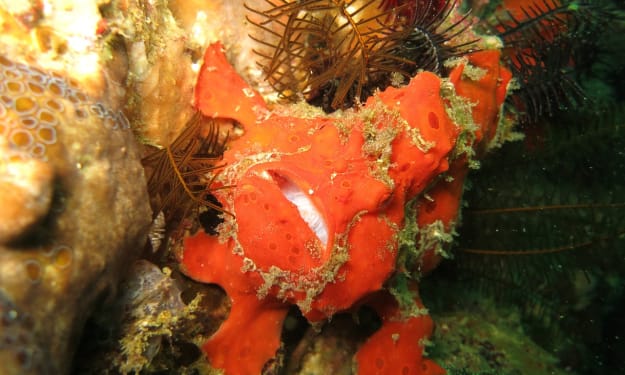
Yes, It's named as Frog but its not a Frog :)
Earth is an beautiful place contains with tons and tons of organism in micro level or macro level. It's full of surprise about the unknown part of the earth called ocean. Even though we're discovering new species daily from the ocean, it has no end to its deepness filled by huge amount of organisms. Yeah i have came across a fish, which can't swim. wait... what? A fish without the nature of swimming... yes, its true the frogfish cant swim. Read some intresting facts about this Psychedelic frogfish.
By Mohamed aashik3 years ago in Earth
Loss and Grief:
Title: Fading Eden In the heart of the Appalachian Mountains, nestled between emerald forests and babbling brooks, there lay a hidden valley known as Green Haven. For generations, it had been a sanctuary of natural beauty and tranquility—a place where time seemed to stand still. But as the relentless march of environmental degradation and climate change began to take its toll, the residents of Green Haven found themselves grappling with an unshakable sense of loss and grief.
By Justin Inyang3 years ago in Earth
Voices of the forest
In a remote corner of the world, nestled deep within an ancient forest, there existed a tapestry of life that had flourished for centuries. Tall trees stood as sentinels, their roots intertwining with the hopes and dreams of countless creatures. Birds painted the sky with their vibrant plumage, while the murmurs of the river wove a soothing symphony through the foliage. But this sanctuary, this Eden of the wild, was under siege. The bulldozers had arrived, roaring monsters of steel and concrete, bringing with them the cacophony of destruction. The forest's voice was silenced as trees crashed to the ground, and the ground beneath it trembled with sorrow. Among the countless souls affected by this relentless march of progress were a family of red foxes. They had made their den beneath the roots of an ancient oak, a sanctuary that had provided safety and warmth for generations. Now, they found themselves fleeing from the terrifying thunder of machinery. As the forest canopy above them crumbled, the fox family embarked on a treacherous journey to find a new home. The elder fox, a wise and grizzled creature, led the way. He had seen the world change before, but never so rapidly. His mate, a sleek vixen with eyes as sharp as obsidian, clung to his side. In her jaws, she carried their three playful pups, each a bundle of fur and boundless curiosity. Their journey was fraught with danger. The once-familiar paths were now blocked by fallen trees and debris. They crossed wide rivers and scaled steep cliffs, their hearts heavy with the weight of uncertainty. The cries of their pups for food and warmth were a constant reminder of the home they had lost. As the days turned into weeks, the fox family encountered others on the same desperate quest. Families of deer, rabbits, and squirrels, all displaced by the relentless advance of destruction, sought refuge together. In their eyes, the elder fox saw the same mixture of fear and determination that burned within him. One evening, as the moon bathed the forest in silvery light, the fox family and their newfound companions arrived at a glimmering lake. Its waters were clear as crystal, and a lush meadow stretched beyond it. Here, they hoped to find solace and a new beginning. But the challenges were far from over. Food was scarce, and the predators of this unfamiliar territory were fierce. The elder fox had to use all his cunning to outsmart the wolves and rival foxes who contested for territory. They scavenged for what little remained of the forest's bounty, their instincts honed by the harsh reality of survival. Yet, amidst the hardships, the animals found unexpected moments of unity and connection. The deer taught the fox pups to be swift and agile, while the rabbits shared their burrows for shelter. The forest's once-diverse tapestry of life was now woven into an intricate network of support. One day, while the vixen was teaching her pups to hunt for small prey, she noticed something remarkable. A glimpse of green amid the charred remains of a tree caught her eye. It was a tiny shoot, a tender sprout pushing through the ashes of destruction. The vixen felt a glimmer of hope. Over time, the forest began to reclaim its lost ground. The meadow grew lush with new life, and the animals adapted to their new home. The elder fox, though scarred by the journey, watched with pride as the younger generations thrived in this once-barren land. The forest had spoken, not in the voices of the trees or the songs of the birds, but in the resilience of its inhabitants. It had shown that even in the face of devastation, life could find a way to persevere. The animals, displaced by deforestation, had written a new story of survival and hope, a testament to the enduring spirit of the wild. And as the years passed, the whispers of the ancient forest began to return. The birds sang their melodies once more, and the river's voice flowed with renewed vigor. The land healed, slowly but surely, as the forest reclaimed its rightful place in the world. The fox family, now with a new generation of pups, continued to call this forest home. They knew that the journey had been arduous, but it had also been a testament to their strength and resilience. They had listened to the voices of the forest, and in doing so, they had found their own voices of hope in a world forever changed.
By Grace Adeoye3 years ago in Earth
A whisper in the wind
In a world where the song of the lark had grown faint, and the once-vibrant meadows lay barren, there lived a young activist named Lily. She had a heart as vast as the wilderness itself, and her spirit burned with a fierce determination to save a species on the brink of extinction. It was a quest that would take her to the edge of despair and back, but it was also a journey that would reveal the enduring power of hope. Lily's love for nature was born on a sunny day, under the shade of a giant oak tree. Her grandmother, a wise and gentle soul, had shared stories of the world's wonders and the importance of protecting them. She spoke of colorful meadows, teeming with life, and skies filled with the joyful melodies of birds. Lily cherished those stories, and as she grew, so did her passion for preserving the environment. One crisp morning, while wandering through the remnants of a once-lush forest, Lily stumbled upon a creature she had only read about in books - the elusive and endangered Silver-Winged Lark. This small bird, with its silver-tipped feathers, was known for its exquisite song, a melody that had the power to heal the hearts of those who heard it. But the Lark's song had become a rarity, lost in the clamor of progress and indifference. Tears welled up in Lily's eyes as she watched the fragile bird hop from one withered branch to another. Its song was but a whisper in the wind, barely audible. She knew then what she had to do. Lily embarked on her quest to save the Silver-Winged Lark. Armed with a notebook, binoculars, and an unwavering determination, she journeyed into the heart of the wilderness. Her days were filled with endless walks through desolate landscapes, her nights spent camping under a canvas of stars. She befriended fellow activists and learned from seasoned conservationists, all sharing her passion for preserving nature's treasures. Weeks turned into months, and Lily's hope wavered as she witnessed the relentless destruction of the Lark's habitat. Logging, pollution, and urban sprawl were robbing these birds of their homes. Lily's heart ached for the suffering creatures she encountered, and she often found herself asking if her efforts were in vain. One evening, as she sat by her campfire, a stranger approached her. His name was Max, a grizzled old ranger who had spent a lifetime protecting the wilderness. Max saw the weariness in Lily's eyes and shared stories of his own battles against the forces of destruction. He told her about the resilience of nature, how even in the face of devastation, life found a way to persist. With newfound determination, Lily continued her quest. She began working with local communities, sharing her passion and knowledge. Together, they planted trees, cleaned polluted rivers, and created safe havens for the Silver-Winged Lark. Lily's hope grew with each small victory, and the whisper of the Lark's song grew stronger. One crisp morning, after years of tireless effort, Lily stood in a meadow bathed in golden sunlight. She watched in awe as a group of Silver-Winged Larks perched on the swaying grass. Their songs filled the air, a symphony of hope and resilience. Tears of joy streamed down her face as she realized that, against all odds, she had helped save a dying species. Lily knew that the battle was not over, but she also knew that as long as there were people who cared, there was hope. She had discovered that hope was not a distant beacon but a fire that burned within, a fire that could light the way even in the darkest of times. And so, the young activist continued her quest, not only to save the Silver-Winged Lark but to inspire others to join her in the fight to protect the fragile beauty of the natural world. As long as there were whispers in the wind and hearts filled with hope, the song of the Lark would endure, a reminder that even in the face of despair, there was always a chance for renewal and redemption.
By Grace Adeoye3 years ago in Earth