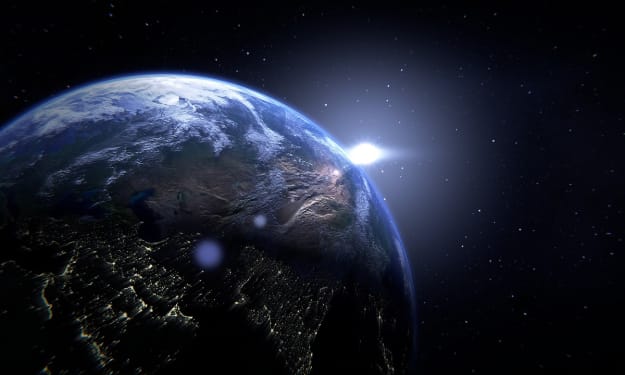
Nature
A Ray of Hope
. in a quiet coastal town named Havenwood, nestled between lush forests and the serene azure of the ocean, lived a young woman named Eliza. Eliza had grown up in this idyllic town, surrounded by the beauty of nature. But as the years passed, she watched in despair as the world around her began to change.It all started with the erratic weather patterns. Summers grew hotter, and winters brought more unpredictable storms. The once-plentiful fishing waters became unpredictable, and the lush forests she loved to explore as a child began to wither. Eliza couldn't ignore the signs; climate change was real, and it was happening right before her eyes.
By Sunny Douglas3 years ago in Earth
Elephant
To claim the title of the Earth's mightiest terrestrial creature, one must possess extraordinary powers, an exceptional intellect to secure sustenance and hydration, finely tuned senses for perceiving both peril and opportunity and the resolve to engage in combat against formidable adversaries. Such a feat demands immense courage.
By Osman Lawalli3 years ago in Earth
The Alien of Antarctica
• Welcome to Animal of the Week. so let's get right into it. This week is about a brand new animal discovered just recently, and so a lot of the information on this animal is speculative, but grounded in logic, reason, and the information we know about other similar species. The Antarctic strawberry feather star has taken the internet by storm since its discovery, which was published in July. Largely due to its otherworldly appearance, some have compared it to the face Huggies in Alien and the fact that it has Antarctic in its name, which usually sparks interest. The strawberry comes from the fact that the nub at the bottom of its body from which the feather-like structure protrudes resembles a knobbly strawberry. Feather Star derives from it being a Feather Star, a type of untethered crinoid found all over the world's oceans. The Antarctic Strawberry Feather Star is not the only new Antarctic Feather Star. Previously, it was believed that only one species existed. But authors of the paper resolving the taxonomy of the Antarctic Feather Star species complex, Promaco cryness, Kurgulensis, Emily L. Mcglockin, Nehrada G. Wilson, and Greg W. Roos have found that there are now actually eight species.
By Elvin James3 years ago in Earth
What is causing climate change?
Carbon Dioxide (CO2) Emissions: The burning of fossil fuels such as coal, oil, and natural gas for energy production, transportation, and industrial processes releases carbon dioxide into the atmosphere. Deforestation also contributes to CO2 emissions as trees absorb CO2, and their removal reduces the planet's capacity to absorb this gas.
By Garry Jacques3 years ago in Earth
Connection with Nature
In the heart of the bustling city of Bridgewood, there lived a woman named Eliza who felt like a stranger in her own life. The relentless urban sprawl and the demands of her high-powered job left her feeling disconnected and empty. She longed for something she couldn't quite put into words—a connection to the natural world that once filled her with wonder as a child.
By Kiran kumar P3 years ago in Earth
THE MYTH OF ZEUS
In the shadowy embrace of twilight, a pair of enigmatic, cloaked figures materialized in the quaint hillside village. These mysterious wanderers went from door to door, beseeching the townsfolk for sustenance and refuge. Yet, time and again, their pleas were met with cold rejection. At last, only one humble abode remained, a thatched cottage. Here, Baucis and Philemon, a venerable couple bound by a deep compassion for the needy, answered the resounding knock. Although an air of peculiarity surrounded their unexpected guests, the couple's innate kindness prevailed. Philemon extended an invitation to rest, while Baucis rekindled the hearth's warmth. This enduring pair, whose love had blossomed in youth, weathered the years together in their modest dwelling. Now, their home still stood, and their devotion remained undiminished.
By Kelvin Daniel3 years ago in Earth
NO HUMAN HAS EVER LEFT EARTH ATMOSPHERE, HERE’S WHY
NO HUMAN HAS EVER LEFT EARTH ATMOSPHERE,HERE’S WHY In the annals of space exploration history, there has always been a lingering debate regarding the demarcation between Earth's atmosphere and the vast expanse of outer space. Recently, scientific observations have presented us with a fascinating revelation: Earth's atmosphere is far more extensive than we previously imagined, extending beyond the moon itself.
By Williams James3 years ago in Earth
Farmers turn to tech as bees struggle to pollinate
The avocado trees are being artificially pollinated, so Thai Sade brushes them in the sweltering morning sun. The founder of the tech company BloomX, Mr. Sade, lives on a moshav, or collective farm, in central Israel. According to him, the business has discovered a way to mechanically pollinate crops in a manner similar to bees.
By Alejandro Silvente3 years ago in Earth