
The Alien of Antarctica
The discovery of a new species
•
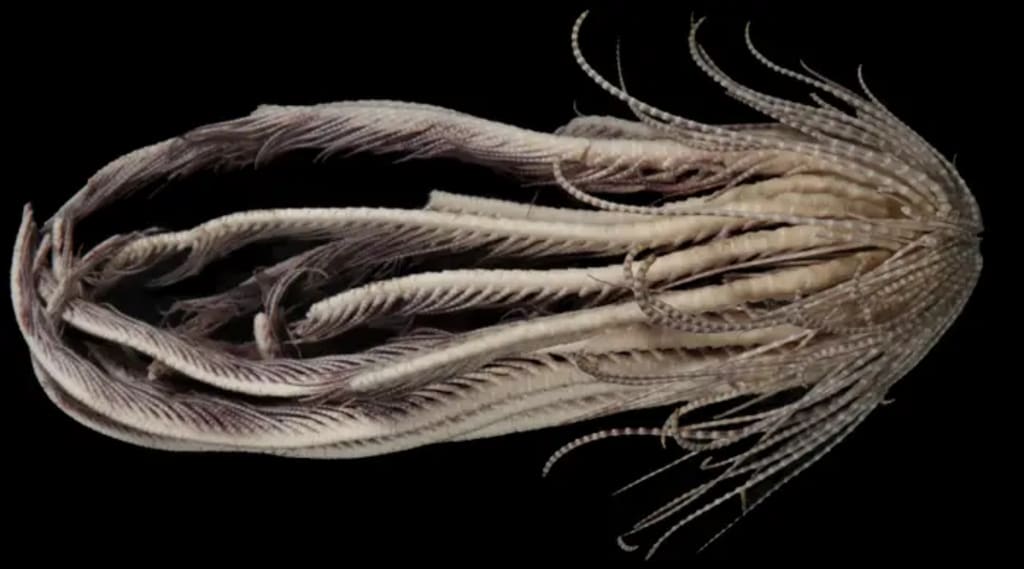
Welcome to Animal of the Week. so let's get right into it. This week is about a brand new animal discovered just recently, and so a lot of the information on this animal is speculative, but grounded in logic, reason, and the information we know about other similar species. The Antarctic strawberry feather star has taken the internet by storm since its discovery, which was published in July. Largely due to its otherworldly appearance, some have compared it to the face Huggies in Alien and the fact that it has Antarctic in its name, which usually sparks interest. The strawberry comes from the fact that the nub at the bottom of its body from which the feather-like structure protrudes resembles a knobbly strawberry. Feather Star derives from it being a Feather Star, a type of untethered crinoid found all over the world's oceans. The Antarctic Strawberry Feather Star is not the only new Antarctic Feather Star. Previously, it was believed that only one species existed. But authors of the paper resolving the taxonomy of the Antarctic Feather Star species complex, Promaco cryness, Kurgulensis, Emily L. Mcglockin, Nehrada G. Wilson, and Greg W. Roos have found that there are now actually eight species.
Four new species were found and captured from the seafloor and following DNA analysis, determined to all be separate species. This prompted a wider search of the existing Antarctic feather star specimens archive. After more DNA analysis, three more species were discovered from these existing specimens. The post-child of the discoveries is the Antarctic strawberry feather star. All are fairly similar though, and the largest difference is the number of tentacles more properly known as Siri, and also the coloration. Siri are different from denticles as they are less flexible, strong, or sensitive. The strawberry flavor has 20 Siri. Six of the species have this many, with the other two having just 10. The strawberry variety also has different colorations. The original Antarctic feather star has a yellowy-brown coloration compared to the strawberry which has a darkish-purple shade to it. Despite this, many of the differences between species are incredibly subtle, so simply identifying them by appearance led to the assumption that there was only one Antarctic species. DNA analysis has allowed for the differences to be discovered. Mitochondrial cytochrome oxidase subunit 1 is the genetic marker used to find the difference between the species.
According to this paper, essentially, this gene is highly variable and mutates so that it is unique in each species and therefore is an indicator of when there is a different species. It is very much in the name that these animals live in Antarctica. They are found in a rather large range of depths, from 65 to 1,170 meters down. Other crinoids, such as sea lilies, are attached to the seafloor. But these feather stars are free-floating, which is why their depth range is so great. They also use their cirie to grip and walk along the seafloor, or more commonly use them as a form of propulsion in the water column. These feather stars are suspension feeders, meaning they'll sit in strong currents and feed upon any particulates that come by them, from plankton to detritus. Anything with nutritional value is important in such an open and expansive environment. They catch these particulates with tube feet, small protruding spine-like objects on the ends of their feathery cirri. They will be covered in mucus to trap anything passing by, which is then rolled into a ball along its body and moved to its mouth. Surprisingly, feather stars do not reproduce asexually.
They are either male or female and so require each other to reproduce. They do this through broadcast spawning, where the male will release sperm into the water and the female will release the eggs, which will then hopefully meet each other and fertilize. The larvae are thought to have a yoke that makes them buoyant, allowing them to spread all over the ocean and live in many different depths as they were carried along by the strong and nutritious currents and upwellings of the Antarctic Sea. Obviously, having only just been discovered, there is no idea about their population size or trend, and it is very hard to find out such information with deep sea-dwelling animals like this, especially ones in the Antarctic. We can't say exactly what may prey upon these feather stars, but in general, sea urchins and fish of all sizes prey upon other species. Thank you for watching this video. I hope you enjoyed it and learned something new. If you'd like to learn more about our world, its history, and the wonderful life that surrounds us all, please feel free to subscribe to the channel if you think we deserve it and if you'd like to see more from us.
About the Creator
Enjoyed the story? Support the Creator.
Subscribe for free to receive all their stories in your feed.
Comments
There are no comments for this story
Be the first to respond and start the conversation.