Nature
Title: The Slow and Surprising Underwater World of Sloths: Masters of Breath-Holding
Sloths: Masters of Slowness To appreciate the sloth's aquatic abilities, we must first understand the essence of these creatures. Sloths, known for their lethargic demeanor and languid movements, are emblematic of a life lived in slow motion. These tree-dwelling mammals inhabit the rainforests of Central and South America, where they spend most of their lives hanging upside down from branches. Their deliberate pace is primarily a consequence of their herbivorous diet and low metabolic rate.
By Princess Bella3 years ago in Earth
The Origins of Water on Earth
The Origins of Water on Earth by Kim Donaie Water, the elemental compound H2O, also known as "agua" in Spanish, serves as the fundamental substance for life itself. It is indispensable for our existence and seems ever-present. Yet, its origins have always been a mystery. Water, in its current abundance, hasn't always existed on Earth. This narrative unravels the fascinating story of Earth's water and where it truly came from.
By Kim Donaie3 years ago in Earth
As the nights begin to cool, the change in seasons brings new harvest
Georgia has been teasing us for the past few days about the promise of fall and the lingering summer. The cool nights and the warm days, and until I saw the yellow of the leaves, I thought fall would never arrive.
By sara burdick3 years ago in Earth
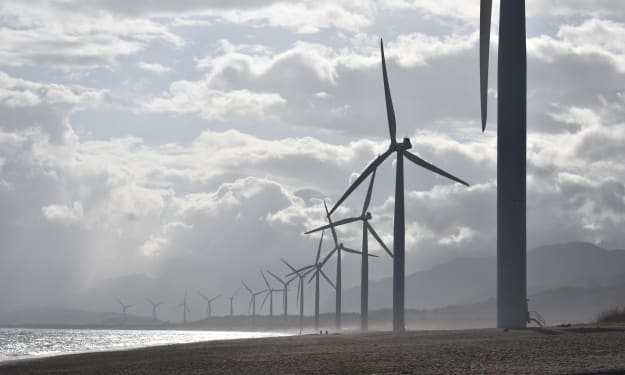
The Transformative Power of Renewable Energy
Navigating the Energy Revolution In the midst of a rapidly changing climate and escalating environmental crises, our world is at a crossroads. The urgency to find sustainable solutions has never been greater, and in this pivotal moment, renewable energy emerges as a beacon of promise. This is a journey through the transformative power of renewable energy—a journey that holds the key to reshaping our world and securing a sustainable future.
By Lewis Nguyen3 years ago in Earth
Sustainable Transportation Trends: What's Next for Eco-Travel?
Sustainable transportation is not just a buzzword; it is becoming vitally important globally. It is a concept that is necessary to be adopted by everyone. You may be wondering why. So, the way we are moving is getting change. If you may have noticed, you have seen that many electric cars are moving on the roads, giving a second thought to how buses and trains work and adopting fancy technology to improve our surroundings.
By Sustainable Travel & Transportation Network3 years ago in Earth
What if our universe were to collide with another?
This is our home planet, Earth, and its satellite, the Moon, as we zoom out. Here we have our solar system, followed by the vast expanse of the Milky Way galaxy. We are but a minuscule dot amidst an infinite number of stars. Moving even further out, we encounter a cluster of galaxies, depicted as dots and swirls in the boundless space. Beyond that lies the Laniakea supercluster, where our galaxy resides. Continuing on, we come across the Hydra-Centaurus supercluster, which consists of immense clusters comprising thousands of galaxies. From this perspective, they appear no larger than a mere speck. Next, we encounter the Pavo-Indus supercluster, an expansive region spanning 200 million light years. As we continue to zoom out, we eventually witness the entirety of the observable universe. Each tiny dot within this vast expanse actually contains thousands of galaxies and an inconceivable number of stars. Scientists speculate that our universe may resemble a bubble, and it is conceivable that this bubble could collide with another universe. In fact, the existence of other universes is not out of the realm of possibility. It is even plausible that an infinite number of universes have emerged following the Big Bang. The occurrence of collisions between these universes is not impossible, as it may have transpired in the past.
By shafwan shariff3 years ago in Earth