Nature
Echoes of the Earth
In the heart of the Arctic Circle, where the icy winds dance with the spirits of the ancestors, there lies a remote Inuit village known as Nanurjuk. For centuries, the Inuit people have called this frozen landscape home, living in harmony with the land and sea, guided by the wisdom passed down through generations.
By Doopie Lexzy3 years ago in Earth
From Seed to Supper. Content Warning.
Welcome to the wondrous world of gardening, a realm where tiny seeds transform into vibrant displays of color, flavor, and life! Forget store-bought, plastic-wrapped produce – this guide unlocks the magic of growing your own food, from seed to supper. Whether you have a sprawling backyard or a sunny windowsill, this journey is open to all.
By Ahmed Mohammed3 years ago in Earth
Black Holes Explained . Content Warning.
Back in 2014, there was a highly successful movie directed by Christopher Nolan, Interstellar. The film explored space-related themes, such as wormholes, black holes, and alien planets, in a scientifically accurate manner. However, the most astonishing moment came at the end of the movie. During the climax, the protagonist, Cooper, plunges into a Black Hole. In the movie, the black hole is named Gargantua. Cooper descends into the black hole aboard his spacecraft. Initially, darkness enveloped him, Pitch black. But as he descended further, He observed tiny particle-like objects. These particles collided with his spacecraft, leaving scratches on it. There were flashes of light, sparks, and his spacecraft caught fire. Forced to abandon his craft, he continued his descent into the black hole. Suddenly, he found himself in a five-dimensional space. A five-dimensional tesseract. It was a mind-bending experience. A place where he could communicate with his past self using gravity. After witnessing these scenes, you may have pondered whether such a scenario is feasible. Does this truly occur within a black hole? If we were to fall into a black hole, what would we perceive? Let's delve into these aspects in today's. "Black holes remained largely mysterious until the 20th century. A black hole is a region in space where gravity's pull is so intense that not even light can escape." "From the outside, the contents of a black hole remain hidden." "Black holes are enigmatic entities in our universe. Dark gravitational powerhouses that consume everything in their vicinity."
By zamai mate3 years ago in Earth
Urban Planning and Green Infrastructure
Green spaces and nature-based solutions play a critical role in shaping sustainable cities of the future. Integrating green infrastructure, such as urban parks, rooftop gardens, and green corridors, enhances biodiversity, promotes physical and mental well-being, and mitigates the effects of climate change.
By Rasmi Ahmed Mohamed3 years ago in Earth
Consider the possibility that The Earth Quit Turning
Earth flies around the sun at 110,000 kph, but what if it just... stopped? Well, for one thing, you'd have only a month to live. First of all, if Earth came to a sudden halt, you'd actually die instantly because you'd be flung off the planet and into space, much like how you lurch forward in a car when a driver slams on the brakes. However, if Earth slowed down more gradually, you'd instead experience a slower (but still horrific) demise. That's because the planet is about to get incredibly hot. The sun's massive gravity pulls Earth towards it. Meanwhile, the planet is trying to veer away in the opposite direction. This back-and-forth keeps us in orbit. But if Earth slows down and stops, the sun wins and drags us towards our destruction. In fact, a model from the University of Colorado shows us how long that dreadful journey would take. Just two months.
By energy consultant3 years ago in Earth
For what reason did Megalodon go wiped out?
In 1667, a Danish scientist made a groundbreaking discovery: the peculiar stones revered for their supposed mystical powers, once believed to have fallen from the sky during lunar eclipses and mistaken for snake tongues, were, in fact, fossilized teeth. Many of these teeth belonged to an ancient creature species that would later be known as megalodon, the largest shark to ever exist. But what was it like when megalodon ruled the seas? And what led to the demise of this colossal predator?
By energy consultant3 years ago in Earth
Exploring the Wonders of Nature: A Journey into the Beauty of the Natural World
In a world that is becoming more influenced by technology and urban development, it is more important than ever to reconnect with nature. This summary will explore the numerous wonders and crucial roles of the environment, highlighting the significance of accepting, safeguarding, and flourishing in the beauty of the planet.
By Rupesh Sah3 years ago in Earth
Consider the possibility that Uranus Crashed into Earth.
It has been exactly 30 days since Uranus first appeared overhead, initially mistaken for a newfound celestial companion to our moon. However, it soon became evident that something much more significant was unfolding. What triggered Uranus's sudden volatility, and how might this mythical collision transform the ice giant? Oh, and that dreadful smell... What if Uranus were to collide with Earth?
By energy consultant3 years ago in Earth
You Won't Believe This..
Food, the cornerstone of human survival and pleasure, has a rich and surprising history that often goes unexplored. From the humble banana to the iconic Thanksgiving turkey, the foods we know today have undergone remarkable transformations over centuries. Join us as we delve into the fascinating evolution of some of your favorite culinary delights.
By Joey Randy 3 years ago in Earth
What if all the stars disappeared suddenly?
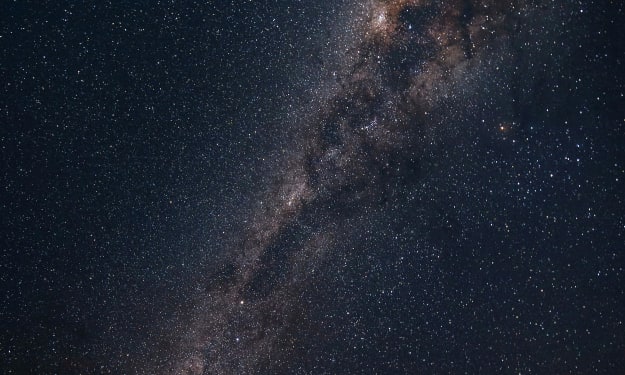
Have you ever wondered what would happen if all the in the universe disappeared suddenly? Definitely, the consequences would be profound and catastrophic. Before talking about the disappearance of the stars, let us first understand why we need a star.
By Vishnu pprasath3 years ago in Earth
Innovative Solutions to Combat Climate Change and Restore Nature.
Climate change is no longer a distant threat; it’s a reality that demands urgent action. With rising temperatures, extreme weather events, and biodiversity loss becoming more pronounced, the need for innovative solutions has never been more critical. Fortunately, scientists, engineers, and visionaries around the world are rising to the challenge, developing groundbreaking technologies and initiatives to combat climate change and restore our precious natural ecosystems.
By Dominic Ach3 years ago in Earth