Nature
More Unsettling News on the Highly Pathogenic Avian Influenza Situation
I was hoping today would bring some better news on the highly pathogenic avian influenza (HPAI) front, but was quickly disabused of that notion when I received word of what had transpired at a teleconference today featuring researcher's from Cornell's Veterinary Diagnostic Center. Unfortunately I was not able to attend but a colleague filled me in and provided a couple of relevant screenshots (included below) of some of the key information shared. I am currently trying to obtain a link to a recording of the event but as of this moment it has not yet been uploaded. Even in the absence of seeing that video the information in the two screenshots is disturbing for many reasons. From the dairy farm in Texas where 4000 cows were tested we see that dead birds (pigeons and grackles) were found on March 18 and then on the 20th, two days later, HPAI was detected in grackles and pigeons. Going to assume that means in the dead grackles and pigeons but not clear from this slide if that is the case or if was also detected in still living birds. That is a critical piece of information because with a 99% lethality rate there should not be many or any still living birds around to test positive. If there are it might suggest this particular variant has reduced lethality compared to wild-type. This is actually not a good thing as the ultra high lethality of the disease is one of the things that tends to limit its spread. Also, disturbing the fact that on 03/21 a cat on the farm (yet another mammal) tested positive for HPAI. No word on why the cat was tested, or if it was showing symptoms or its ultimate fate. HPAI has been detected in cats and dogs in European outbreaks but was thought to be incidental from them going after infected birds or playing with carcasses. They are usually not sick. In this particular instance if the cat actually gets sick that is a very different scenario and potentially highly problematic. I will be listening looking for news on the fate of this particular cat very closely and that information may be in the recording I am still waiting to be posted. Also on 03/21 we see that influenza sequences were detected in 2 cows nasal swabs which were then confirmed as H5N1 that same day. Then four days later on 03/25 the virus was isolated from milk, apparently within MSC cells. I believe these are Mesenchymal stem cells aka mesenchymal stromal cells or medicinal signaling cells, which are multipotent stromal cells that can differentiate into a variety of cell types, including osteoblasts (bone cells), chondrocytes (cartilage cells), myocytes (muscle cells) and adipocytes (fat cells). In any case the virus was present at very, very, very high levels and that fact, combined with some other data, suggests that the virus may actually be capable of replicating in milk.
By Everyday Junglist2 years ago in Earth
Unraveling the Mystery of Anosibe Ambohiby
Madagascar, an island off the coast of Africa, is renowned for its unparalleled biodiversity. Yet, amidst its lush landscapes lies a peculiar anomaly: a massive dark circle atop a mountain, over thirteen kilometers in diameter. This enigmatic spot, known as Anosibe Ambohiby, harbors a village nestled within its crater. Its isolation and remote location piqued curiosity, prompting an investigation into the origins of its inhabitants and their remarkable choice of dwelling.
By Samuel Kirubi2 years ago in Earth
Wonders of the animal Kingdom
The animal kingdom is teeming with remarkable creatures, each with its own unique abilities and adaptations. From the seemingly mundane to the downright extraordinary, animals never cease to amaze us with their fascinating traits and behaviors. Let's delve into the world of animals and uncover some astonishing facts that will leave you in awe.
By David Shawn Farrell2 years ago in Earth
SHOCKING NEWS TAIWAN EARTHQUAKE CLAIMING LIVES OF RESIDENTS AND THOUSANDS INJURED.
Taipei, Taiwan — Rescuers in Taiwan scrambled to free dozens of people trapped in highway tunnels after the island was struck by its strongest earthquake in 25 years Wednesday, killing at least nine and injuring more than 900 others.
By Thando Xulu2 years ago in Earth
The Economic of Climate Change: Cost, Benefits and Policy Implications
In the heart of a bustling metropolis, where skyscrapers pierced the clouds and the streets hummed with the rhythm of life, there lived a man named Alex. He was a numbers guy, a financial analyst, who spent his days immersed in spreadsheets and economic forecasts. But beneath his crisp suit and meticulously combed hair, Alex carried a burden heavier than any balance sheet could measure.
By Kenechukwu Prince Eneasato 2 years ago in Earth
Echoes of Treachery: A Captain's Warning from the Void
Once upon a time, amidst the vast expanse of the galaxy, there existed a species known as the Staton. Standing at just a meter and a half tall, adorned with insulating fur and short tusks, they were not particularly imposing creatures. Yet, despite their unassuming appearance, they harbored a trait that made them the most dreaded species to encounter in the cosmos - their utter lack of scruples.
By Samuel Kirubi2 years ago in Earth
Highly Pathogenic Avian Influenza Has Made the Jump to Mammals and That is Very Scary
Had a very scary telephone call this morning with a number of my technical and business colleagues discussing various aspects of the news that highly pathogenic avian influenza (HPAI-H5N1) has apparently made the jump to mammals with confirmed or suspected cases in dairy cattle herds across the country and several people who had been in close contact with said cattle are said to have symptoms of the flu though there has been no official confirmation of either humans with symptoms or any confirmed human infections. Rumors are flying that beef cattle have also been infected though there has been no confirmation of that of which I, nor anyone on the call, was aware. The persons taking part in this particular call were some of the most well connected to all aspects of the dairy and beef industries as any in the world, so if it were known, they would have known it. I don't take much comfort from that fact however, and was very disturbed to learn this morning in the very first email I opened in my overflowing inbox that cases, or at least symptoms, in humans working with the infected dairy cattle had also been reported. If this is in fact accurate then we have the possibility that highly pathogenic avian influenza has not only made the jump to mammals in the form of dairy cattle, but that this particular variant of the H5N1 strain also has the ability to be transmitted from cows to humans. This is scary stuff and I will admit I am much more nervous about this then I ever was about Covid19. Highly pathogenic avian influenza is not called that for nothing. It is in fact highly pathogenic. Fatality rates in susceptible bird populations regularly reach 99%. The jump to mammals is a thing that has always been highly feared but felt unlikely to occur due to the ridiculously high virulence of HPAI. In addition to limiting the spread of the virus the high lethality rate means that it has historically been under very little evolutionary pressure to mutate and thus potentially gain the ability to more readily infect a non- avian species. This is very unlike seasonal flu in humans which is under a ton of selective pressure and mutates left and right. Thus the reason we need a new flu vaccine every year. The fatality rate in infected humans is closer to 50% which might sound like a good thing, but is actually probably a net negative as it gives the virus more time to spread. That said for a human to become infected takes a ridiculously high exposure as the virus is not at all well adapted for survival and replication in humans and there has never been a confirmed case of human to human transmission. If that ever were to change, thankfully we always have optimal virulence to save us from a human species level extinction catastrophe even in the worst case scenario.
By Everyday Junglist2 years ago in Earth
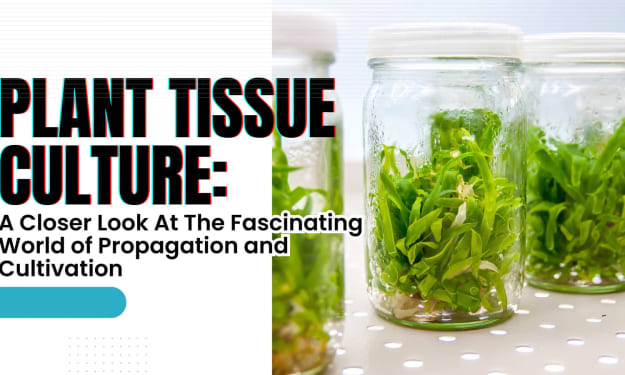
Plant Tissue Culture: A Closer Look At The Fascinating World of Propagation and Cultivation
If you’re a plant enthusiast, you may have heard of plant tissue culture. This technique is used in propagation and cultivation, which involves growing plant cells in a laboratory setting. It has opened up new possibilities in the field of agriculture and floriculture across the globe. So, if you want to develop a green thumb with science, you’re in the right place! In this beginner’s guide, we’ll explore the basics of plant tissue culture and how to use it in propagation and cultivation.
By Bryce Carin2 years ago in Earth
A solar eclipse is coming on April 8. . Content Warning.
On April 8, for around four minutes, numerous Americans will have the intriguing opportunity to observe a complete solar eclipse. The last time that occurred in North America was 2017 - and the in the future will not be until 2044. The obscuration, which happens when the moon moves before the sun, will go through a more thickly populated way than in 2017, allowing additional individuals to watch the obscured skies from their own homes. Overshadow watchers are additionally expected to go to regions along the way.
By Mbebla Jemimah Aaron2 years ago in Earth
Roots Of Resilience
In a forgotten corner of the city, where concrete towers overshadow patches of struggling greenery, lives unfolded amidst stark contrasts. Maria, a determined community leader, witnessed firsthand the harsh realities of environmental injustice.
By Daniel Asamoah2 years ago in Earth