Nature
Inspiration and Wonder
The Symphony of Nature In a quiet village nestled amidst rolling hills and lush forests, there lived a young girl named Maya. From a tender age, Maya felt a deep connection to the natural world that surrounded her. She spent her days exploring the woods, listening to the melodies of the birds, and marveling at the colors of the sunset painting the sky.
By Ikimat Olatunji2 years ago in Earth
A Tribute To Women - What the Hell is Botanical Sexism?
The food I bought at the market is possible because of the female trees. Being a female comes with more fight for life. So much is expected of us and most of us give without thought. Fighting for equal rights in almost all areas of life including our bodies is frustrating. But for me, all this fight just made me stronger. Yesterday was International Women's Day to celebrate females. All of us add something to our world that improves it directly, or indirectly.
By Annelise Lords 2 years ago in Earth
Air pollution reduce life span by 5 years among South Asians!. Content Warning.
In a recent study by Energy Policy Institute at the University of Chicago it was found that particulate air pollution is the major cause of reduction of life expectancy, far exceeding malaria, tuberculosis and even deadly infection like the HIV/AIDS.
By Mind Mastery2 years ago in Earth
Know the mystery of The biggest mammal on Earth
Blue whales are the greatest animals anytime known to have existed in the world. These incredible marine very much developed animals have a spot with the baleen whale suborder, Mysticeti, and are tentatively named Balaenoptera musculus. In this unmistakable note, we'll examine various pieces of blue whales, including their real characteristics, lead, climate, protection status, and significance in sea life natural frameworks.
By Vivek Kumar2 years ago in Earth
The Celestial Spectacle of Eclipse 2024: A Once-in-a-Lifetime Cosmic Phenomenon
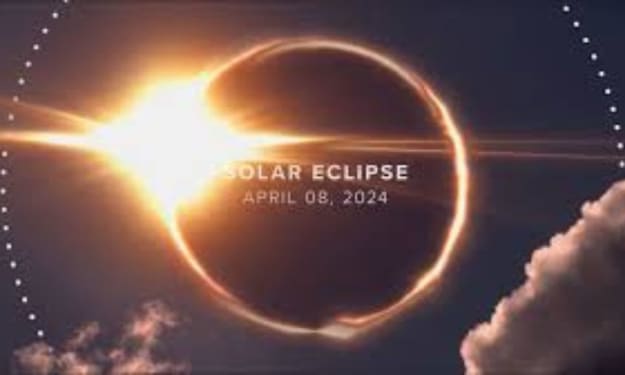
In the realm where science meets wonder, few events captivate humanity's collective imagination like a total solar eclipse. As celestial bodies align in a dance of cosmic proportions, casting the Earth into temporary darkness, people around the globe are gearing up for an astronomical extravaganza – the total solar eclipse of 2024. Anticipation is reaching fever pitch as astronomers, enthusiasts, and curious onlookers prepare to witness this awe-inspiring spectacle firsthand.
By Azam Javed2 years ago in Earth
Ayurveda
Ayurveda, originating in India more than 3,000 years ago, is one of the oldest traditional medical systems in the world. The term Ayurveda stems from Sanskrit, combining ayur (meaning life ) and veda (meaning science or “knowledge ). Thus, Ayurveda translates to the science of life. This ancient practice takes a holistic and individualized approach to wellness, emphasizing harmony and balance with nature.
By Allwyn Roman Waghela2 years ago in Earth
Unveiling the Unthinkable: Decoding the Mind-Blowing 2024 Total Solar Eclipse in 5 Astonishing Steps!
On Monday, April 8, 2024, a highly anticipated celestial event will grace the skies of North America—a total solar eclipse. During a total solar eclipse, the moon passes between the Earth and the sun, casting a shadow on Earth and momentarily obscuring the sun. While everyone in North and Central America will be able to witness at least a partial eclipse, those within a specific path stretching across 15 U.S. states, Mexico, and Canada will be treated to the awe-inspiring spectacle of a total eclipse. If you're eager to witness this extraordinary event, you can tune into a live stream of the total solar eclipse on Space.com. They will be providing real-time coverage and updates on the eclipse through their blog. To better understand the different types of solar eclipses, let's delve into the details. A total solar eclipse occurs when the moon is relatively close to the Earth and perfectly aligns with the sun, completely blocking its disk. This results in a remarkable sight where the sun appears as a dark circle surrounded by a radiant halo known as the corona. It's a breathtaking experience that leaves observers in awe of the wonders of the universe. Another type of solar eclipse is the annular solar eclipse. This occurs when the moon is farther away from Earth, making it appear smaller in the sky. As a result, during an annular eclipse, the moon does not fully cover the sun, leaving a ring of sunlight visible around its edges. The last annular eclipse visible in the United States occurred on October 14, 2023. Lastly, partial solar eclipses occur when the alignment between the Earth, moon, and sun is not perfect. In such cases, the moon only partially blocks the sun, resulting in a crescent-shaped sun or a "bite" taken out of its disk. Partial eclipses can be observed from various locations, but they do not offer the same level of awe-inspiring spectacle as total eclipses. On April 8, 2024, the moon will be in its new moon phase, appearing relatively large in the sky. This allows it to fully cover the sun's disk within a narrow path of totality. The magnitude of the eclipse, which represents the fraction of the sun's diameter covered by the moon, will be 1.0566, slightly more than complete coverage. For those interested in witnessing the total solar eclipse in person, NASA has released an interactive map that details the exact path of totality. However, it's important to note that the appearance of the total solar eclipse will vary depending on your specific location. The eclipse will progress through five distinct stages, each occurring at different times and durations in different areas. The stages of a total solar eclipse are as follows: 1. First Contact: The moon begins to pass in front of the sun, creating a partial eclipse. During this stage, it will appear as if a small bite has been taken out of the sun. 2. Second Contact: The diamond ring effect occurs, signifying the imminent onset of totality. At this point, only a sliver of sunlight remains visible, creating a dazzling display resembling a diamond ring. 3. Totality: The moon completely covers the sun, plunging the surroundings into darkness. The corona, the sun's outer atmosphere, becomes visible—a delicate, ethereal glow surrounding the darkened disk of the sun. During totality, stars and planets that are typically hidden during daylight hours may also become visible, creating a truly mesmerizing experience. 4. Third Contact: The moon starts moving away from the sun, ending the totality phase and initiating the second partial eclipse. The diamond ring effect occurs again, indicating the fading of the total eclipse. 5. Fourth Contact: The moon is no longer blocking any part of the sun, marking the conclusion of the total solar eclipse. The sun gradually resumes its normal appearance. As you prepare to witness this extraordinary event, it's crucial to prioritize safety. Viewing the sun directly without proper protection can cause severe eye damage. Regular sunglasses are not sufficient for observing a solar eclipse. To ensure your safety, you will need specialized eclipse glasses made from safe solar filter materials or special filters for telescopes. Take the necessary precautions and immerse yourself in the breathtaking beauty of the total solar eclipse on April 8, 2024. It's an opportunity to witness the grandeur of our universe and appreciate the wonders of celestial events. Enjoy this incredible experience safely!
By Precious Kayce2 years ago in Earth
Exploring the Future: Humanity's Journey One Billion Years Ahead
Title: "Exploring the Future: Humanity's Journey One Billion Years Ahead" As humanity stands on the precipice of time, we gaze into the unfathomable depths of the future, pondering the cosmic tapestry that awaits us. With each passing moment, the universe unfurls its mysteries, offering glimpses of what may lie ahead in the vast expanse of one billion years.
By Batshal Sharma2 years ago in Earth