Nature
Earth ending in 2038
13th April, 2029. A huge asteroid Apophis, more than 1000 feet in diameter, will pass by the Earth at a close prproximity. If it hits the earth, it will bring about such a devastation which has never been seen before in human history. Compared to the bomb dropped on Hiroshima this will release 1 million times more energy. There will be tsunami waves of hundreds of metres. And entire cities will be wiped out. But not only that, on 12th July, 2038, another asteroid can collide with the earth. And look at this post. There is a 72% chance of this collision. NASA has already issued an alert and has started its planetary defence exercises. And look at this post, it's only a few weeks old. After NASA Chief, ISRO's Chief has now issued a warning that we can all go extinct. Oh, my God! An earth-destroying asteroid is speeding towards us. ISRO Chief says that migrating to Mars is an option and all global space agencies are working on it. How much truth is there in such news? Which asteroids pose the most danger for Earth? And what is NASA's plan? Let's understand all these things in depth in this video. Asteroids are also called Planetoids. Because they are like small planets. They are basically some huge pieces of rocks that are orbiting in space. Their diametre can be as small as 10-20 metres or as big as 100-200 kilometres. The smallest existing asteroid we've discovered is only 2 metres wide and the biggest is called Ceres with a diameter of 940 kilometres. Most of the asteroids in our solar system are found in the Asteroid Belt between Mars and Jupiter. It houses millions of asteroids. The drawing of this asteroid belt in our textbooks looks like this. This might seem like these asteroids are so close to each other, but in reality, the average distance between any two asteroids is more than 1 million kilometer. But sometimes these asteroids move away from this belt and get quite close to the earth. In such cases, these are known as Near Earth Objects. In short, they are called NEOs. NEOs are not just asteroids, they can be Comets, Meteors, Meteorites, and Meteoroids. You may ask what is the difference between them? Basically, all of them are just pieces of rocks moving through space. But the way we define them, is different for each. Like asteroids are made of rocks and metals. Comets are made of ice, rocks, and dust. They are known as Dirty Snowballs too. Asteroids are found between Mars and Jupiter in the asteroid belt. Comets are found in the Kuiper belt. This belt lies before Neptune, quite far from our Sun. When comets move in space, they seem to have a tail which asteroids don't. Typically, comets can be large too, with a diametre of 1-10 km. And whenever a comet passes by earth, it can be easily seen with the naked eye. But to see asteroids, telescopes are needed in most cases. In terms of danger posed to us, a comet is far more dangerous than an asteroid. Because first, a comet travels at twice the speed of an asteroid. And second, the warning time is shorter. A comet may suddenly appear and collide with the Earth, and unfortunately, we won't find out about it for a long time. This was shown in the film, Don't Look Up. In this film, we see how there was a 6-month warning time of a comet colliding with the Earth. And how the government and space agencies react to it. A Meteoroid is a small piece of an asteroid or comet. When a meteoroid gets closer to the earth and enters our atmosphere, we call it a Meteor. When that happens, it burns very quickly and we see a streak of light. It is also known as a shooting star and some of you might have seen it yourself. When this happens in large numbers, it is called a Meteor Shower. And if a piece of meteor, travels through our atmosphere and falls on the earth, it is called a Meteorite. That's the only difference. However, for us, the important thing is are the NEOs. The asteroids and comets that pass by the earth. Those posing considerable risk of of crashing on the earth. And bringing about the end of our world. This is a justified concern because this happened 66 million years ago to the dinosaurs. If they can go extinct, so can we. But before measuring this danger and moving ahead, I would like to say one thing. If you get your news from such accounts on Instagram and Facebook, it would be better to stop following news. Because this news about the 2038 Asteroid Strike is completely fake. If you want to follow some pages on Instagram for news, then there are many options like The Hindu, Indian Express, Scroll.in, The Wire, News Laundry. Or even our mainstream news websites, even though the standard of Indian media isn't quite up there, but at least they won't spread this level of lies there. Because see, Times of India has also written an article on this. The headline states that "NASA warns that a planet-sized asteroid has a 72% chance of impacting the earth." This headline is wrong. It is a click-bait headline. But if you read the first line of the article by scrolling further, they have clarified this headline. "NASA recently conducted a hypothetical exercise to assess the planet's preparedness against an asteroid impact." Actually, this 72% chance is not a finding or result. This is a hypothetical imaginary scenario which was created by NASA. They conducted an exercise, that if today we found out that an asteroid is going to collide with earth in July 2038, what can we do? This was a mock test in which more than 100 experts took part from different organisations. NASA, European Space Agency, UK Space Agency, United Nations Office of Outer Space Affairs. Everyone discussed this hypothetical situation if an asteroid were to collide with the earth 14 years from now, what should be the exact steps to stop it. On 20th June, NASA released this report in public which contain some interesting points. We will talk about them in the video later, but before that I would like to tell you, the date of 2029, which I talked about at the beginning of the video, that date is not hypothetical. Apophis asteroid with a diametre of more than 1,000 feet does really exist. And on 13th April 2029, this asteroid will pass by very close to the earth. Only 30,000 km away. Many geostationary satellites are farther away than this. NASA had released a video showing the exact path of this Apophis asteroid. 5 years later, the day this asteroid will pass by the earth you won't need a telescope to see it. You will be able to see it with your eyes at night. So the question is, what are the chances of this asteroid actually colliding with earth? The answer is Zero Percent. This asteroid was discovered in 2004. After which, there was quite an uproar all over the world. Because according to the initial observations, they claimed that there was a 2.7% chance of this asteroid colliding with the earth in 2029. Even though this 2.7% chance wasn't very significant. It basically meant that there's a 97% chance that it won't collide. But when the consequences can be so devastating, even a 2% chance can be terrifying. That's why in those years, this asteroid was called the City Killer, the most dangerous asteroid. This was the origin of its name Apophis. In Egyptian mythology, Apophis is a giant snake which destroys everything. It is also known as the God of Chaos. But the good news is that after further observations of this asteroid by the scientists, they found that in reality, it has a 0% chance of colliding with the Earth. For a few years scientists thought that though it won't collide in 2029, when it'd come closer to Earth the next time, it might be dangerous. Like in 2036 or 2068. Because when it would pass by Earth in 2029, it would pass through a Keyhole Area. In space, those places are said to be Keyholes that is so close to the Earth, where a passing asteroid is affected by Earth's gravitational force. When the asteroid comes close to Earth in 2029, it will pass through a Keyhole region, which will change its orbit. Due to Earth's gravity, the asteroid's orbit will change, which will increase the risk in 2036. Scientists were afraid of this at one time, but today, this threat has been debunked. NASA has confidently stated that in the next 100 years, the asteroid will not collide with the Earth. This is why, it has been removed from the risk list of Near-Earth Objects. You might be surprised at this. To know that there is a risk list. Of course, there is. Space agencies around the world have made a Risk List of the most dangerous asteroids in the near future. For example, on the European Space Agency's website, look at this Risk List. The possible collisions of these asteroids and comets. The Impact Date and Time are mentioned. The probability of their collision. Look at this IP max section. This mentions the maximum probability. And this section at the back, mentions the diameter to show how big the asteroid or comet is. It was only because of Data Science take a closer look at the top three objects in this risk list. At #1 is the 2023VD3 asteroid. The 2023 in the name tell us that this asteroid was discovered in 2023. This asteroid is quite small in size. It is only 11 to 24 metres wide. It might collide with earth on 8th November 2034. And the probability of collision is 1 in 387. That is, in percentage, it has a 0.25% chance of colliding. This is a substantial chance actually. That is why it is placed at the top of the list. But because of its smaller size, it is not very dangerous. The chances are that even if it collides with earth, it will fall into a sea or ocean or somewhere with few people. It won't cause much damage. In 2013, there was a similar incident when in Chelyabinsk, Russia, the Chelyabinsk meteor blasted above the city. "It came out of nowhere a bright speck in the sky seen streaking across the horizon. Followed by an almost apocalyptic scene. A blinding flash of light and then, all hell broke loose." The diameter of the meteor was about 20 metres and a powerful shockwave was released. Some buildings were damaged, some people were injured but thankfully, no lives were lost. "Nearly 1,500 people were injured. Most of them suffered cuts from shattered windows." At #2 on the risk list is the 1979XB asteroid. It is quite big. Its diameter is around 400-900 metres. Potentially, it will collide with earth on 12th December 2056 and the probability of the collision is 1 in 4.27 million. That is 0.00002%. The chance of this collision is almost negligible, but it is still ranked #2 on the risk list because of its size. We cannot afford this low chance. At #3 is asteroid 2008JL3. With an estimated diameter of 23-50 metres. And the potential impact date as 1st May 2027. And the probability of impact at 1 in 6,711. That is a 0.01% chance of collision. As you can see, these scientists working in these space agencies are doing a great job. Because they don't want to risk Earth's future due to these small risks. The only problem is that these are the asteroids that we have discovered so far. They may discover more asteroids in the future. But Comets don't have such a proper calculated trajectory. That is, we won't get a big warning window about comets. Tomorrow, we may discover a new comet that may collide with the Earth and for that we will have only 6-7 years to prepare. The detection systems on Earth, work well most of the time, but sometimes they might not. I would like to tell you about 4 most popular detection projects. The first is LINEAR, Lincoln Near-Earth Asteroid Research. It was started in 1996 by the US Air Force, NASA, and MIT, in a joint collaboration. Two 1-metre long telescopes and a 0.5-metre telescope is used to discover more than 10,000 objects every year. Today, out of all the asteroids that are being discovered, 65% of them are being discovered by this project. The second is CSS, Catalina Sky Survey. Established by the University of Arizona in 1998, it uses two big telescopes. Its measurements are so precise that in 2008 it found an asteroid which was only 4 metres in diameter. And it had accurately predicted the exact time and day when this asteroid will fall on the earth and the exact location. 19 hours after its prediction this asteroid fell in the desert of North Sudan the same place it had predicted. The third is PAN STARRS Panoramic Survey Telescope and Rapid Response System. It is located in the middle of the Pacific Ocean in Hawaii and it uses the world's largest digital cameras to find asteroids. The images captured by this largest camera are of 1.4 billion pixels. And the fourth is ATLAS Asteroid Terrestrial Impact Last Alert System. It is also located in Hawaii. And scientists have created it as a final warning of sorts. In case all the other systems are unable to detect an asteroid, if an asteroid goes undetected by mistake, then this system will give us a last minute warning of a possible asteroid impact. Every night this system scans the sky twice to detect any danger. So overall, Earth's defence system is quite brilliant and strong. But sometimes there might be some errors. Like, sometimes small meteors remain undetected as they get closer and then collide with the earth. Like the Chelyabinsk meteor in February 2013. This 20-metre wide meteor was not detected by any system on time. That's why for such scenarios, a Civil Defence Component becomes crucial. NASA has talked about this on Page 12 of their mock test report. If a small asteroid or meteor is about to crash somewhere International coordination is required at the right time, as well as the activation of the Disaster Management plans. But what will happen if a large asteroid is about to collide? There are three strategies to deal with it. First are the Kinetic methods, second are the Slow Push and Pull methods and the third are the Nuclear methods. The first of these three, the Kinetic Method is the only one that has been successfully tested in real life. In this, we send a spacecraft that collides with the asteroid and changes its orbit. The asteroid moves in a new orbit. This is a simple and effective method. Its practical experiment was conducted two years ago in NASA's Double Asteroid Redirection Test (DART). On 26th September, 2022, a 170-metre-wide Dimorphous asteroid was in space, far away from Earth and NASA launched a spacecraft to collide with it. "NASA's first planetary defence test to strategically crash into an asteroid..." This asteroid didn't pose any danger to us. It was just an experiment to see whether doing this really changes the orbit of the asteroid or not. You can watch the video of this collision on the screen. After that, when NASA looked at the result, the asteroid's orbit had actually changed. The same experiment is going to be conducted by China's National Space Agency next year. In 2025, they will have their spacecraft collide with a 30-metre-wide asteroid, and try to change its path. The second method is Slow Push and Pull. In this, we change the asteroid's orbit gradually. Solar energy can be used for this. If a spacecraft is sent near the asteroid it can concentrate the sun's rays on the asteroid to vaporise a part of the asteroid, this reaction will release some amount of gas, which will cause a small thrust on the asteroid. And gradually, the asteroid will change its orbit. This happens naturally on asteroids when an asteroid passes near the sun. But if it is done by sending spacecraft, scientists' only concerns is before the rocks on the asteroid are vaporised, these rocks should not interfere with the spacecraft's optical system. Thirdly, we have the Nuclear Method. Literally, sending a spacecraft carrying nuclear b0mbs to destroy the asteroid. It sounds very filmy but realistically, it may hardly ever be used. There are two reasons behind this. First, deploying a nuclear b0mb in space can lead to many legal, international, and geopolitical problems. And second, when an asteroid is destroyed, its pieces will be blown up all around and we can't control the orbit of those pieces. A piece may even collied with earth after the asteroid is destroyed. But this method is still under consideration because if an asteroid is large beyond an extent, like if the asteroid's size is more than 10 km, the same size that caused the extinction of dinosaurs. Then the other methods may not work as well because of the extreme size of the asteroid. In NASA's mock test from a few months ago they discussed these points. "Exactly how to deal with an asteroid which is going to collide with the Earth after 14 years with a chance of collision at 72%." The good news is that 81% of the participants participating in this mock experiment believed that we are ready to deal with such a threat. There are only a few gaps that scientists have raised regarding such scenarios. For example, one gap mentioned was that we have tested only one method till now, the Kinetic Method. We should test this Kinetic Method more times in the future so that we can be sure that it will work as needed. This was the 5th meeting to discuss a hypothetical asteroid strike. Before this, in 2013, 2014, 2016, and then in 2022, similar meetings were held. It was named Planetary Defense Interagency Tabletop Exercise. And in John Hopkins Applied Physics Laboratory, around 100 experts came together. So, in conclusion, friends, there is nothing to worry about. First of all, in the next 100 years there are no big asteroids that have even a 0.01% chance of colliding with the Earth. Secondly, our Earth's defence systems are becoming more advanced with time. In the year 2028, NASA is planning to launch a space telescope named Near Earth Object Surveyor. It will be stationed outside Earth, to detect such asteroids so our detection systems will improve further. And thirdly, even if we find an asteroid that can collide with the earth, we already have adequate systems to stop it. Stop believing in such fake news.
By Vashundhara2 years ago in Earth
Mount Merapi
Volcanoes represent a persistent threat while simultaneously playing a crucial role in sustaining life on Earth. Their dual nature as both perilous and awe-inspiring necessitates ongoing efforts from rescue teams. A significant number of individuals reside in proximity to active volcanoes, underscoring the importance of being prepared for potential evacuations. In late October 2010, Mount Mori experienced a notable eruption, triggered by magma ascending to approximately one kilometer beneath the surface, which resulted in heightened seismic activity and volcanic tremors. The expansion of the lava dome created a significant risk, prompting the evacuation of 19,000 residents within a 10-kilometer radius. Eruptions within the Pacific Ring of Fire are primarily fueled by the explosive expansion of gases. This region has witnessed the majority of the most substantial eruptions over the past 12,000 years. In 2014, Japan's Mount Onake experienced a significant eruption that was not predicted. Volcanic eruptions can be both lethal and devastating, as superheated water and steam can lead to explosive bursts of hot water and rock fragments. Even volcanoes that appear relatively dormant, such as Kilauea in Hawaii, can still present significant risks. Different types of volcanoes exhibit varying levels of destructive potential. Shield volcanoes, with their gently sloping profiles, tend to be less destructive than the more iconic stratovolcanoes. Stratovolcanoes, characterized by their conical shapes, are formed from layers of lava and debris, resulting in particularly hazardous eruptions. Volcanic ash poses serious health risks and can endanger aviation. Composed of silicon, volcanic ash can irritate the eyes, nose, and throat, and inhalation may lead to a cement-like buildup in the lungs, displacing thousands of people and affecting aircraft operations. A volcanic eruption in 2010 had a significant impact on global air travel, incurring costs of approximately $1.7 billion, as it released 250 million cubic meters of ash into the atmosphere.
By Isaac Ekow Anyidoho2 years ago in Earth
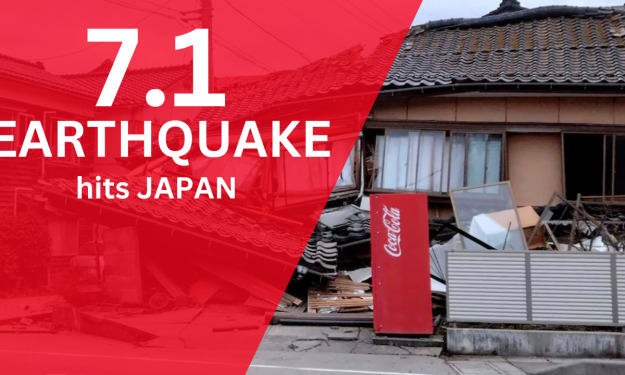
Unsettling Developments in Japan: The Earthquake That Shook More Than Just the Ground
On Thursday, southern Japan was rocked by a magnitude 7.1 earthquake that, at first glance, seemed to pass with little fanfare. The initial tremor, while significant in its own right, appeared to cause minimal damage and led to a quick scaling back of the tsunami warning. This seemed to signal a return to normalcy. However, beneath the surface of this seemingly ordinary seismic event lay a series of unsettling developments that have left the nation on edge.
By Cris Hibaya2 years ago in Earth
The True nature of Beauty
**The True Nature Beauty** In the heart of a sprawling city, where skyscrapers kissed the sky and the noise of traffic was a constant hum, lived a young woman named Maya. Though she was surrounded by the wonders of modern life—technology, entertainment, and endless opportunities—something inside her always felt incomplete. The city's concrete jungle, with its artificial lights and polluted air, felt like a cage that kept her away from her true calling. She longed for something real, something pure that would rekindle the spark within her. One evening, as the sun dipped below the horizon, casting a golden hue over the city, Maya found herself wandering into a small, forgotten corner of the city. Here, time seemed to stand still. The streets were narrow, lined with cobblestones, and the buildings, with their faded facades, whispered tales of a bygone era. As she walked, she stumbled upon an old bookstore, its wooden sign creaking in the gentle breeze. The store was dimly lit, the scent of aged paper filling the air. Shelves crammed with books of every size and shape lined the walls. Drawn to the back of the store, Maya's fingers brushed against a leather-bound tome, thick with dust. Curiosity piqued, she opened it, revealing an ancient map tucked away between the pages. The map was faded and worn, but it depicted a hidden valley deep within an untouched wilderness—a place that was said to hold the "True Nature Beauty." The legend, scribbled in the margins, spoke of a landscape so breathtaking, so pure, that it would awaken the soul and reveal the secrets of life itself. Maya's heart raced as she studied the map. The allure of such a place was irresistible. It was as though fate had led her to this moment. Without hesitation, Maya decided to embark on a journey to find this hidden paradise. The preparation for the journey was no small feat. She packed her bags with essentials—camping gear, food supplies, a journal to document her experiences, and the ancient map that had set her on this path. Saying goodbye to the city, Maya ventured into the unknown, leaving behind the noise and chaos of urban life. The journey was arduous and fraught with challenges. The first leg of her expedition took her through dense forests, where towering trees blocked out the sun, and the undergrowth seemed to pull at her every step. She navigated by the light of the moon, using the stars as her guide. Each night, she would sit by a campfire, the crackling flames the only sound in the stillness of the wilderness. Despite the hardships, Maya felt a growing sense of peace. The further she traveled from the city, the more alive she felt. As days turned into weeks, Maya found herself climbing steep mountains, their jagged peaks piercing the sky. The air grew thin and cold, but the view from the summit was worth every struggle. Below her, the world stretched out in all its natural glory—vast forests, shimmering lakes, and rivers that wound like silver ribbons through the landscape. The beauty of it all filled her with a sense of awe and wonder. But the true test came when she reached the raging rivers that guarded the entrance to the hidden valley. The waters roared with a ferocity that could sweep away the unwary, but Maya was determined. She constructed a makeshift raft and, with sheer willpower, navigated the treacherous waters. It was a battle of strength and wits, but as she finally reached the other side, drenched and exhausted, she knew the hardest part was behind her. At long last, Maya stood before the entrance to the hidden valley. As she stepped through the natural archway formed by towering trees, she was met with a sight that took her breath away. The valley was a paradise, a sanctuary untouched by human hands. The air was crisp and fragrant with the scent of wildflowers, and the colors of the landscape were more vibrant than anything Maya had ever seen. The valley was teeming with life—birds of every hue sang in the trees, while deer and other animals roamed freely, unafraid of the human visitor. A crystal-clear stream wound its way through the valley, its waters sparkling in the sunlight. As Maya followed the stream, she felt a sense of peace and belonging she had never experienced before. At the heart of the valley, she found a clearing surrounded by ancient trees, their branches forming a protective canopy overhead. In the center of the clearing stood a single, magnificent tree, its trunk wide and gnarled with age. The tree seemed to pulse with energy, and Maya knew she had found the source of the True Nature Beauty. As she approached the tree, Maya felt a warmth envelop her, and she was filled with a deep understanding. The beauty of nature was not just in its physical appearance, but in its balance, its harmony, and its ability to nurture life. The True Nature Beauty was a reminder of the interconnectedness of all things—a lesson that humanity had forgotten in its pursuit of progress. Maya spent days in the valley, absorbing its wisdom and learning from the creatures that called it home. The birds taught her about freedom and perspective, while the animals showed her the value of community and coexistence. The plants whispered secrets of patience and growth, and the wind carried the stories of time itself. When it was time to leave, she did so with a heavy heart but with a newfound purpose. She would return to the city, but she would not forget the lessons she had learned. She would work to protect the natural world, to remind others of the beauty and importance of nature, and to live a life in harmony with the earth. As Maya made her way back to the city, she carried with her a piece of the True Nature Beauty—a piece that would guide her for the rest of her life. No matter where she went, the memory of the valley would remind her that true beauty lies not in what we build, but in what we preserve.
By Karl Nicken 2 years ago in Earth
Sustainable Living
In moment's world, where environmental challenges are enhancing, the conception of sustainable living has come decreasingly pivotal. Sustainable living focuses on reducing our environmental footmark, making it not just a choice, but a necessary step toward a more flexible future. As we grapple with issues like climate change, resource reduction, and pollution, new and innovative results are arising to help us move towards a more sustainable and greener hereafter.
By Joseph Balami2 years ago in Earth
Into the Heart of Darkness: An Inside Look at Papua's Last Cannibal Tribe
In the dense, untamed jungles of Papua, where modernity and tradition clash with an intensity that’s palpable, lies a world almost untouched by the 21st century. Here, amid the sprawling rainforests and towering treehouses, I embarked on a journey that would push my limits and immerse me in a culture shrouded in both fascination and fear. My quest: to uncover the truth about Papua's enigmatic cannibal tribes.
By Rapelang Malebelle2 years ago in Earth
Bridging the Divide: Cape Town's Persistent Racial Chasm and the Legacy of Apartheid
In the heart of Cape Town, a starkly divided cityscape lays bare the enduring legacy of South Africa's apartheid era. The divide is not just a geographical one but a reflection of deep-seated socio-economic disparities that persist decades after the official end of apartheid. This story unfolds across a seemingly innocuous strip of land—a narrow stretch that separates the affluent beachside community of Strand from the densely populated township of Nomzamo. Although they are only a few meters apart, the two areas could not be more different.
By Rapelang Malebelle2 years ago in Earth
Latest news worldwide
The Modern Mysteries of Mythical Beasts: Ancient Legends Meet Today's Monsters In an era where mythical creatures have become central to our entertainment, it's intriguing to reflect on the roots of these fantastical beings. Long before the age of CGI and blockbuster kaiju movies, ancient cultures across the globe were crafting stories of formidable monsters whose legacies still captivate our imagination. As we delve into these legends, it becomes clear that the terrifying monsters of contemporary media often have their origins in these age-old myths.
By Rapelang Malebelle2 years ago in Earth
How many things are There!?
Hey, Vsauce. Michael here. Imagine if we gathered every single human alive today and threw them into the Grand Canyon. The result would be a fascinating yet sobering sight. The Grand Canyon, a colossal natural wonder, wouldn’t even be remotely filled by all 7.159 billion of us. We would form only a modest pile, a mere fraction of the Canyon’s vast expanse. This visualization not only offers a stark perspective on humanity's physical scale relative to the natural world but also prompts a deeper reflection on the nature of "things" and our place within the universe.
By Rapelang Malebelle2 years ago in Earth