Nature
How Climate Change Could Exacerbate Arsenic Contamination in Rice: A Looming Global Health Crisis. Content Warning.
Rice, the staple food for over half of the world’s population, faces a dual threat from climate change: not only could yields decline in key growing regions, but the grain may also accumulate dangerous levels of arsenic, a toxic carcinogen. Recent research highlights how rising temperatures, shifting precipitation patterns, and elevated atmospheric carbon dioxide (CO₂) levels are altering soil chemistry and plant physiology in ways that amplify arsenic uptake in rice crops. This convergence of environmental and health risks poses unprecedented challenges for food security and public health, particularly in Asia, where rice accounts for up to 70% of daily caloric intake in countries like Bangladesh and Cambodia.
By Tech Horizonsabout a year ago in Earth
"Resurrecting Legends: The Genetic Revival of the Dire Wolf"
On April 7, a biotechnology company in Texas, U.S., named Colossal Biosciences announced that they had resurrected a dire wolf, a large dangerous predator that went extinct more than 10,000 years ago. In a paper uploaded by the company on April 11, Colossal Biosciences claimed that the genomes of the gray wolf and the dire wolf are 99.94% identical, implying that 2.445 billion of the 2.447 billion base pairs were in the same places in the two genomes.Scientists extracted DNA from ancient dire wolf fossils, including a 13,000-year-old tooth and a 72,000-year-old ear bone.They sequenced the dire wolf genome and identified 20 key genetic differences between dire wolves and their closest living relative, the gray wolf.It takes surprisingly few genetic changes to spell the difference between a living species and an extinct one. Like other canids, a wolf has about 19,000 genes. Creating the dire wolves called for making just 20 edits in 14 genes in the common gray wolf, but those tweaks gave rise to a host of differences.The dire wolf genome analyzed to determine what those changes were was extracted from two ancient samples—one a 13,000-year-old tooth, the other a 72,000-year-old ear bone.
By San Rafael . Aabout a year ago in Earth
Top 10 Animals with Incredible Camouflage
These creatures are some of Nature's sneakiest Masters of Disguise. Welcome to WatchMojo.com, and today we're counting down our picks for the top 10 animals with amazing camouflage. Before we begin, we publish new videos every day, so be sure to subscribe for more great content. For this list, we're focusing on members of the animal kingdom that survive and thrive thanks to their ability to blend in with their surroundings.
By Mohammed thanvirabout a year ago in Earth
Earth’s Deepest Abyss
The Mariana Trench represents the deepest section known to exist in every ocean worldwide by settling in the western Pacific Ocean. At its deepest section the underwater trench extends deeper than Mount Everest could reach with its maximum height while reaching 36,000 feet below sea level (10,984 meters). This ocean trench stretches more than 1,500 miles at 2,550 kilometers while forming a curved scar across the ocean's floor so it received its name after the Mariana Islands.
By Arefin Foysalabout a year ago in Earth
Most recent earthquake. . AI-Generated.
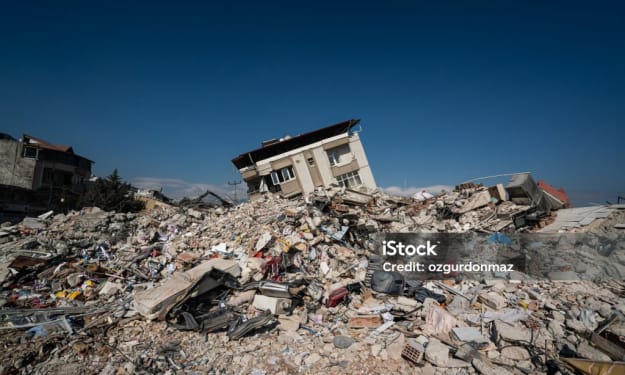
http htternat Recent Earthquake in Myanmar: A Catastrophic Event Myanmar experienced a disastrous earthquake of 7.7 to 7.9 on March 28, 2025. The epicenter was near Mandalay in Sagaing Region, making it the strongest earthquake that hit Myanmar since 1912. The effects of the quake were felt in neighboring countries like Thailand, China, and Vietnam.
By Farjana Akterabout a year ago in Earth
Upper Dolpo Trek Guide: Exploring Nepal’s Hidden Himalayan Paradise
The Upper Dolpo Trek is one of Nepal’s most remote and culturally rich trekking routes. Known for its rugged terrain, ancient Tibetan culture, and stunning landscapes, the trek offers an unparalleled adventure. Situated in the rain-shadow region of the Himalayas, Upper Dolpo remains one of the least-explored areas of Nepal, making it a perfect destination for trekkers seeking isolation and authenticity.
By Lucifer Smithabout a year ago in Earth
Astronomers say they’ve found strongest ever ‘hints’ of life beyond our solar system
The strongest ever "Hints" of life beyond our solar system are discovered by astronomers. Astronomers have reported the strongest evidence yet suggesting the possibility of life beyond our solar system, in a groundbreaking development that has the potential to reshape our understanding of the cosmos. The discovery, made through the James Webb Space Telescope (JWST), focuses on the atmospheric analysis of a distant exoplanet where signs of potential biological activity have been detected.
By GLOBAL NEWSabout a year ago in Earth
Amazing Plannet. AI-Generated.
In a distant corner of the multiverse, where time ticked not by hours but by the bloom of cosmic orchids, there existed a planet unlike any other. Its name, as pronounced by the native tongues of the whispering trees, was Plannet. Not "Planet" as humans might spell it, but Plannet—a deliberate name, as if fate had woven it twice into the fabric of reality, a double thread of destiny and design.
By Muhammad Asadabout a year ago in Earth
“India’s Hidden Wealth: A Deep Dive into the Net Worth of Its Natural Resources”. AI-Generated.
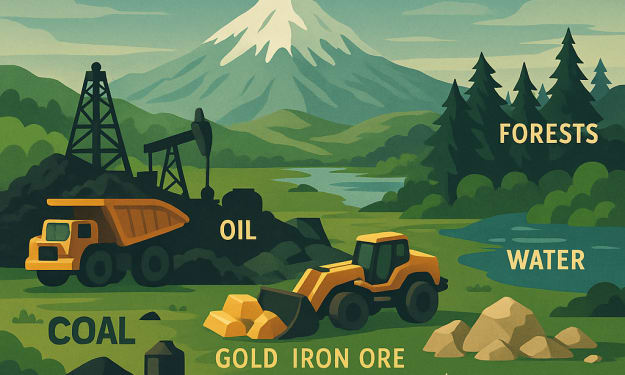
India’s Hidden Wealth: A Deep Dive into the Net Worth of Its Natural Resources India is not only a land of cultural and spiritual richness but also a nation blessed with an extraordinary bounty of natural resources. These natural endowments — including minerals, fuels, forests, water, and renewable energy sources — have powered India's civilization for millennia and continue to serve as the bedrock of its modern industrial and economic development. A Legacy Rooted in Nature From the time of the Indus Valley Civilization, India's terrain has yielded everything from precious gems to vast timber forests. Historical texts, including those from travelers like Marco Polo and Ibn Battuta, speak of India as a land of gold, spices, and mineral treasures. The colonial powers, particularly the British Empire, exploited these resources extensively, laying down the groundwork for modern mining and industrial infrastructure. After independence, India took aggressive steps to regulate and develop its resource-based sectors, creating national organizations such as the Oil and Natural Gas Corporation (ONGC), Coal India Limited, and Indian Bureau of Mines. These institutions have been instrumental in discovering and quantifying the country's natural wealth. Mineral Wealth India’s mineral reserves are among the largest in the world: Coal: India holds the fifth-largest coal reserves globally, estimated at over 319 billion tonnes. These are primarily located in Jharkhand, Odisha, Chhattisgarh, and West Bengal. With energy demands on the rise, coal continues to be India's primary source of electricity. Iron Ore: Rich deposits in states like Odisha and Karnataka make India one of the leading iron ore producers in the world. Annual production exceeds 200 million tonnes. Bauxite and Manganese: India’s reserves of bauxite — the ore for aluminum — are among the top five in the world. These are located in Gujarat, Jharkhand, and Madhya Pradesh. Gold: While not on the scale of Australia or South Africa, India’s Kolar Gold Fields and new discoveries in Uttar Pradesh are noteworthy. Estimated mineral net worth: India’s known mineral wealth is estimated at around $10–12 trillion, with coal, iron, and bauxite forming the core. Oil and Natural Gas India’s oil and gas resources are significant, although still underdeveloped compared to Middle Eastern giants: Oil Reserves: India has approximately 4.5 billion barrels of proven oil reserves, mainly located in the Western Offshore (Mumbai High), Assam, and Gujarat. Natural Gas: The Krishna-Godavari basin is a major hub, along with the Cambay basin. India’s gas reserves are around 1.3 trillion cubic meters. Estimated net worth: As of current global prices, the total value of India’s oil and gas reserves exceeds $1.5 trillion. Forests and Biodiversity India’s forests, covering roughly 24% of its total area, are home to valuable timber species like teak, sal, and sandalwood. Additionally, India is one of the most biodiverse countries in the world, with immense potential in medicinal plants and eco-tourism. Estimated ecological resource value: Including ecosystem services and bio-resource value, the worth of India’s forests and biodiversity is estimated to be over $3 trillion. Water Resources India is endowed with major river systems — the Ganges, Brahmaputra, Godavari, and Krishna, to name a few. Water powers agriculture, which employs over 40% of the population, and is also essential for energy (hydropower) and drinking supplies. Estimated value: In economic terms, India’s water resources contribute nearly $1 trillion to its GDP, factoring in agriculture, hydropower, and ecosystem services. Renewable Energy Potential India has immense potential in solar, wind, and hydroelectric power: Solar Energy: With over 300 sunny days a year, India’s solar capacity is currently at 72 GW and growing rapidly. Wind Power: Coastal states like Tamil Nadu and Gujarat offer high wind speeds ideal for turbine installation. Hydropower: India ranks 5th in the world in hydropower generation. Estimated value: The long-term potential of renewable energy development in India is projected to be $2 trillion by 2040. Putting It All Together: India’s Natural Net Worth Combining coal, oil, gas, minerals, forests, water, and renewables, the estimated total net worth of India’s natural resources surpasses $18–20 trillion. This figure could be higher with the discovery of new reserves and improvements in extraction technologies. Strategic Importance India’s natural resource wealth plays a crucial role in: Energy security: Reducing dependence on oil imports. Industrial growth: Supporting steel, aluminum, cement, and manufacturing sectors. Economic independence: Potential for export-driven growth. Geopolitical power: Ability to influence global markets and trade policies. Conclusion India’s natural resources are not just numbers on a ledger — they are the legacy of millions of years of geological evolution and centuries of civilization. The country’s strategic management of this wealth, combined with sustainable development practices, can elevate India into a global economic powerhouse. With innovation, policy reforms, and conservation, India can ensure that its natural treasures remain a source of prosperity for generations to come.
By Say the truth about a year ago in Earth
"Vietnam's Wealth Uncovered: A Journey Through Economic Growth, Natural Riches, and National Prosperity"
Vietnam’s Wealth Uncovered: An Exploration of Its Economic Ascendancy and National Value From the remnants of conflict to the luminous skyline of Ho Chi Minh City, Vietnam has emerged as one of Southeast Asia’s most vibrant economies. This article investigates the economic evolution of Vietnam, examining its GDP, national assets, industries, and estimated value, while emphasizing the elements driving its extraordinary advancement. Vietnam, once emblematic of the harrowing struggle that shook the 20th century, is now acknowledged as a rapidly expanding economic force in Southeast Asia. Over the preceding four decades, the nation has transformed from a war-ravaged territory into a contemporary economy characterized by strong manufacturing, agriculture, tourism, and a burgeoning technology sector. But what precisely is Vietnam’s "value"? To comprehend this, it is essential to evaluate its natural resources, industrial expansion, infrastructure, workforce, and gross domestic product (GDP). 1. Historical Context: From Recovery to Reform After the Vietnam War, the nation encountered substantial economic obstacles, including poverty, inflation, and restricted foreign trade. However, in 1986, the Vietnamese government initiated the Đổi Mới (Renovation) reforms, converting its centrally regulated economy into a market-focused one. These reforms opened the country to international investment, fostered entrepreneurship, and rejuvenated sectors such as textiles, rice cultivation, and electronics. 2. The Economic Engine: GDP and Beyond As of 2024, Vietnam’s GDP is approximately US$430 billion, positioning it among the top 40 largest economies globally. With an average annual growth rate of 6–7% over the past two decades, Vietnam’s economy is regarded as one of the fastest-growing in Asia. When assessing a country's "value," economists also consider: National assets: land, structures, and infrastructure. Natural resources: oil, gas, minerals, and cultivable land. Human capital: the worth of a skilled and productive workforce. Sovereign wealth: national reserves and overseas investments. Taking these factors into consideration, Vietnam’s estimated national value ranges from approximately US$1. 1 trillion to US$1. 3 trillion. 3. Natural Resources: The Concealed Wealth Vietnam is endowed with abundant natural resources. The nation possesses significant deposits of bauxite (utilized in aluminum production), coal, and rare earth elements. Offshore oil and gas reserves also play a vital role in government revenues. The Mekong Delta, one of the most fertile agricultural areas worldwide, enables Vietnam to be a leading exporter of rice, coffee, pepper, and cashews. This agricultural proficiency contributes an additional layer to the country’s wealth. 4. The Industrial Surge Vietnam’s manufacturing sector serves as a key driver of growth. Multinational corporations such as Samsung, Apple, Intel, and Nike operate substantial facilities in the country. Electronics now constitute approximately 30% of total exports, with textiles, furniture, and machinery closely following. The increase in foreign direct investment (FDI)nearly US$36 billion in 2023 aloneis a clear indication of Vietnam’s rising significance in global supply chains, particularly as companies seek alternatives to China. 5. Tourism and Cultural Value Vietnam's cultural legacy, varied landscapes, and economical travel expenses have established it as a prominent tourist destination. Prior to the pandemic, the nation attracted over 18 million visitors each year, generating more than US$32 billion in revenue. As global travel resumes, this amount is anticipated to exceed US$40 billion by 2026. 6. Urban Development and Real Estate Cities such as Hanoi, Ho Chi Minh City, and Da Nang have experienced remarkable expansion in infrastructure, real estate, and smart city initiatives. Skyscrapers, metro systems, technology parks, and luxury resorts are swiftly altering the urban horizon. Vietnam's real estate sector alone is appraised at over US$300 billion, rendering it a notable contributor to the nation's overall net worth. 7. Challenges Ahead Despite its achievements, Vietnam confronts obstacles: Environmental deterioration and climate variations, particularly in the Mekong Delta. Corruption and administrative inefficiencies. An aging demographic and escalating labor costs. To sustain progress, Vietnam must invest in education, innovation, and sustainable technologies. Conclusion Vietnam’s evolution from a war-torn state to a flourishing economy is one of the most remarkable success narratives in contemporary history. With a projected national net worth surpassing US$1. 2 trillion, it exemplifies resilience, reform, and ingenuity. As the nation advances further onto the global platform, its wealthquantified not solely in financial terms, but also in culture, talent, and opportunitycontinues to expand.
By Say the truth about a year ago in Earth