Humanity
Reflections on the Africa Climate Summit 2023 and the Importance of Climate Education
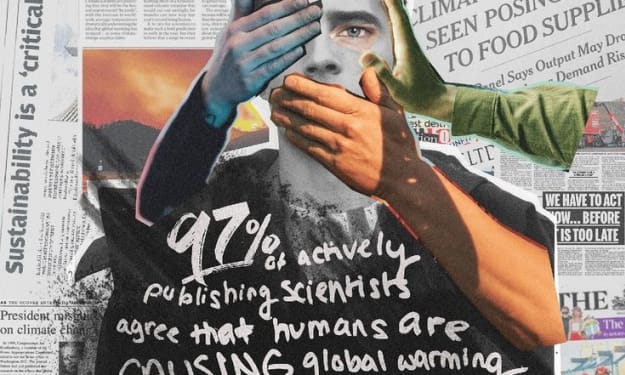
I had the privilege of participating in the Africa Climate Summit (ACS) 2023 held in Nairobi, Kenya, and it proved to be an incredibly inspiring event. This summit served as a remarkable platform for governments, leaders, businesses, practitioners, youth, and children hailing from various corners of Africa to converge and engage in discussions about, and commitment to, climate action.
By Chela Kikwai3 years ago in Earth
Currents of Change: Definitive Study Confirms Gulf Stream Weakening. Content Warning.
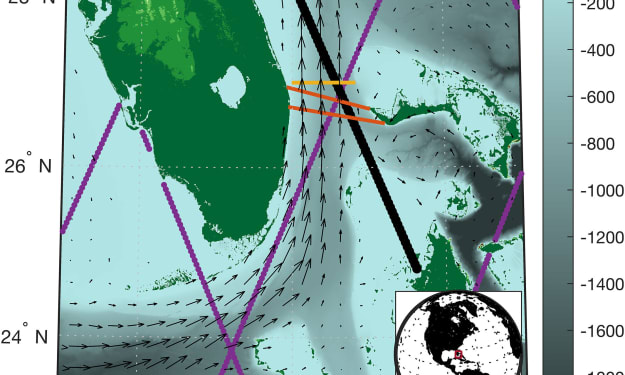
The Earth's climate is a complex and interconnected system, and one of its vital components is the Gulf Stream—a powerful ocean current that plays a crucial role in regulating the planet's climate. Recent scientific research has provided definitive evidence that the Gulf Stream is weakening, raising concerns about the potential consequences for our environment and weather patterns.
By Stephen Keith B. Labto3 years ago in Earth
"Rising Voices: Stories from a Changing Planet"
In the land where the ice kissed the sky and the stars danced on frozen waters, there lived a young Inuit girl named Alyana. Her village, nestled on the icy shores of the Arctic Ocean, had thrived for generations, but now it faced a dire threat – the changing climate.
By Abeeha Malik3 years ago in Earth
The documentary Elizabeth Bathory: The Blood Countess Part 3.
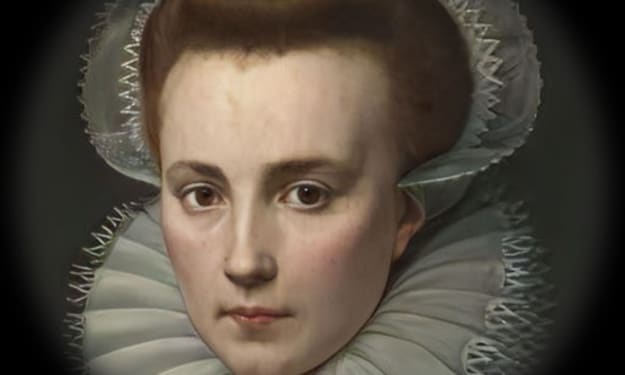
The **Habsburgs**, one of Europe’s most powerful dynasties, ruled parts of **Hungary** for an extended period and eventually took control of the entire country, maintaining authority until **1918**. Despite the turbulent political environment, the region of **Transylvania**, where much of the **Báthory family’s** influence was concentrated, prospered under a stable governance structure. The Báthory family played a significant role in Transylvania's development, and their wealth and political standing contributed to the region’s relative stability. One of the critical reasons for the prosperity of **Transylvania** during this period was the presence of a **constitution** that safeguarded the authority of the **Transylvanian princes**. These princes were regarded as representatives of the three "historic nations" of the region: the **Hungarians**, the **Saxons**, and the **Szeklers**, an ethnic group with a strong presence in Transylvania. This framework ensured that local governance maintained a degree of autonomy and independence from external pressures, particularly from the **Habsburgs** and the **Ottoman Turks**. Despite being caught between the **Catholic Habsburgs** to the west and the **Muslim Ottoman Turks** to the east, **Transylvania** managed to avoid the severe religious conflicts that were rampant throughout much of Europe during the period. One of the factors contributing to this peaceful coexistence was the region’s **princes**, who often encouraged religious tolerance. While the **Habsburgs** were staunchly Catholic and the **Ottomans** adhered to Islam, the rulers of Transylvania fostered a spirit of tolerance among their diverse population. This allowed various religious groups to coexist, though it should be noted that not everyone benefited equally from these policies. For example, **Catholics**, **Lutherans**, and **Calvinists** were granted religious freedom under the **Edict of Torda** in **1568**, which was a groundbreaking moment in Christian Europe. The edict marked the first formal guarantee of religious freedom in the region, offering protection for different Christian denominations and allowing them to worship freely without fear of persecution. However, the **Romanian** or **Vlach** people, who followed the **Greek Orthodox** faith, were not included in this edict, highlighting the limits of religious tolerance at the time. Transylvania's unique political and religious conditions allowed it to avoid much of the religious strife that plagued the rest of Europe during the Reformation and the **Thirty Years’ War**. The **Báthory family**, particularly **Stephen Báthory**, was instrumental in ensuring the region's growth and stability. **Stephen Báthory**, Elizabeth’s uncle, initially reigned as a **Voivode** (prince) before becoming the **Prince of Transylvania** in **1576**. Under his leadership, the **Principality of Transylvania** became a semi-independent state, balancing its allegiance between the **Ottoman Empire** to the east and the **Habsburgs** to the west. Though **Stephen Báthory** himself was a devout **Roman Catholic**, his rule was marked by efforts to manage the complex religious landscape of Transylvania. His tolerance toward various Protestant denominations, such as **Lutheranism** and **Calvinism**, was crucial in maintaining peace and stability within his domain. The **Edict of Torda** was a direct result of his policies, which aimed at reducing religious tensions and promoting unity among the different factions within the region. In **1571**, **Stephen Báthory** also established the **Royal House of Báthory**, which further solidified the family’s political and economic power in the region. Although his reign began under **Ottoman** influence, it later transitioned to **Habsburg** administration, making Transylvania a semi-independent principality with shifting allegiances. This transition was part of the broader struggle for control in **Central Europe**, where power was constantly contested between the Ottoman Empire and the Habsburgs. Under **Báthory’s** leadership, **Transylvania** saw significant growth in terms of both its economy and political structure. The region's semi-autonomous status allowed it to thrive while navigating the complex and often dangerous geopolitics of the time. It became a haven for a diverse range of religious and ethnic groups, with the nobility and many of its princes playing an essential role in maintaining this peace. However, not all were in agreement with these policies, and the influence of the **Habsburgs** and the growing **Ottoman** threat continued to loom over the region throughout the 16th and 17th centuries. One of the significant factors that ensured **Transylvania's** relative success in this period was the region’s ability to adapt to the changing power dynamics between the Catholic and Protestant powers in Europe. While much of the continent was embroiled in religious wars, Transylvania managed to maintain a fragile balance. The region’s **princes**, including **Stephen Báthory**, continued to navigate this delicate balance by encouraging tolerance and embracing a policy of religious pluralism that allowed different sects to coexist, at least for a time. However, the tensions between the **Habsburgs**, **Ottomans**, and local factions in **Transylvania** were not entirely resolvable. The eventual absorption of **Transylvania** into the **Habsburg Empire** after **Elizabeth Bathory’s** death marked the end of the principality’s semi-independence. The complex and often shifting alliances between the Ottomans and Habsburgs eventually left the region under Habsburg control, and the Báthory family's influence waned. In conclusion, the **Báthory family**, especially under **Stephen Báthory**, played a crucial role in shaping the history of **Transylvania** during the 16th century. Despite the challenges of religious conflict, Ottoman incursions, and Habsburg ambitions, Transylvania managed to prosper under a system that valued religious tolerance and political autonomy. While the region's independence eventually succumbed to external pressures, the legacy of the **Báthory family’s** rule continues to be an important chapter in the history of **Central Europe**.
By Nora Ariana3 years ago in Earth
The documentary Elizabeth Bathory: The Blood Countess Part 2.
The **Voivode of Transylvania**, **Andrew Bonaventura Bathory**, was the highest-ranking authority in the region and also held the title of **Hungary's Chief Justice**. His prominence in both local and regional matters placed him among the most powerful figures of the time. Adding to the significance of the Bathory family, **Stephen Báthory**, a maternal uncle of **Elizabeth Bathory**, wed the Queen of Poland and later became **King Stefan Batory** of Poland. In **1575**, he expanded his authority further by adding the title of **Grand Duke of Lithuania** to his impressive list of noble positions. He was also made **Prince of Transylvania** and became a prominent figure in the **Commonwealth of Poland and Lithuania**. His marriage and subsequent rise in status reflected the growing influence of the Bathory family in the politics of Central and Eastern Europe during this period. Throughout the time of **Elizabeth Bathory’s** life, many members of her extended family held the title **Prince of Transylvania**. This included two of her cousins, **Sigismund** and **Gabriel Bathory**, who carried on the legacy of their powerful ancestors after Elizabeth’s death. The **Báthory family** was not only influential politically but also incredibly wealthy. Their property spanned regions in what are now **Slovakia**, **Romania**, and the **Kingdom of Hungary**. This vast territory allowed the Báthory family to lend money to many powerful families, including the **Austrian Habsburgs**, further solidifying their prominence in European politics and finance. The Báthorys' strategic wealth and influence made them key players in the power dynamics of East-Central Europe during the 16th century. The **Austrian Habsburgs**, one of the most renowned royal families in medieval and early modern Europe, played a central role in the history of the time. The Habsburg dynasty lasted for an impressive **636 years**, from **1282 to 1918**, and was one of the most influential families in Europe. They controlled large territories across **East-Central Europe**, with their capital in **Vienna**, Austria. From **1583 to 1611**, during the time of Elizabeth Bathory, the Habsburgs temporarily moved their seat to **Prague**, reflecting the shifting political and military concerns of the time. The **Habsburg family** produced monarchs in various European countries, including **Spain**, **Portugal**, **Bohemia**, and **Galicia-Lodomeria**, as well as in colonies around the world. The dynasty expanded through a combination of military conquest and strategic marriages. Later in history, the Habsburgs also controlled regions in **Italy** and the **Low Countries** and even produced a **Mexican emperor** in the 19th century. The family’s political maneuvering, particularly through marriage alliances, enabled them to cement their dominance. However, by the **mid-16th century**, the Habsburg dynasty had split into two branches: the **Spanish** and the **Austrian** branches, following the abdication of **Charles V**. This division marked a pivotal moment in European history and was accompanied by complex political shifts that would shape Europe’s future. One of the key strategies of the Habsburgs was their use of **interfaith marriage**, which helped to retain diplomatic ties between the family branches. While this was a practical approach to maintaining power, it had a long-term consequence: the family’s gene pool became increasingly limited, leading to genetic impairments such as the famous **Habsburg jaw**, a physical anomaly that became emblematic of the family’s decline. By the time **Elizabeth I** was queen of England in the late **1500s**, the Habsburgs had reached the zenith of their power. From **1438 to 1806**, they held the title of **Holy Roman Emperor**, a position that was theoretically chosen by the **prince-electors** but was often dominated by the Habsburgs due to their vast landholdings within the Holy Roman Empire. The Habsburgs ruled over a sprawling empire that included modern-day **Germany**, **Austria**, **Czechia**, **Switzerland**, parts of **Eastern France**, **Slovenia**, and the **Low Countries**, as well as **northern Italy** and parts of **western Poland**. The Holy Roman Empire, which sought to position itself as the heir of **Imperial Rome’s** tradition, aggressively enforced the **Roman Catholic faith** across its territories. During this period, Protestantism began to take hold in the Empire, especially after **Martin Luther** posted his **95 Theses** in **Wittenberg** in **1517**, challenging the Catholic Church’s practices and sparking the **Protestant Reformation**. During the **Middle Ages**, a nation like **Hungary**, located in **East-Central Europe**, faced constant challenges due to its proximity to powerful neighbors. The **Austrian Habsburgs** to the west and the **Ottoman Turks** to the east created a volatile environment for Hungary’s political and social structures. The **Ottoman Empire** presented a constant military threat, as it sought to expand its territory into Europe. The geopolitical landscape in Hungary during Elizabeth Bathory’s lifetime was shaped by these external pressures. The ongoing conflict with the **Ottoman Turks** and the influence of the Habsburgs had significant personal and political repercussions for Elizabeth and her family. Despite her family’s vast wealth and power, these larger geopolitical dynamics were beyond their control, influencing their fate and contributing to the complex web of intrigue that surrounded **Elizabeth Bathory's** infamous legacy. **King Matthias Corvinus of Hungary**, a notable **Renaissance monarch**, ruled Hungary from **1490** until his death. After his passing, Hungary fell into political decline, setting the stage for the tumultuous events that would unfold in the coming decades. The capture of **Constantinople** by the **Ottoman Turks** in **1453** marked the fall of the **Byzantine Empire**, further destabilizing the region and setting the stage for the era in which Elizabeth Bathory would live.
By Nora Ariana3 years ago in Earth
Making Sense of Reality: How Our Brain Constructs Our Perception
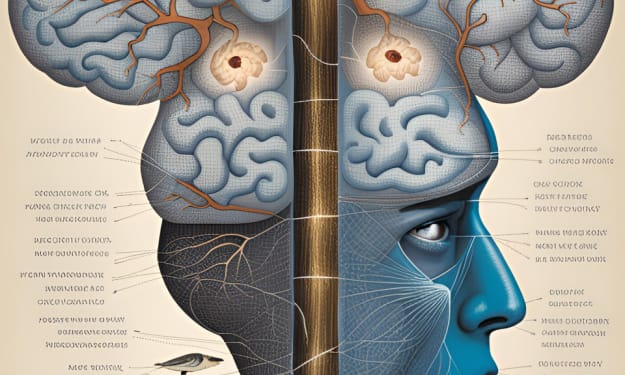
Introduction In the realm of philosophy, one question has persisted through the ages: Do our experiences align with objective reality, or are we merely interpreting a subjective version of the world around us? This philosophical conundrum has been a topic of heated debate, but the answer is far from straightforward. The truth lies in the complex relationship between our sensory experiences and the intricate signals processed by our brains.
By Gufran Kandemir3 years ago in Earth
Ten historical monsters you probably didn't know existed Part 2.
**The Shadows of Infamy: History’s Most Disturbing Criminal Minds** Leopold II of Belgium is a figure whose name will forever be associated with the exploitation and atrocities committed in Africa. As the ruler of the Congo Free State, he faced international condemnation for his policies that led to forced labor, mutilation, and countless deaths. However, Belgium, as a small European nation, largely escaped blame, allowing Leopold to shoulder the burden of criticism alone. His narrative defense, steeped in claims of bringing "civilization" to Africa, could not mask the horrors inflicted under his reign. Turning to another dark chapter of history, we find Leonardo Cianciulli, an infamous 20th-century Italian serial killer. Known by the nickname “Soap-Maker of Correggio,” Leonardo’s outward appearance belied her deeply disturbed mind. Beneath the façade of a kind, neighborhood woman who valued cleanliness was a person driven by an obsession with the occult and an unrelenting desire to protect her family. Convinced that human sacrifices were the only way to safeguard her loved ones, Leonardo lured unsuspecting women into her home, drugged them, and used an axe to kill them. What followed was even more grotesque: she dismembered their bodies and turned parts into soap and tea cakes. This macabre practice earned her a sinister reputation that shocked Italy when her crimes were finally uncovered. Fortunately, she was brought to justice, but not before her actions scarred a nation. Another name etched in the annals of infamy is Carl Panzram, a man whose life was marked by violence and depravity. Born in 1891, Panzram’s troubled childhood set the stage for his descent into criminality. Over the years, he committed numerous murders, arson, sexual assaults, and burglaries. Panzram’s true nature came to light only after his imprisonment. Even then, he showed no remorse and made no effort to disguise his crimes or reform himself. Instead, he confessed to 21 murders and over a thousand acts of sexual violence. His brutal honesty shocked authorities, and he was ultimately hanged in 1930. Panzram remains a chilling example of a man completely consumed by violence. In the 19th and early 20th centuries, Belle Gunness terrorized Laporte, Indiana, with her cunning and cruelty. Known as a black widow, Gunness lured wealthy bachelors to her farm, where they would mysteriously vanish. She would kill her victims, dispose of their remains, and profit from their wealth. Rumors about Gunness and her farm swirled for years, but it wasn’t until her property was engulfed in flames that the horrifying truth was revealed. In the charred ruins of her home, authorities found the remains of several unidentified individuals, cementing Gunness as a notorious murderer. Her story highlights the capacity for violence and deceit, regardless of gender. During World War II, humanity witnessed some of its darkest moments, with figures like Oscar Dirlewanger epitomizing the depths of evil. As the leader of the SS Dirlewanger Brigade, Dirlewanger committed some of the most heinous atrocities of the war. Known for his sadistic cruelty, he oversaw operations marked by massacres, rape, and the torture of civilians. While Dirlewanger may not have been as infamous as Adolf Hitler or Heinrich Himmler, his actions left a lasting scar on the annals of history. The stories of these individuals serve as stark reminders of the capacity for human cruelty. From Leopold’s exploitation in Africa to Leonardo’s occult-driven murders, Panzram’s violent rampage, Gunness’s black widow schemes, and Dirlewanger’s wartime atrocities, each case reflects a unique but chilling manifestation of evil. These figures not only left a trail of destruction in their wake but also challenged society's ability to comprehend and confront such darkness.
By Nora Ariana3 years ago in Earth
Threading On Thin Ice
In a world not far away, there is a place called Evergreen Valley. It's an idyllic corner of Earth, a picturesque kingdom where lush forests meet crystal-clear lakes and dancing meadows with dazzling wildflowers. Children ran freely in the fields, laughter echoed in the air. But behind this peaceful exterior lies a growing threat: climate change.
By yusuf zakariya3 years ago in Earth
Extreme Weather Event. Content Warning.
In the heart of a quaint coastal town named Havenbrook, nestled between the rolling hills and the azure sea, life had always been peaceful. Families thrived, fishermen cast their nets, and children played on golden beaches. It was a place untouched by the relentless march of time, where the seasons whispered secrets to the trees and the waves sang lullabies to the shore.
By Sunny Douglas3 years ago in Earth
A Ray of Hope
. in a quiet coastal town named Havenwood, nestled between lush forests and the serene azure of the ocean, lived a young woman named Eliza. Eliza had grown up in this idyllic town, surrounded by the beauty of nature. But as the years passed, she watched in despair as the world around her began to change.It all started with the erratic weather patterns. Summers grew hotter, and winters brought more unpredictable storms. The once-plentiful fishing waters became unpredictable, and the lush forests she loved to explore as a child began to wither. Eliza couldn't ignore the signs; climate change was real, and it was happening right before her eyes.
By Sunny Douglas3 years ago in Earth
The creation of Adam
God created Adam from the earth He took different parts of the earth, including white rocks, black rocks, brown soil, red soil, and yellow sand. He molded these materials into clay and added water to it until it turned dark and black. Then, he fashioned the clay into the form of a human being.
By knowledge And Fun3 years ago in Earth