Humanity
30+ Fantastic 'What If' Scenarios You Never Thought About
30+ Fabulous 'Consider the possibility that' Situations You Won't ever ponder In the domain of creative mind, 'consider the possibility that' situations fuel imagination, interest, and examination. They permit us to investigate elective real factors and contemplate the potential outcomes of various results. Here, we dive into more than 30 interesting 'imagine a scenario in which' situations that stretch the limits of our ordinary reasoning.
By robail shahzadi2 years ago in Earth
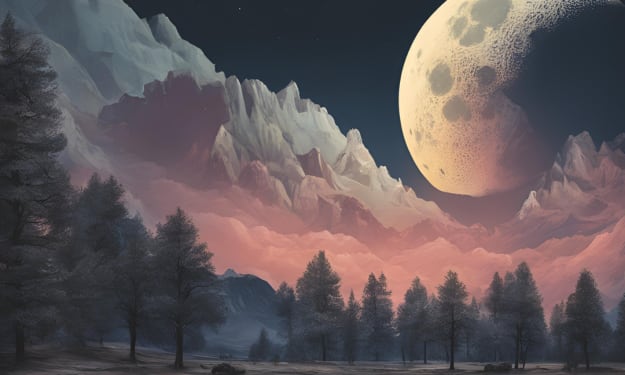
The Moon becomes a mine of gold... and other metals. AI-Generated.
Space exploration has long focused on reaching very distant destinations, but now there is a race to exploit new frontiers with the extraction of their minerals. Neil Armstrong's first walk on the Moon in 1969 was part of a strategy to beat the Soviets in the space race, a victory of imagination and innovation, not an attempt to mine precious metals. No one knew if there was water in that dusty celestial body. What a difference a generation makes... Mysterious and beautiful, the Moon has been a source of admiration and inspiration for humanity for millennia. It is now the center of a space race to extract minerals to power our future: smartphones, solar panels and possibly even a colony of earthlings. "We know there is water on the Moon, which changes the game for the Solar System. Water is rocket fuel. It is also fuel for life and agriculture. So exploring the Moon commercially is a first step to making it part of what that humanity sees as our world," says Bob Richards, CEO of Moon Express, one of 25 companies bidding to win the $30 million Google Lunar X prize. The Californian company is among the top three in the race. The others are Astrobiotic, from Pittsburgh, and Moon Team, from Barcelona. Google's first prize, of US$20 million, will be awarded to the first private company to put a robot on the Moon, successfully explore the surface by moving at least 500 meters and send high-definition video to Earth. The second prize, of US$5 million, goes to the second company to complete the same mission, with additional prizes for teams that travel more than 5 kilometers or find water. The deadline is 2015. But $30 million is a relatively small amount to fund a lunar mission. The competing companies have business models far beyond the Google prize, with the real prize being the potential treasure trove of valuable minerals. Does the Moon have an owner? "The most important thing about the Moon is probably what we haven't even discovered," Richards says. "But what we know is that there could be more platinum group metals on the surface of the Moon than in all the reserves on Earth." But can anyone own the Moon, and what happens if multiple companies and countries manage to get there? Under the 1967 outer space treaty, no nation can own the Moon, and most people believe that extends to individuals and companies. But would-be lunar miners may have something like property rights. And there is an advantage in arriving first and claiming rights. "The treaty does not allow appropriation, but open access exploitation is encouraged," notes space lawyer James Dunstan. "You can't own it, although you can use it, but how do we strike a balance?" China has plans to send a probe to the moon this year and astronauts in 2020. Because China's lunar plans are more ambitious than most, some fear it could gain too much control. Dunstan does not believe that China will flout international law to dominate space. "Trade sanctions would be very harsh if a country or corporation appropriated other people's assets." If Moon Express and others get it right, it is conceivable that in the future the lunar surface will host a colony of mining robots and astronauts who would use it as a base for further exploration of the solar system. Richards believes humans will discover ways to live permanently on the Moon. "We are becoming a multi-world species. The first traces of human beings on Mars will arrive in our era, in the next 10 to 20 years," he adds. "People will be transformed. They will merge with their technologies. And what we call human will be redefined as we seek to reprogram our bodies to live longer and find machines capable of working symbiotically with us to cure diseases." "So what we consider human today will continue to evolve." A space without pollution Moon Express, whose offices are at NASA's Ames Research Center, is financed by businessman Naveen Jain. Jain says the location is key, because it is in Silicon Valley, which he believes will become home to space pioneers. "We are those crazy people who think that every idea is crazy, until we make it concrete and then people say 'of course,'" he points out. So, if we will one day live on the Moon, shouldn't we be worried about contaminating it? Won't robot armies ruin our real estate future? Margarita Marinova, a planetary scientist at NASA, believes that we will not make the same mistakes in space as we did on Earth and that man cannot afford to explore space without taking advantage of local resources to survive. "For me it's hard, because I see these planets as beautiful and pristine as the Earth is no longer, so the idea of mining is a little difficult," she admits. The Moon's potential resources are vast. M. Darby Dyar, a professor of astronomy at Mount Holyoke College, Massachusetts, says ice reserves in the Moon's polar regions probably come from comets that collided with the Moon in the last 4 billion years, and that future miners Lunars could strike it rich with precious metals in ancient lunar rocks. But even if no company meets the 2015 deadline to win the Google award, Dyar says it has already borne fruit. "I lived through the excitement of the Apollo era, my father helped design thrusters on the lunar landing modules, and those remembered feelings of patriotism and wonder about the universe led me to lunar science in the first place." "When I give a girl a meteorite and tell her it's 4 billion years old, her entire frame of reference changes, and that's what science should do. Not everyone wants to be a scientist, but everyone is excited about learning to respect and understand their progress. "Competitions like this bring science to the public's eyes. Where better than on the Moon, which seems to be so close to us?"
By Isabela Stender 2 years ago in Earth
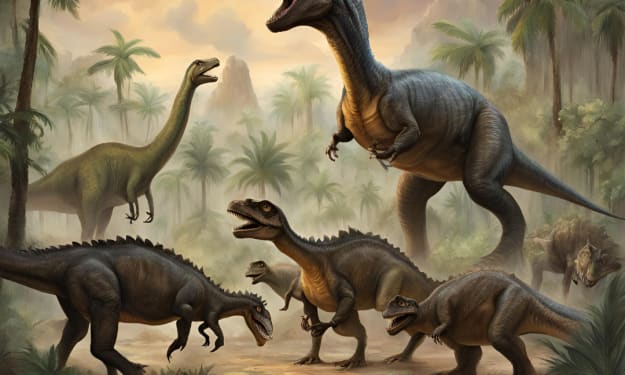
What is the origin of oil (and no, it does not come from dinosaurs) . AI-Generated.
Known as “black gold”, it is a mixture of hydrocarbons, compounds that contain in their molecular structure mainly carbon and hydrogen. It is a motor of today’s society, a motive for wars, and one of the main drivers of climate change.Every day more than 80 million barrels of oil are produced in the world, whose name comes from the Latin and means “stone oil”. This viscous liquid known as “black gold” is a mixture of hydrocarbons, compounds that contain in their molecular structure mainly carbon and hydrogen. Oil is the product of a process of processing over millions of years. But where does it come from?Most scientists are in favour of a theory and assure that the origin of oil “is well understood”. But that didn't stop some false beliefs from circulating... The myth of dinosaurs It is estimated that about 70% of the current crude deposits were formed in the Mesozoic or Mezozoic Era, which extended between 252 and 66 million years ago. The Mesozoic, which is divided into the Triasic, Jurassic and Cretaceous periods, is also known as the reptile era and in it dinosaurs had their apogee. This could explain why misinformation has circulated. “For some strange reason, the idea that oil comes from dinosaurs has remained in many people. But oil comes from trillions of tiny algae and plankton,” said Reider Müller, a geology professor at the University of Oslo. No one knows for sure how this myth was born, but it also circulated in Latin America.BBC Mundo asked two Mexican experts if they were aware of that belief. “Yes, it’s a misconception, but very common,” said Darío Solano and Iza Canales, professors at the Faculty of Engineering at the National Autonomous University of Mexico, UNAM, in the Division of Earth Sciences. “At least within our community, we can identify that many of the rocks that generate hydrocarbons are found in layers of the Jurassic, which is a geological time period that is usually associated with dinosaurs, and that is the relationship that has helped reinforce the idea that this is their origin,” Solano explained. “It is important that these myths are dismissed, firstly to help society as a whole eliminate ignorance of a substance of common and widespread use, in short, only by general culture. Secondly, by advancing in understanding the origin of this resource, it will be possible to advance in the development of new technologies or uses,” added Canales. How oil is formed The protagonists in the history of the origin of oil are not the big reptiles but tiny beings.The most accepted theory about the origin of oil is the organic term, according to which the resource originated from the decomposition of the remains of animals and microscopic algae accumulated on the bottom of seas and lagoons. This theory indicates that fine sediments and organic residue, mainly terrestrial or marine vegetables, are deposited in a basin. After certain processes the kerogen is formed, which is a mixture of these organic materials, and after a long time the pressure and temperature are increased, eventually forming hydrocarbon chains, the scientists of UNAM explained. The accumulation of other geological layers on the deposits of organic matter generates pressure and temperature conditions that facilitate the action of anaerobic bacteria to slowly transform organic material into hydrocarbons with small amounts of other elements. “In a simplified way, we can think of cooking our mixture of materials in an express pot (i.e. with certain pressure and temperature conditions) for a long time, until the original material is broken down into carbon and hydrogen chains. Something similar is happening in the basement. Then the material needs to migrate from the rocks where it was cooked to the rock that will store it,” explained Mexican experts.This theory is one of the most accepted, since all the oil deposits are found in sedimentary land and, in addition, there have been found fossil remains of animals and plants. Where does the energy in oil come from Oil can also come from the processing of organic material from ancient forests. Within organic theory it is understood that any type of organic material can be present. In fact, the kind of hydrocarbon that is obtained from kerogens rich in terrestrial plant matter is associated with gas deposits, Mexican scientists added. And here's another myth to clarify. Is the energy in oil the solar energy captured in photosynthesis by the phytoplankton (plant organisms) and transferred to the zooplancton (animal organisms)? “No, this is a misconception,” said Canales, adding: “The energy we obtain today from oil is obtained by the oxidation (combustion) of hydrogen and carbon (hydrocarbons) chains.” “It’s true that energy and matter are interchangeable, but to say so sounds like phytoplankton and zooplancton are solar batteries. It can rather be thought of as an analogue to how humans can eat many things and the body transforms food by breaking it down in our digestive system through another process of oxidation (digestion) and our body takes advantage of those simpler components at the cellular level,” Solano added. IMAGES Alternative theories Some scientists held in the past that oil has an inorganic origin and is formed in the depths of the Earth without the need for remains of living organisms. Several of these theories were proposed as early as the 19th century, for example by Dmitry Mendeleev, the Russian chemist who published the first periodic table of elements. Inorganic theories argue that inside the Earth's mantle, coal may exist as hydrocarbon molecules, mainly methane, and a large amount of hydro-carbons found in oil may be generated by processes that do not regulate organic fossils. Inorganic theories argue that inside the Earth's mantle, coal may exist as hydrocarbon molecules, mainly methane, and a large amount of hydro-carbons found in oil may be generated by processes that do not regulate organic fossils. The Asteroid That Ended the Dinosaurs Also Generated a Monstrous Earthquake These hydrocarbons can migrate out of the mantle to the terrestrial crust to escape to the surface or remain in waterproof layers, forming oil deposits. One version of these theories is that of the Austrian astrophysicist Thomas Gold (1920-2004), who was a professor of astronomy at Cornell University. Gold published a study in 1992 in PNAS, the journal of the American Academy of Sciences, which he later expanded into a book with the same title, Deep Hot Biosphere. For him, hydrocarbons on Earth are not the by-product of biological waste (“fossil fuels”), but were a common constituent of the materials from which the Earth was formed about 4.5 billion years ago. Gold acknowledged that the same hypothesis had already been supported in the 1950s by Soviet scientists. The theory of the inorganic origin of oil is not accepted by most scientists “We dare to speak on behalf of our fellow academics and scientists to say that the theories of inorganic origin have not been successfully tested and that in this way it has not been possible to generate hydrocarbon in a laboratory,” said UNAM experts. One last doubt? Given that the organic theory of the origin of oil is the most accepted, some readers might ask themselves this question. If dinosaurs lived at the same time as the formation of oil in the Mesozoic, it could have happened that their remains, organic matter of some dinosaur, fell to the bottom of the sea or lagoons and underwent a process of compression and transformation turning into oil.“In fact, we could say that any organic matter could be present in oil generation,” said UNAM experts. “ it is important to mention that oil generation is a very delicate process, and it requires very large volumes of matter, which were possible to reach only by the large volume of plankton in the sea, so volumes from other sources are not so significant,” they concluded.
By Isabela Stender 2 years ago in Earth
The last tree
The village of Verde lay nestled in a valley that once boasted lush forests and flowing rivers. But those days were long gone. Deforestation and climate change had turned the land into a dry, barren place, with only one tree remaining—a towering oak that stood as a lone sentinel against the relentless march of time and environmental decay. Twelve-year-old asha had grown up hearing stories from her grandmother about the forest that used to thrive around Verde. The oak tree, known as the Guardian, was the last of its kind, a relic from a bygone era when nature and humanity coexisted in harmony. Every day after school, Asha would visit the Guardian. She felt a deep connection to the tree, often sitting beneath its sprawling branches to read or simply to think. It was her sanctuary, a place where she could escape the harsh reality of a world plagued by environmental degradation. One particularly dry summer, Asha noticed the Guardian's leaves were turning yellow and brittle. Panic gripped her heart. She rushed home to her grandmother, the village's unofficial historian and storyteller. "Grandma, the Guardian is dying," Asha said, her voice trembling. Her grandmother's face grew somber. She had feared this day would come. "The land is thirsty, child. The climate is changing, and the rains are not coming as they used to. The Guardian is struggling to survive." Asha refused to accept this fate. "There must be something we can do," she insisted. Her grandmother thought for a moment, then nodded. "There might be a way. The tree needs water, and not just any water, but the purest we can find. We must create a system to bring water from the distant mountains where streams still flow." Asha's eyes sparkled with determination. "I'll do it, Grandma. I'll save the Guardian." With the help of her grandmother and some villagers who still remembered the old ways, Asha began constructing a simple irrigation system. They used bamboo and clay pipes to channel water from the mountains to the village. It was hard work, and the scorching sun made the task even more challenging, but Asha's determination never wavered. The village was initially skeptical. "It's just a tree," some said. "What difference can one tree make?" But as they saw Asha's unwavering dedication, more villagers joined the effort, bringing their skills and labor to the project. Finally, after weeks of relentless work, the system was complete. Water trickled down from the mountains, flowing through the pipes and into a makeshift reservoir near the Guardian. Asha carefully watered the tree, her heart filled with hope. The change was not immediate, but slowly, the Guardian began to show signs of recovery. New leaves sprouted, green and vibrant. The tree seemed to stand taller, its branches spreading wide as if embracing the sky. The villagers, inspired by the tree's resilience and Asha's determination, started planting new trees around the Guardian, using the irrigation system to nurture them. As the years passed, the once-barren valley began to transform. New trees took root and flourished, and the air grew cooler and cleaner. Wildlife returned, drawn by the renewed habitat. The Guardian stood at the center of it all, a symbol of hope and a testament to what could be achieved through collective effort and a deep respect for nature. Asha, now a young woman, often sat beneath the Guardian with her own children, telling them the story of how the last tree had almost died and how the village had saved it. The tree had given them more than just shade and fruit; it had given them a reason to believe in the future. In the end, the Guardian was not just the last tree—it was the first of many in a reborn forest, a living reminder of the power of hope, community, and the enduring bond between humanity and the environment.ha
By Anthony mutafela 2 years ago in Earth
10 interesting facts about planet Earth that you may not have known . AI-Generated.
Millions of people around the world celebrate International Earth Day today, with which the United Nations wants to raise awareness about the importance of preserving our planet's natural resources and facing the challenges of climate change. The date chosen by the UN to honor the Earth recalls the events of April 22, 1970, when 20 million people took to the streets of major cities in the United States to protest the damage that human activities were causing to the Earth. environment. On the occasion of Earth Day, BBC Mundo reviews some fascinating facts about the planet we call our home. 1- The Earth is not a perfect sphere Our planet is usually represented as a perfect sphere, but that is not its precise shape. The Earth is flattened at the poles, so its shape is more like an ellipse than a circle. As happens on other planets, the effect of gravitation and centrifugal force produced by rotation on its axis generates polar flattening and equatorial widening. Thus, the diameter of the Earth at the equator is about 43 kilometers greater than the diameter from one pole to the other. 2- Water covers more than 70% of the Earth On Earth, water is found in solid, liquid and gaseous states. Furthermore, it covers three-quarters of the earth's surface in the form of swamps, lakes, rivers, seas and oceans. The latter contain around 97% of all the water on the planet. 3- The border between Earth and space is 100 kilometers high It is considered that the border between the atmosphere and space is called the Kármán Line, which is 100 km high. 75% of the atmospheric mass is found in the first 11 km of altitude from the sea surface. 4- The Earth is an iron planet Earth is the densest and fifth largest planet in the Solar System. The most present chemical elements are iron (around 32%), oxygen (around 30%), silicon (around 15%). Scientists believe that the Earth's core is composed primarily of iron (about 88%). 5- Earth is the only known planet with life The Earth is the only astronomical body in which we have been able to confirm that there is life. There are currently around 1.2 million cataloged species of animals, although scientists believe that is only a small percentage of the total. The Earth formed approximately 4.5 billion years ago and life has been present on it for much of that period. The physical properties of the Earth, its geological history and its orbit have allowed life to exist for millions of years. 6- Gravity is not the same in all places on Earth Our planet is not really in the shape of a sphere, but rather a shape closer to an ellipse. Furthermore, the Earth's soil is irregular and the mass of our planet is not distributed perfectly homogeneously. This causes variations in the value of the gravitational field. Thus, for example, as we move from the equator towards the poles, the intensity of the gravitational field gradually increases, although the difference is imperceptible to humans. 7- The Earth is a planet of extremes Our planet is full of contrasts. The variety of its geographical areas and climates means that practically each region has its own particularities. There are several candidates to be considered the warmest places on Earth, but the place with the highest temperature ever recorded is in Death Valley in the United States, where on July 10, 1913 the thermometer rose to 56.7°C. At the other end is Antarctica. At the Vostok station on July 31, 1983, the measuring instruments reached −89.2 °C. 8- The largest living structure on Earth The Great Barrier Reef, located off the coast of Australia, is the largest single structure made up of living organisms on the planet, to the point that it is the only one that can be seen from space. It extends for more than 2,000 kilometers and is home to thousands of marine species. In 1981, it was declared a World Heritage Site by UNESCO. 9- Earth is the only planet in the solar system with active tectonic plates The movement of these plates causes the surface of our planet to be constantly changing, being responsible for the formation of mountains, seismicity and volcanism. The cycle of these plates also plays an essential role in regulating the Earth's temperature, contributing to the recycling of greenhouse gases such as carbon dioxide, through the permanent renewal of the ocean floor. 10- The Earth has a protective shield The Earth's magnetic field acts as a shield against the continuous bombardment of particles from the Sun. This field extends from the Earth's inner core to the boundary where it meets the solar wind. Among other things, the magnetic field also helps the orientation of some animals and ours, with the use of compasses.
By Isabela Stender 2 years ago in Earth
Disappearing Acts: Unraveling the Bermuda Triangle Mystery
The Bermuda Triangle, also known as the Devil's Triangle, has long been a subject of fascination and intrigue. This loosely defined region, located in the western part of the North Atlantic Ocean, is notorious for the unexplained disappearances of ships and aircraft. Over the years, the Bermuda Triangle has spawned numerous theories, ranging from the scientific to the supernatural. This article delves into the history, mysteries, and scientific explanations of the Bermuda Triangle, seeking to unravel the enigma that continues to captivate imaginations worldwide.
By Aravind 17072 years ago in Earth
Moment Davido broke into tears on his weeding day
On Tuesday, Lagos witnessed a spectacle of love and emotion as Afrobeats sensation David Adeleke, popularly known as Davido, tied the knot with his longtime partner, Chioma Rowland. The wedding, which took place at the prestigious Eko Hotel and Suites, was not just a union of two hearts but a grand event that drew the attention of dignitaries, celebrities, and fans alike.The moment that has since captured the hearts of many was when Davido, overwhelmed by the gravity and beauty of the moment, broke down in tears. This poignant scene, caught on video and widely circulated online, showed the ‘Assurance’ singer surrounded by his supportive groomsmen. As cheers erupted around him, the depth of Davido’s emotions was laid bare. His bride, Chioma, tenderly wiping away his tears, added to the touching display of their deep bond and affection.Davido’s wedding was a star-studded affair, reflecting the high regard and wide-reaching influence he holds. The guest list was a testament to his status, featuring an array of prominent figures from various sectors. His uncle, Ademola Adeleke, the Governor of Osun State, was present, underscoring the familial ties and support that have always been a part of Davido’s journey. Former President Olusegun Obasanjo, a significant figure in Nigeria’s history, also graced the event, highlighting the wedding’s importance on a national scale.From the political arena, former Akwa Ibom State Governor Udom Emmanuel was in attendance, alongside the revered Ooni of Ife, HRH Adeyeye Enitan Ogunwusi, who brought a touch of royal splendor to the ceremony. The presence of such notable individuals underscored the significance of this union not just as a personal milestone for Davido and Chioma but as a moment of cultural and social importance.The entertainment industry, of which Davido is a cornerstone, was well-represented by luminaries such as Patoranking, Obi Cubana, and Seyi Tinubu. Fellow musician B-Red, who is also Davido’s cousin, was there to celebrate the joyous occasion. Sports stars like Victor Osimhen, and popular personalities such as Craze Clown and Paul Okoye, added to the diverse mix of attendees, blending the worlds of music, business, sports, and comedy.Ebuka Obi-Uchendu, known for his charismatic presence and hosting prowess, helmed the event, ensuring that the celebrations were smooth and memorable. His role as the host added a layer of elegance and sophistication, aligning perfectly with the high-profile nature of the wedding.The emotional breakdown of Davido during the ceremony can be seen as a reflection of his journey – one marked by significant highs and lows. From losing his mother at a young age to facing public scrutiny and personal challenges, Davido’s path has not been without its trials. However, his ability to rise above these adversities and find profound happiness in his union with Chioma speaks volumes about his resilience and the strength of their relationship.Chioma Rowland, who has been a steadfast presence in Davido’s life, shares a story intertwined with his. Their relationship, often under the public eye, has withstood rumors and challenges, making their wedding day a celebration of true love and commitment. Her gesture of wiping Davido’s tears during the ceremony was more than just an act of comfort; it symbolized their mutual support and the deep emotional connection they share.The grandeur of the wedding, coupled with the heartfelt moments, created an unforgettable event that will be remembered by all who attended and those who witnessed it online. The venue, Eko Hotel and Suites, provided a perfect backdrop for such a significant event, combining luxury with an atmosphere of celebration and joy.As the newlyweds embark on this new chapter of their lives, their wedding day stands as a beacon of love, resilience, and the power of genuine connection. Davido’s tears, a moment of vulnerability and joy, captured the essence of their relationship and the collective happiness of their loved ones.In conclusion, Davido’s wedding was not just a union of two individuals but a significant cultural event that brought together people from various walks of life. The tears shed, the smiles exchanged, and the love celebrated created a tapestry of memories that will endure in the hearts of all who witnessed it. This moment, forever etched in the annals of Nigerian entertainment history, is a testament to the enduring power of love and the joy it brings. Tuesday, Lagos witnessed a spectacle of love and emotion as Afrobeats sensation David Adeleke, popularly known as Davido, tied the knot with his longtime partner, Chioma Rowland. The wedding, which took place at the prestigious Eko Hotel and Suites, was not just a union of two hearts but a grand event that drew the attention of dignitaries, celebrities, and fans alike.The moment that has since captured the hearts of many was when Davido, overwhelmed by the gravity and beauty of the moment, broke down in tears. This poignant scene, caught on video and widely circulated online, showed the ‘Assurance’ singer surrounded by his supportive groomsmen. As cheers erupted around him, the depth of Davido’s emotions was laid bare. His bride, Chioma, tenderly wiping away his tears, added to the touching display of their deep bond and affection.Davido’s wedding was a star-studded affair, reflecting the high regard and wide-reaching influence he holds. The guest list was a testament to his status, featuring an array of prominent figures from various sectors. His uncle, Ademola Adeleke, the Governor of Osun State, was present, underscoring the familial ties and support that have always been a part of Davido’s journey. Former President Olusegun Obasanjo, a significant figure in Nigeria’s history, also graced the event, highlighting the wedding’s importance on a national scale.From the political arena, former Akwa Ibom State Governor Udom Emmanuel was in attendance, alongside the revered Ooni of Ife, HRH Adeyeye Enitan Ogunwusi, who brought a touch of royal splendor to the ceremony. The presence of such notable individuals underscored the significance of this union not just as a personal milestone for Davido and Chioma but as a moment of cultural and social importance.The entertainment industry, of which Davido is a cornerstone, was well-represented by luminaries such as Patoranking, Obi Cubana, and Seyi Tinubu. Fellow musician B-Red, who is also Davido’s cousin, was there to celebrate the joyous occasion. Sports stars like Victor Osimhen, and popular personalities such as Craze Clown and Paul Okoye, added to the diverse mix of attendees, blending the worlds of music, business, sports, and comedy.Ebuka Obi-Uchendu, known for his charismatic presence and hosting prowess, helmed the event, ensuring that the celebrations were smooth and memorable. His role as the host added a layer of elegance and sophistication, aligning perfectly with the high-profile nature of the wedding.The emotional breakdown of Davido during the ceremony can be seen as a reflection of his journey – one marked by significant highs and lows. From losing his mother at a young age to facing public scrutiny and personal challenges, Davido’s path has not been without its trials. However, his ability to rise above these adversities and find profound happiness in his union with Chioma speaks volumes about his resilience and the strength of their relationship.Chioma Rowland, who has been a steadfast presence in Davido’s life, shares a story intertwined with his. Their relationship, often under the public eye, has withstood rumors and challenges, making their wedding day a celebration of true love and commitment. Her gesture of wiping Davido’s tears during the ceremony was more than just an act of comfort; it symbolized their mutual support and the deep emotional connection they share.The grandeur of the wedding, coupled with the heartfelt moments, created an unforgettable event that will be remembered by all who attended and those who witnessed it online. The venue, Eko Hotel and Suites, provided a perfect backdrop for such a significant event, combining luxury with an atmosphere of celebration and joy.As the newlyweds embark on this new chapter of their lives, their wedding day stands as a beacon of love, resilience, and the power of genuine connection. Davido’s tears, a moment of vulnerability and joy, captured the essence of their relationship and the collective happiness of their loved ones.In conclusion, Davido’s wedding was not just a union of two individuals but a significant cultural event that brought together people from various walks of life. The tears shed, the smiles exchanged, and the love celebrated created a tapestry of memories that will endure in the hearts of all who witnessed it. This moment, forever etched in the annals of Nigerian entertainment history, is a testament to the enduring power of love and the joy it brings.
By Michael Donald 2 years ago in Earth
The Environmental and Ethical Impact of Vegan Food
Introduction Hey there! Have you ever thought about going vegan or just curious about what vegan foods are all about? Whether you're a seasoned vegan or just starting out, this guide will help you understand Vegan Food and how to buy them online, specifically focusing on Vezlay Foods, a fantastic option for all your vegan needs.
By Vezlay Foods2 years ago in Earth
Why Choosing Vegan Food is Beneficial for You and the Earth
Introduction In today's rapidly evolving world, making conscious choices about our diet has never been more important. The decision to adopt a vegan lifestyle is one that brings with it a multitude of benefits, both for our personal health and for the planet. By choosing Vegan Food, we are not only opting for a healthier lifestyle but also taking a significant step towards environmental sustainability. This article delves into the numerous advantages of veganism, highlighting why it is a beneficial choice for both individuals and the Earth.
By Vezlay Foods2 years ago in Earth